Thailand

Bali

Japan

India

Welcome to Bali!

INDONESIA IMIGRASI

NGURAH RAI, BALI

VISA CLASS:  Temporary Visitor   

DATE:___________________________


Permitted to Enter on the

Date Shown Above

MASUK


Back to Home

Balinese Religion and Spirituality

Balinese Traditional Gamelan Music

Balinese Drama and Dance

Glossary

Resources and References


Balinese Religion and Spirituality


It has been said that it is almost impossible to differentiate between Balinese culture and customs and the Hindu Dharma religion, which the majority of Balinese people practice.  The differences are almost imperceptible.  Can the same be said if you look at Canadian culture and religion?
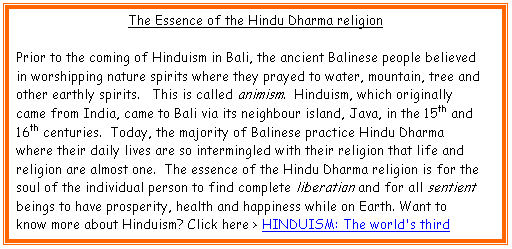
Text Box: The Essence of the Hindu Dharma religion

Prior to the coming of Hinduism in Bali, the ancient Balinese people believed in worshipping nature spirits where they prayed to water, mountain, tree and other earthly spirits.   This is called animism.  Hinduism, which originally came from India, came to Bali via its neighbour island, Java, in the 15th and 16th centuries.  Today, the majority of Balinese practice Hindu Dharma where their daily lives are so intermingled with their religion that life and religion are almost one.  The essence of the Hindu Dharma religion is for the soul of the individual person to find complete liberation and for all sentient beings to have prosperity, health and happiness while on Earth. Want to know more about Hinduism? Click here > HINDUISM: The world's third largest religion


Text Box: Ceremonies and customs

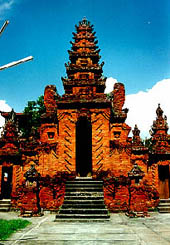
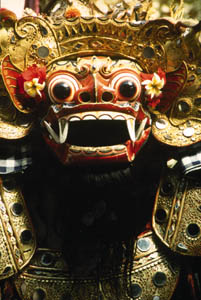
The Balinese practice many different kinds of religious ceremonies on a daily, weekly, monthly and annually basis.  When they celebrate a particular event is dependent upon the nature of that religious event and what time of year it is.  The most frequent is the Mesaiban.  This is where each family, every day, gives small offerings of food wrapped in banana leaves to the Gods and Goddesses and leaves them beside the small shrines which surround each families’ home.  This is for the protection of the family in everyday life.  The Hindu Dharma religion has many shrines, statues, temples, and masks; all objects, which act as bridges for the Balinese to communicate with God.  Click on the link below for more information about the different kinds of ceremonies and important Gods.
Golden Hands - Travel Guide to Balinese Ceremonies


Text Box: Temples and Devotional Activities

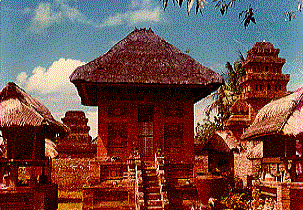
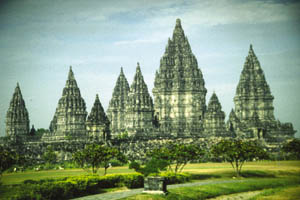
Bali has over 20,000 temples on this very small island!  At every corner, every home, every field, pond or lake, mountain, bridge, everywhere, one will see a shrine or temple.  Among the hundreds of different temples and smaller shrines dedicated to lesser Gods and Goddesses, there are typically three major temples in each village. The Pura Desa; the temple to worship Brahma (God as Creator), the Pura Puseh; the temple to worship Wisnu (God as Preserver) and the Pura Dalem; the temple to worship Siwa (God as Destroyer).  The Balinese perform rituals and offer gifts of food, money and other sundries during their devotional acts.  Often these rituals are social affairs where there is a mingling of dancing, drama, music, singing, offering of paintings, carvings and flowers and the burning of incense.  There is no separation between art and devotional worship; the two are inseparable.  Click on the link for Balinese Temples


Back to Top


Balinese Traditional Gamelan Music
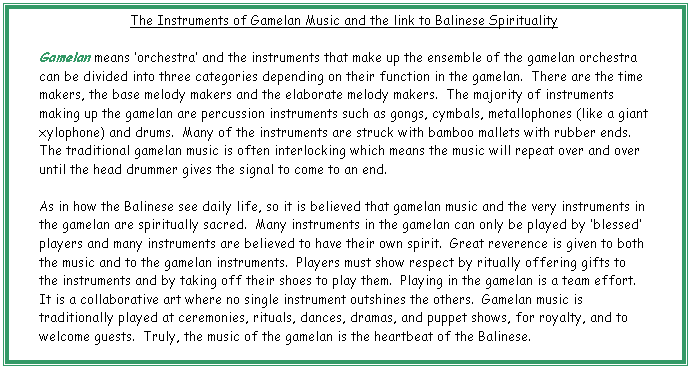


Text Box: The Instruments of Gamelan Music and the link to Balinese Spirituality

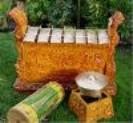
Gamelan means ‘orchestra’ and the instruments that make up the ensemble of the gamelan orchestra can be divided into three categories depending on their function in the gamelan.  There are the time makers, the base melody makers and the elaborate melody makers.  The majority of instruments making up the gamelan are percussion instruments such as gongs, cymbals, metallophones (like a giant xylophone) and drums.  Many of the instruments are struck with bamboo mallets with rubber ends.  The traditional gamelan music is often interlocking which means the music will repeat over and over until the head drummer gives the signal to come to an end.

As in how the Balinese see daily life, so it is believed that gamelan music and the very instruments in the gamelan are spiritually sacred.  Many instruments in the gamelan can only be played by ‘blessed’ players and many instruments are believed to have their own spirit.  Great reverence is given to both the music and to the gamelan instruments.  Players must show respect by ritually offering gifts to the instruments and by taking off their shoes to play them.  Playing in the gamelan is a team effort.  It is a collaborative art where no single instrument outshines the others.  Gamelan music is traditionally played at ceremonies, rituals, dances, dramas, and puppet shows, for royalty, and to welcome guests.  Truly, the music of the gamelan is the heartbeat of the Balinese.


Text Box: Music, Drama and Dance

Drama and dance are inseparable in Balinese art.  When a specific style of drama/dance is being preformed the music that accompanies the performance is often only played for that drama/dance.  It is so specific that often only a key instrument or instruments are used for that particular drama/dance.  As in the Legong dance, a bronze instrument called the Pelegongan, is used specifically for this dance.

Text Box: Want to have a listen to interlocking Gamelan Music?

Gamelan Music


Back to Top


Balinese Drama and Dance


Text Box: Drama and Dance

One does not have to look very far to see how interconnected Balinese Drama and Dance is with the Hindu-Dharma religion.  You have only to look as far as the costumes, headdresses, physical stances, musical tonal influences and jewelry to see the ornate influences of Hinduism.  Many of the story lines in these drama/dances come directly from the teachings of Hinduism, the most famous being the Ramayana.  The Balinese categorize the drama/dances based on their purpose; some are sacred drama/dances, some ceremonial and the others just for entertainment.
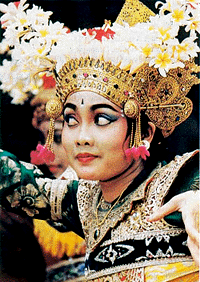
Balinese dancing greatly differs from the less flamboyant style of Javanese dancing.  Balinese dancers use their eyes for emphasis and to convey messages, their arms gesticulate, their legs take high steps and they move with much more speed than their Javanese contemporaries.  Dancers learn their art at a very young age by watching their master teachers and emulating their movements.  It is very important for the dancer to have complete control over their movements to achieve balance and grace.  The dancer is to completely take on the role of the character they are playing without displaying their own self.  They are to transcend the self, a very spiritual act.


Text Box: Arja Dance

The Arja dance is an ancient drama-dance in the Balinese repertoire.   The Arja is one of the most beautiful, artistic and technically difficult of all Balinese dances.  The dance tells Balinese folkloric stories and of Javanese princes and princesses. It is said that it is a dance that tries the patience of the audience in several ways.  First of all, it begins in the evening and lasts well past midnight and into the early morning and secondly, before the dancers make their entrance they introduce their characters by shaking the curtain backstage for a long time.  The special gamelan instrument, the Gauntang, is used for the music of the Arja.  What makes this dance so challenging and special is that the dancers must sing during the many scenes of this drama.  It is like an opera.  


Text Box: 2 women perform the Arja


Text Box: Legong Dance

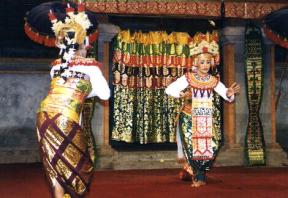
The term ‘classic’ is only applied to a Balinese dance that is exceptional in quality and has stood the test of time. The Legong is one such dance.  Today, only young girls often as young as eight, dance the Legong.  They dance the Legong until they are at the age of puberty where they go on to perform other dances.  The traditional Legong is staged outside in an open space, the shape of a horseshoe, which is created by the spectators under the protection of an enormous banyan tree.  Quite a spectacle!  When the Legong was first performed by only male dancers as was the custom for most dances but it is now mostly females who perform this delicate and beautiful dance.  The Legong was borne from a dream which a prince in Bali had while he was ill.  He dreamt of nymphs dancing to melodious and hypnotizing music.  When he was well, he created the Legong dance from this dream that he had.

Text Box: A young girl uses her eyes to convey the messages of the Legong


Back to Top


Glossary

Text Box: liberation:  The act of liberating or the state of being liberated.

Pelegongan:  a type of gong-like percussion instrument used in gamelan.  It is struck with a rubber mallet.

Ramayana:  A Sanskrit epic, traditionally attributed to Valmiki, that concerns the banishment of Rama from his kingdom, the abduction of his wife Sita by a demon and her rescue, and Rama's eventual restoration to the throne.
sentient:  Having sense perception; conscious.  Experiencing sensation or feeling. 
shrine:  A place at which devotion is paid to a venerated person.


Bali et Java - Indonésie : voyage "Chemins d'Initiés", itinéraire "Sourires et Volcans"... - Absolu Voyages.Bali et Java - Indonésie : voyage "Chemins d'Initiés", itinéraire "Sourires et Volcans"... - Absolu Voyages.


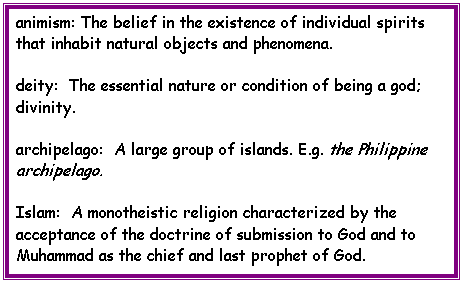
Text Box: animism: The belief in the existence of individual spirits that inhabit natural objects and phenomena.
deity:  The essential nature or condition of being a god; divinity.
archipelago:  A large group of islands. E.g. the Philippine archipelago.
Islam:  A monotheistic religion characterized by the acceptance of the doctrine of submission to God and to Muhammad as the chief and last prophet of God.


Text Box: Source:

www.dictionary.com  Source:
The American Heritage® Dictionary of the English Language, Fourth Edition
Copyright © 2000 by Houghton Mifflin Company.
Published by Houghton Mifflin Company


Bali et Java - Indonésie : voyage "Chemins d'Initiés", itinéraire "Sourires et Volcans"... - Absolu Voyages. 


Back to Top


Resources and References  - Balinese Spirituality through Drama, Dance and Music


WEBSITES

www.balilife.com/spirituality/


www.balivision.com/index.asp


www.batukaru.info/


www.dictionary.com


www.indonesiaphoto.com/index.php


www.ransomeverglades.org/pages/about/facilities/ms/mstour/banyan.html


www.religioustolerance.org/hinuism.htm


www.si.umich.edu/CHICO/gamelan/gamelanVT7.html


www.teakline.com/giftsfromnature/bali_guide.htm


BOOKS

Muller, K.  Indonesia; Tropical Paradise, Singapore: Periplus Editions (HK) Ltd., 1994.


Back to Top

Hosted by www.Geocities.ws

1