Lakonia is one of the most known areas of Greece. It was the homeland of the Lakedemonians or
Lakones with capital the city of Sparta. Most of its reputation is due to its rivalry with Athens
and its strict, militaristic organisation that produced hardened and loyal soldiers. It was the
kingdom of Menelaos and beautiful Helen, the woman that according to Homer caused the Trojan war.
Today Lakonia is not anymore inhabited by the hard, assertive soldiers of the past but still
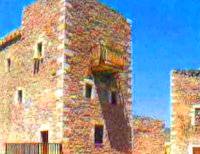
retains lots of "raw" characteristics. The people of Mani, known for their pride and harsh but
enchanting at the same time culture, don't do anything else than to follow the inner rhythm of
the rocky landscape which stark beauty comes in contrast with the deep blue, velvet-like sea all
around it.
|
 Sparta was founded around 1000 Bc from the Dorians that would descend from the north. The broader
area though is inhabited since prehistoric times and even before the arrival of the Dorians it
was a wealthy, glorious kingdom. It is mentioned in Homer's Iliad as the kingdom of Menelaos and
Helen. The Dorian populations soon realised that in order to retain their cultural and racial
identity and avoid being absorbed by the local populations that were superior in numbers had to
safeguard their autonomy and isolation by establishing a military and estrovert society. The
autochthonus populations were forced to work the fields and provide for the Spartan society. The
latter was organised in a strict and absolute way, very different than the Athenian one. As a
matter of fact, Sparta and in general Lakedemonian people grew to become probably the worst
opponent of Athens and eventually it was the ultimate clash of these two city-states and their
culture, the Peloponnesian War, that led to the decay of the Hellenic world and the ascent of the
Roman. The Spartans had no money since it was thought to corrupt a man and since it was of no use
to them.
Sparta was founded around 1000 Bc from the Dorians that would descend from the north. The broader
area though is inhabited since prehistoric times and even before the arrival of the Dorians it
was a wealthy, glorious kingdom. It is mentioned in Homer's Iliad as the kingdom of Menelaos and
Helen. The Dorian populations soon realised that in order to retain their cultural and racial
identity and avoid being absorbed by the local populations that were superior in numbers had to
safeguard their autonomy and isolation by establishing a military and estrovert society. The
autochthonus populations were forced to work the fields and provide for the Spartan society. The
latter was organised in a strict and absolute way, very different than the Athenian one. As a
matter of fact, Sparta and in general Lakedemonian people grew to become probably the worst
opponent of Athens and eventually it was the ultimate clash of these two city-states and their
culture, the Peloponnesian War, that led to the decay of the Hellenic world and the ascent of the
Roman. The Spartans had no money since it was thought to corrupt a man and since it was of no use
to them.
 The "eilotes", the local who would work the fields on behalf of the Spartans and would
belong to the Spartan state and not to some individual, were an adequate source of resources for
the Spartan society. Despite the lack of money Sparta soon became very powerful. It established a
series of colonies in today's south Italy.
The "eilotes", the local who would work the fields on behalf of the Spartans and would
belong to the Spartan state and not to some individual, were an adequate source of resources for
the Spartan society. Despite the lack of money Sparta soon became very powerful. It established a
series of colonies in today's south Italy.
Probably the most interesting aspect of Sparta was its social organisation which was totally
different than the one most people imagine about ancient Greece. Even though Sparta was a rival
city with Athens and democracy was hated as corrupting (the Athenians were thought to be soft and
stuck in meaningless details such as art and philosophy by the Spartans. Of course the Spartans
themselves were thought to be cruel and uncivilised by the Athenians!) the Spartan society had in
many aspects more liberties than the Athenian one. Women had the task to bring up healthy and
emotionally strong children. All children with physical or psychological handicaps were thrown to
"Kaiadas", a gorge of the Taygetos mountain. The children would stay with their mothers
until the age of seven. After that, both girls and boys, would attend something like a military
school until the age of twenty where they would learn how to fight, endure pain, cold and extreme
conditions, and survive difficult situations. Bravery was the ultimate virtue and it was expected
from both men and women who, after finishing school, were ready warriors. Women would participate
in all social events they would even fight or participate in sport competitions naked alongside
with men. Married couples were free to live in their own house only after they would become
thirty. Before that they would meet secretly. Despite the fact that the constitution of
marriage was present in the Spartan society sexual relationships were very liberal and it was
totally acceptable for a Spartan citizen, male or female, to have lots of different sexual
partners at any given time.
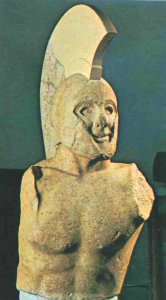 Probably the most characteristic thing about Spartans is the "lakonizein", the ability to
speak concisely and briefly. In this laconic way the Spartan war philosophy was best described
with the phrase "e tan e epi tas", meaning "with it or on it" that the Spartan women would
say to their male relatives who would leave for the battle. The Spartan warriors used to carry
large heavy shields that were very protective in the battlefield but very heavy to carry in case
someone wanted to run away. So if one ever wanted to run away because he felt scared had to throw
his shield first. All the dead Spartans found away from their shields were immediately thought
to be cowards, the ultimate insult not only for the soldier but for his whole family as well. On
the contrary all soldiers that had an honourable death in the battlefield were carried in their
homes on their large shields as a sign of honour and recognition. So the Spartan women used to
say to their men, brothers, or sons "Go and return victorious with the shield or dead on it. Not
without it".
Probably the most characteristic thing about Spartans is the "lakonizein", the ability to
speak concisely and briefly. In this laconic way the Spartan war philosophy was best described
with the phrase "e tan e epi tas", meaning "with it or on it" that the Spartan women would
say to their male relatives who would leave for the battle. The Spartan warriors used to carry
large heavy shields that were very protective in the battlefield but very heavy to carry in case
someone wanted to run away. So if one ever wanted to run away because he felt scared had to throw
his shield first. All the dead Spartans found away from their shields were immediately thought
to be cowards, the ultimate insult not only for the soldier but for his whole family as well. On
the contrary all soldiers that had an honourable death in the battlefield were carried in their
homes on their large shields as a sign of honour and recognition. So the Spartan women used to
say to their men, brothers, or sons "Go and return victorious with the shield or dead on it. Not
without it".
 Politically Sparta had an oligarchic organisation. There were two kings one of which was
responsible for the running of city and the other with the war affairs. The latter would
participate in battles in the first line as well. The kings were controlled by five
ephoroi that were making the laws and they were elected every year. They were in the
position of changing or even killing the kings if they thought it was necessary for the good of
the city. A group of elder Spartans, the "Apella", the members of which were chosen by the
people of Sparta for their wisdom and experience was controlling the ephoroi. Sparta had
an indirect democracy, closer to our own model today, where the decision were taken by the
representatives of the people. Athens on the contrary had a direct democracy where the people
would take the decisions on their own.
Politically Sparta had an oligarchic organisation. There were two kings one of which was
responsible for the running of city and the other with the war affairs. The latter would
participate in battles in the first line as well. The kings were controlled by five
ephoroi that were making the laws and they were elected every year. They were in the
position of changing or even killing the kings if they thought it was necessary for the good of
the city. A group of elder Spartans, the "Apella", the members of which were chosen by the
people of Sparta for their wisdom and experience was controlling the ephoroi. Sparta had
an indirect democracy, closer to our own model today, where the decision were taken by the
representatives of the people. Athens on the contrary had a direct democracy where the people
would take the decisions on their own.
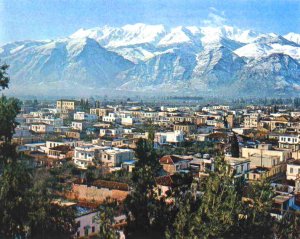
The modern city of Sparta is built next to the archaeological site of ancient Sparta and it is a
beautiful small provincial city from which pass most of the main transportation lines that lead
to south Peloponnesos. It was built by the Franks but his ultimate form was given by king Otto in
1834.
|
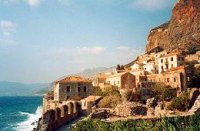 Monemvasia:
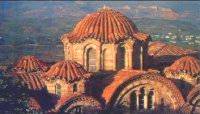 Mistras:
 Mani:
Mani: