|
 Originally the name Mani was used only for the castle "le Magne" built in 1248. Later on
the name came to mean the place where during the time of slavery people could be free due to its
inaccessible location on the barren rocks of southern Peloponnesos. In Mani everything is ranges
to the extreme: winders are harsh and cold, summers sizzling and merciless, the landscape rocky
and barren, the ideal environment for an isolated culture to flourish without external
interruptions and influences. Mani is pre-rational, instinctive place where bravery, revenge and
passion coexist with the myths of fairies, pirates, Frank soldiers and Byzantine princesses.
Originally the name Mani was used only for the castle "le Magne" built in 1248. Later on
the name came to mean the place where during the time of slavery people could be free due to its
inaccessible location on the barren rocks of southern Peloponnesos. In Mani everything is ranges
to the extreme: winders are harsh and cold, summers sizzling and merciless, the landscape rocky
and barren, the ideal environment for an isolated culture to flourish without external
interruptions and influences. Mani is pre-rational, instinctive place where bravery, revenge and
passion coexist with the myths of fairies, pirates, Frank soldiers and Byzantine princesses.
Inhabited since prehistoric times, Mani was strongly associated with Sparta. During the era of
the Frank occupation the area will receive waves of emigrants from the rest of the Greece but it
was only during the Turkish occupation times when the people of the area will begin a fierce
strangle against the conqueror. Greeks from Minor Asia and Crete will move to Mani seeking a
remote place where they could enjoy a greater degree of freedom. There they will built villages
with cretan names and they will enrich the local dialect with Cretan words and names. Soon the
barren land will lead them to a straggle for survival that will make whole families turn against
other families. For centuries the "vendettas" will create a war-like atmosphere in Mani
and only the common enemy, the Turk conqueror, will unite the Maniats who will either join the
Venetian army or they will become pirates inflicting great damage to
 the Turkish fleet. The
Maniatic strangle against the Turks and the vendettas lead to the formation of the very
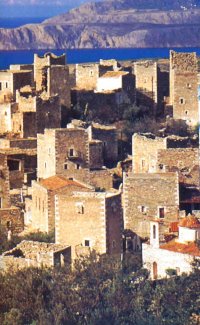
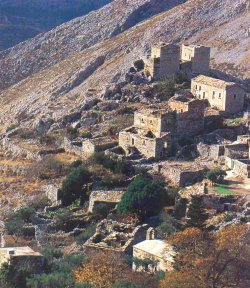
characteristic castle-houses of Mani for the protection of their owners. They usually have 4-5
floors but their height is determined by the family status of the owners. Very soon the "stronger"
families would forbid the "weaker" ones to built high houses. In the case of an armed conflict
between families the winning family would demolish the house of the defeated one. Today there are
around 800 castle-houses in Mani most of which are semi-collapsed.
the Turkish fleet. The
Maniatic strangle against the Turks and the vendettas lead to the formation of the very
characteristic castle-houses of Mani for the protection of their owners. They usually have 4-5
floors but their height is determined by the family status of the owners. Very soon the "stronger"
families would forbid the "weaker" ones to built high houses. In the case of an armed conflict
between families the winning family would demolish the house of the defeated one. Today there are
around 800 castle-houses in Mani most of which are semi-collapsed.
From the Maniatic families moving to Italy known is the Stefanopoulos family who made its home in
Corsica and retained its language and customs and still today are known as "the Greeks".
In the middle of the 17th century AD the Turks decide to leave the Maniats on their own in the
exchange of an annual tax which very often would not be paid at all.
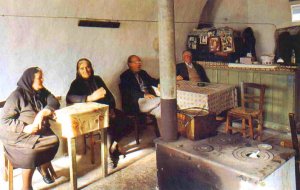 One of the most characteristic customs of the area are the "moirologia" (sing.
moiroloi) , the lament songs, sang by women in funerals who basically improvise based on
given typical phrases. Women in general pay an unusual role for a Mediterranean culture in Mani. It is one of the areas in Greece where society is organised in a matriarchal way tottaly incompatible with the bassicaly male oriented organisation of the maniatic life. Or at least that's how it seems! In Mani it is men that offer a dowery whe they get married and women are mainly responsible for most of the tasks that need a great degree of exposure to the outside world, such as the cultivating of the fields or the representation of the family. That was mainly because most of the male members very often had to stay hidden inside the family castle-house to avoid beeing killed by a rival family.
One of the most characteristic customs of the area are the "moirologia" (sing.
moiroloi) , the lament songs, sang by women in funerals who basically improvise based on
given typical phrases. Women in general pay an unusual role for a Mediterranean culture in Mani. It is one of the areas in Greece where society is organised in a matriarchal way tottaly incompatible with the bassicaly male oriented organisation of the maniatic life. Or at least that's how it seems! In Mani it is men that offer a dowery whe they get married and women are mainly responsible for most of the tasks that need a great degree of exposure to the outside world, such as the cultivating of the fields or the representation of the family. That was mainly because most of the male members very often had to stay hidden inside the family castle-house to avoid beeing killed by a rival family.
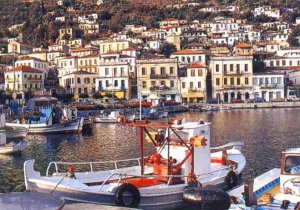 Diros cave, inhabited by prehistoric men and today open to the public for visiting is another attraction of Lakonia. Gytheio is the main port of the Laconic peninsula. It is a vivid colourful privincial city with amazing natural beauty. According to legend it was founded by Heracles. The mythical hero went to the oracle of Delphi to ask Apollo how to redeam himself after a terrible murder he had commited. When Pytheia, the high-priestess of the oracle, found out the details of the murder she refused to give a prediction and ordered Heracles to go away. Then the hero in anger stole the sacred tripod of the oracle where the prediction were taking place and took it to where Gytheio is located today with the intention to found a new oracle there. God Apollo who could not accept such a blasphemy fought with Hercules but it was only after the intervention of Zeus when Heracles was forced to give back the tripod. Gytheio was built as a sign of their renewed friendship. Close by there is the Marathonisi or Kranai island, where according to the legend Paris and Helen passed their first night after they left Menelaos' palace and before they sail to Troy. The two lovers built a small temple there dedicated to Aphrodite, Goddess of Love and their protector. Menelaos though, after his return from Troy with his wife, built another temple next to it dedicated to Thetis, Goddess of Justice!
|