Tips on How to Find
Best Stock Trading Books
Ch1: What is needed for success in trading?
Know your biggest enemy in trading: YOU!
Ch2: Plan your Trades
and
Trade as per your Plan
Limit your losses
with Stop loss
Here are some feedbacks about one book
Best on the Net- Online Resources for Traders and Investors
STOP-LOSS: HOW TO USE IT IN TRADING
Chapter Outline:
- INTRODUCTION TO STOP-LOSS
- COST AND BENEFIT OF USING STOP-LOSS
- HOW TO EFFECTIVELY USE STOP-LOSS
- PROGRESSIVE STOP-LOSS
(one unsolicited opinion about this page.)
Hi, I am an investor who is trying to protect some profitable trades. In doing so I was looking for a method of setting STOP LOSSES on my stocks. I found your write-up to be excellent. It was very helpful in understanding the method of setting a Stop Loss for a stock. Most write-ups describe why a Stop Loss should be set but never explain how to determine where to set the stop.
This is a THANK YOU for your excellent explanation.
Regards, Phil Lenkevich
One important dimension of any trading system is the ability to keep losses small. This is most of the times achieved with the use of STOP-LOSS. So let us spend some time to learn what a Stop-loss is and how one can use it in trading to his advantage.Stop-loss is a widely used term in investment circles. As the name says, it is a price level at which one should stop or limit his losses in a position. Investing or trading is like gambling when one looks at from the outcome perspective. When a person gambles or speculates, he does not know what the outcome will be. He would hope the outcome to be in his favor but it could very well go against him. The same thing goes for investing or trading. When someone buys a stock, he might be thinking, and to a great extent hoping, that the stock price would go up, but it could very well go down. So what should a person do if the prices go contrary to one's expectations?
There are two alternatives: (i) He can continue to hold it believing, and hoping, that it will ultimately go up; or (ii) He can blame the unexpected mess on his wrong selection, bad judgment, bad timing or on circumstances/development beyond his control or imagination, and… get out of the position.
It is a price level or a mechanism that forces a trader to take/book losses in a losing position instead of letting them grow any bigger. Ideally a Stop-loss level should be decided as soon as a trade is executed. If a stock say ABC is bought at 25$, Stop-loss for it can be kept at a price level somewhat lower than 25$. It can be 24, 23, 20 or even 15$. Let us assume the Stop-loss is kept at 20$. This means if the price of ABC, after having bought at 25$, goes below 20$, one should close the position by selling it. 5$ is the loss the buyer is limiting to. This might be little confusing for novice traders because it involves closing a position willingly at a loss! Remember: In a long position, the Stop-loss level is usually lower than the entry price.
Likewise if a person Shorts (what is this term? It means sell first even if you don't own the stock with the hope to buy it back later at a lower price) ABC stocks at 25$, he should keep a Stop-loss at any price higher than 25$. Say if it was kept at 30$, this means if the price moves up contrary to the initial expectations of it going down, and touches 30$, one should call it a quit and square up the position. Thus, in a short sell, the Stop-loss price is higher than the price at which the stock was sold.
COST AND BENEFIT OF USING STOP-LOSS
The use of Stop-loss has its merits, and problems too. Let us take two examples to illustrate cost and benefit of it.
Let us assume someone bought a stock like, CMGI or ARBA, around 150$-level during the Year 2000 boom period, thinking that it was a great company (Believe me there were many investors who believed so at that time!). And if he continued to hold to that position during its downtrend (hoping that it would one day reach 200$!!!), he would have seen the stock price drop to as low as 1$ in 2002! In this kind of situations, one would wish if he had kept a Stop-loss and limited his losses to 5 or 10$ per share! This makes a strong case for the use of Stop-loss.
Now let us look at an opposite situation. Assume that the same person had bought Yahoo at split adjusted 10$ in October 1997 and kept a Stop-loss at 9$. Suppose the price went below 9$ and triggered his Stop-loss. He would be out of Yahoo! Position at a 100$ loss! Then as time passed, Yahoo kept climbing up and ultimately reached as high as 500$ in January 2000! An initial 1,000 $ investment could have been worth 50,000$ if there were no Stop-loss were used!
Should A Trader Use Stop-loss?
So a million dollar question is: Should you use Stop-loss or not? Answer is that it depends. If you are an investor with purely long-term perspectives and with a diversified portfolio, you should probably not.
As the saying goes, there is no free lunch in financial markets. So the use of a Stop-loss has its benefits and problems. In a few paragraphs below, I will try to show you how to get the maximum out of this Stop-loss and how to use it in your favor. Let us go back to the above two scenarios one more time.
Let us assume that that 1000$ position in Yahoo at 10$ price had no Stop-loss. Do you think the buyer would have continued to hold onto it until it touched 500$? It is very likely he might be out before it even doubled or tripled! I think most of the investors including myself would be pretty satisfied to have doubled or tripled our investment over a short period. Let us assume our buyer of Yahoo in this example is made of different material. Suppose he had guts to hold on to a winning stock and he watched Yahoo go up to 20, 50, 100, 150, 300$ level. I am curious to know what would have prompted him to sell Yahoo around that 400/500$ level. It is possible that his patience and guts may have glued him to that Yahoo position, even when the YHOO stock reversed its trend and price touched 10$ level back sometimes in 2002. This is an extreme example and I have mentioned it to highlight two things: Most of the investors get satisfied with small profits, and a new type of Stop-loss- Progressive Stop-loss that we will discuss later in this chapter.
What in the case of CMGI or ARBA? It is very likely that individuals who usually take small profits might have stayed in such losing positions all the way to zero! My point is: Most individuals play stock market like a D or F-grade student! When it comes to booking profit, they get easily satisfied with a few points of profit but when it is a loss situation loss, they are likely to hold on and stick to the stock too long. Most investors are more risk-averse (they hate the risk of profit going down) in the profit zone and less risk-averse (they tend to take a lot of risk in the hope that prices will go up someday) when in a loss zone. This asymmetrical behavior is typical for most investors. What is the end result? Small profits but big losses!!!! This is the reason I advise most traders to use stop-loss when they are trading stocks or Futures.
It is very much feasible that (small) profits in ten positions can easily be wiped out by two/three big losses! So even if a trader has 70 to 80% success rate in stock selection, we would hardly break if he does not stop his losses! I think this is one of the main reasons why our trading results in losses most, if not all, of the time! I think this makes a solid case for every trader to understand and learn to use a Stop-loss on every trading position.
HOW TO EFFECTIVELY USE STOP-LOSS
Almost every person loves to take profit but if things go contrary to his expectations, he must also use a Stop-loss to limit his losses. Question is how much loss is enough? There is no clear answer to this question that will suit every trader's needs and circumstances. If one does not want to lose a great deal, he should keep the Stop-loss close to his trade price. The benefit is a small loss. However this would increase the probability of the Stop-loss being triggered. So the result is small but frequent losses. On the other hand, if a trader does not want his Stop-loss levels to be frequently triggered, he should keep more distance between his entry price and the Stop-loss. This will result in less frequent but higher losses. So how much loss is ideal? It is really an individual's decision based on his risk-tolerance, asset base, trading system, return objective in the position, market conditions and the nature of the stock itself.
So how much is enough?
One should look at the stock's price, volatility, current market conditions and return expectations to determine an efficient loss/risk amount for him. For an average individual, it could be from 5% to 25%. For a 5$ stock, with high volatility and expectations for 100% return over the intended holding period, it could be 25% of the amount invested. This means if someone buys at 5$, Stop-loss could be kept at 3.75$. In the opposite extreme, for a 120$ stock with average volatility and a target return of 30%, the Stop-loss can be placed at even as low as 3%. As this kind of Stop-loss will protect one from big unexpected losses, they are frequently called as Protective Stop-loss.What should be a base/price level to calculate our stop-loss?
Let us assume that 5% is the ideal Stop-loss or safe distance percentage for a given position. Now another question is what level one should use to calculate his Stop-loss price. If he buys this stock at 50$, the most obvious choice is to use the 50$ level and go for a safe distance of 5%. This will be 47.50$. This is the most widely used approach to determine Stop-loss levels- to use the purchase price as the base price.
However John Magee in his classic book on Technical Analysis of Stock Trends (a must-read for chart reading investors) suggests using Minor Tops and Minor Bottoms as base points. It makes a lot of sense. An individual's purchase price has no meaning in the universe of constantly fluctuating stock prices but Minor Bottom/Minor Top is a somewhat significant price level. Minor bottom is the price point where at least for some time buyers were more aggressive than sellers and were able to push prices higher. Minor bottom means buyers' gained more strength to outbid selling pressure. Similarly a Minor Top the recent high price. It is the price at which the stock attracted more selling.
How to decide a minor bottom?
It is tricky and subjective. Different people can have different methods or parameters to find Minor Tops and Bottoms. Here also, I like John Magee's definition.
Let me try to explain a Minor Bottom:
- Suppose prices are going down for a stock for some time (how much is some time? It could be 2, 3 or more days. One can pick his own number and fine tune it as he gains trading experience.)
- The stock price makes a low of 45$ on day X. The high on that day was 48$.
- Let us call this high price (48$ in this case) on the low price day (X) a Key Price. As soon as there are three consecutive days on which stock does not trade below this Key Price (48$ in this example), the low price of day X will become a Minor Bottom (45$ in this case).
The same thing can be applied in reverse for calculating a Minor Top. Read this again and again until you comfortably understand it. Thus for best results, one should use the Minor Top or Bottom as his basis to calculate Stop-loss level for his position. This is likely to provide better protection than the stop-loss calculated based on his entry/trade price.
Stop-loss is mostly referred to a loss situation. This should not be the case. Stop-loss can also be used to a trader's advantage in a profitable trade when prices are moving the direction he wanted them to. A Protective Stop-loss level can be changed in the direction of the stock price. If one has taken a long position and the prices are going up, he can increase his stop-loss level. This makes it a Progressive Stop-loss. (The word "Stop-loss" word becomes deceptive in this context. Instead of relating to a loss, it is used to protect a profit).
Let me explain a Progressive Stop-loss in more details. Let us continue our example above. Assume that the trader bought the stock at 50$ after a Minor Bottom was confirmed at 45$, and kept a stop-loss with 5% distance which is 42.75$. This is the initial Protective Stop-loss.
Assume that the stock price goes up and touches 55$ and then enters into a reaction and slides back to 50$. The day it touches 50$, the high was 52$. Now again the price seems to be going up and there were three consecutive days on which stock traded above 52$. This will confirm a higher Minor Bottom at 50$! Now he can raise Stop-loss to 47.5$ (50$ minus 5%) from initial level or 42.75%.
Assume that the stock resumes it up-trend and makes a higher Top at 65$. Then it slides back to as low as 58$ and passes the 3-day test of a Minor Bottom. So now one can raise his Stop-loss to 55$ (58$ minus 5%). This trading position is in profit now and profit is also sort of guaranteed! Say the upward trend in prices of this stock continues. It touches a price as high as 85$. Subsequently let us say a Minor Bottom is confirmed as per our three consecutive days test at 78$. So the new Stop-loss level is now at 74$ (78 minus 5%).
Now let us assume that after the last Top and Bottom being confirmed at 85$ and 78$ respectively, the stock fails to go higher than 85$. This is an indication of some weakness. Now when it starts going below 78$ (the last Minor Bottom), one should get worried. Still there is no need to sell the position because the stop-loss is 5% below the last Minor Bottom. This helps us if the stock is forming a mid-trend pattern like flag or pennant. If after going as low as 75$, the stock resumes its upward trend and goes above 85$, one is still in the game! However if it does not go higher and instead goes below 74$ (current Stop-loss level), one should close the position. As you can see, even if the stop-loss triggered, the position had a profit of 24$ (Sell price 74$ versus purchase price of 50$) per share!
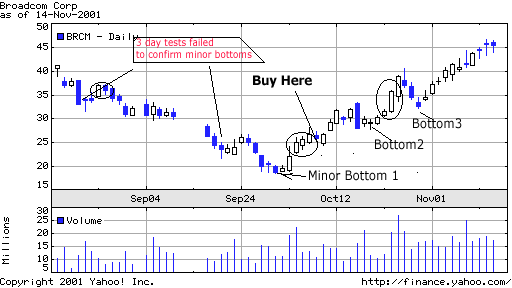
I hope above description about Progressive Stop-loss makes sense to you. Here is one real example:
This is the Chart of BRCM (Broadcom Corp)- a one-way superstar, during 2002. Around that time, I was watching it closely. It was drifting from 40$ down to less than 20$ but did not confirm any Minor Bottom on the way according to the 3-consecutive-days test. Ultimately it touched 18.40 and then later on, on 3rd, 4th and 5th day it passed the 3-day consecutive rule! It formed a Minor Bottom as marked on the Chart. It was a buy signal for the first time and one could have bought it for around 25$. Initial Protective Stop-loss would be at 16.50$ (18.40$ minus 10%) allowing a loss potential of 8.50$/share!
The next Bottom -- Bottom2 -- was confirmed at 27.50$ which would bring the Stop-loss to 25.00$ (27.50$ - 10$). Then it made another higher Minor Bottom -- Bottom3 -- around 33.00$ bringing the Stop-loss to 30.00$. At the time, the Chart was drawn, BRCM stood at 45$. At that time, one could have booked profit of 20.00$ or like an astute trader, he could have held on to it with a 30.00$ Stop-loss and raising it progressively higher if the stock continued to confirm new higher Bottoms.
Now is the time to look at some trading signals. Click here to look at U-TURN signal.