Rated a Good  Seller
by mnot12b (1) Seller
by mnot12b (1) |
| Stock
trading strategy book investment J Patel CFA
(Mar 03 07:10 2005 PST) |
Comment:
Excellent! This book which
is a complete trading methodology, including specific setups, gives
more detailed trading information than books by "big name" authors
costing 4 - 10 times the price. You can't go wrong buying this book.
(Mar 12 11:42 2005 PST) (most recent) |
SIGNAL
–R1: U-TURN
Here on this page you will learn about one powerful
trend reversal signal. Few minutes spent on this page will go a long
in impoving your success in trading. We will see this signal for two
situations. One pointing a trend reversal from a downtrend to an up-trend
and the other one pointing a reversal from an uptrend to a downtrend.
U-TURN (BUY)
U-TURN (SELL)
| Limited time offer: |
|
You can currently buy PROFIT FROM PRICES
ebook at 50% discount to regular price.
Buy it now for only $9.95 only $19.99
. Click
here to purchase it now.
|
|
*This half price offer ends on August 31, 2005.
|
| |
Want to see the performance of this signal? Out of curiosity,
I back tested both versions of this signal for the first half
of 2004 on stockfetcher.com.
For the U TURN (BUY) signal:
Annualized
Return on Investment (ROI): 22.82% versus the ROI of ^SPX was:
4.81%.
(Click here for an EXCEL file with
all details about his back-testing.)
For the U TURN (SELL) signal:
Annualized
Return on Investment (ROI): 24.60% versus the ROI of ^SPX was:
4.81%.
(Click here for an EXCEL file with
all details about his back-testing)
|
|
(Note:
If you get confused by some term(s) used on this page, you can look
at that term by clicking on this link.
Don't give up. Try to understand this signal because this can make you
lots of money. Feel free to ask me a
question or email me feedback.)
U-TURN
(BUY)
U-TURN
(BUY) is one of my most favorite signals. As mentioned earlier, the (BUY)
version of U-TURN takes place when a stock is in a down-trend and is like
to enter into an up-trend. It signals possibilities about the start of
an up-trend.
Assume
a stock is going down for quite some time. The following are quotes for
the latest two days:
| Today |
22, 27,
21, 26 |
| Yesterday (Previous
day) |
25, 26,
23, 24 |
Yesterday,
the stock opened at 25$, touched a high of 26$ and a new recent low of
23$, and at the end of the day it closed at 24$. Now today, when market
opens, this stock opened at 22$ (a price lower than the Previous Day's
Low price of 23$) and started going down. Now when it is trading as low
as 21$, there are signs of fresh buying which pushes the price higher.
Not a big thing so far because this kind of buying could be seen several
times during any trading session. However, when the stock manages to trade
higher than today's Open price or 22$, we need to be vigilant for a likely
trend reversal. Now if the stock keeps going up and closes for today at
say 26$, which is higher than both Previous Day's Open price of 25$ and
the Previous Day's Close price of 24$, we have a trend reversal signal!
The stock that has been going down for the last few days and also during
first few hours today, somehow closed with a happy ending and a strong
Close price. This reflects a 180-degree change in the sentiment. Hence
we will call this signal a U-TURN (Buy) signal.
What
makes U-TURN a powerful trend reversal signal?
As we know, when a stock is in a downtrend, sellers out-number or out-power
buyers. In such circumstances, it is normal for the stock to keep making
lower Low prices as time passes. This reflects bearish, negative sentiment
or outlook for this stock. Now when trading starts for today, this stock
opens at a price lower than Previous Day's Low price. This is in line
and indicates continuation of the current bearish mood and reflects a
further build up of negative sentiment. Now if at some point in time during
the session, the stock stages a reversal and starts trading higher. This
is likely due to an emergence of fresh demand at current low price of
the stock. Now how can we determine that the stock is really staging a
reversal? To answer this question, following tests can help us differentiate
a strong reversal from a temporary emergence of buying. First, there has
to be a noticeable increase in volume since this turning point. Second,
it has to keep going up and cross Previous Day's Open and also the Close
price. If both these conditions are fulfilled, we can be sure that the
buying in the stock has been real and powerful. To take advantage of attractive
current low level of stock price, some influential players seem to have
started buying it decisively despite the strong negative sentiment held
by most other players. This buying is significant because it not only
absorbed what most players had to sell/offer, buyers kept asking for more
stocks even at higher prices. Today's demand not only absorbed the selling
pressure, but it even pushed the price higher than the prices of the Previous
Day! Isn't this a convincing reversal in stock prices?
This
is a complete U-TURN (BUY) in the stock price trend and now with a Stop-loss
at Today’s Low price, one can start taking long positions.
These
are the conditions required for the U-TURN (BUY) signal:
- The
stock has to be in a continued downtrend
-
Today’s Low price (TDL) has to be the LOWEST price for the stock over
the last few days.
(If it is the lowest for last few weeks, we are likely to have a strong
major trend reversal signal- a strong form of U-TURN. However
if Previous Day’s Low price is the lowest for only last three to ten
days, we have a signal that is more likely to mark the beginning of
a Correction or the end of a Reaction
– a weak form of U-TURN).
- Today’s
Open price (TDO) has to be LOWER than Previous Day’s Low price (PDL).
TDO < PDL
The more the difference between PDL and TDO, the more powerful the signal
is going to be.
-
Today’s Close price (TDC) has to be HIGHER than Previous Day’s Close
price (PDC).
TDC > PDC
-
Today’s Close price (TDC) has to be HIGHER than Previous Day’s Open
price (PDO).
TDC > PDO
- Today’s
Volume has to be decisively HIGHER than the normal volume over the last
few days or Previous Day’s volume. If the above conditions were fulfilled,
you would most likely see a decisive jump in stock volume today. If
you don’t see a jump in the volume today, the signal loses some of its
strength.
Key
Points to remember:
Current Trend- Down. Weak Open. Strong Bull Day. Increase in Volume.
Stockfetcher.com
syntax: "Show stocks where Close gained more than .15% percent
over the last 1 day and open is more than .25% below the low 1 day ago
and close is above the open 1 day ago and LOW reached a new 4 week low
and volume gained more than 20% over volume 1 day ago"
Here is an example: See the prices below
for PCS (Sprint PCS Co.) during May 2003.
|
Daily Prices with Volume for PCS
|
Here is the chart for PCS
|
|
16-May-03
|
3.5
|
3.81
|
3.5
|
3.8
|
23705400
|
|
15-May-03
|
3.67
|
3.71
|
3.55
|
3.55
|
12393200
|
|
14-May-03
|
3.78
|
3.82
|
3.64
|
3.67
|
10333600
|
|
13-May-03
|
3.8
|
3.84
|
3.75
|
3.78
|
5211000
|
|
12-May-03
|
3.75
|
3.86
|
3.75
|
3.85
|
9816100
|
|
9-May-03
|
3.82
|
3.84
|
3.78
|
3.84
|
6566900
|
|
8-May-03
|
3.79
|
3.84
|
3.75
|
3.82
|
3851600
|
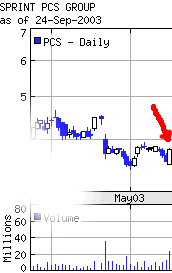
When
you look at the Chart, you will notice that the stock is in a downtrend
(Condition 1). On the 16th, the stock opened at 3.50, which was
lower than Previous Day's Low of 3.55 (Condition 3). During today's
trading stock touched a low of 3.50 that was sort of the lowest
price for the last five to ten days (Condition 2). At the end of
the day, however the stock closed at 3.80, which was higher than
Previous Day's Open (3.67) and higher than Previous Day's Close
price (3.55) (Conditions 4 and 5). As you see, the volume on May
16th was also higher than the previous few days' volumes (Condition
6). Thus all the conditions were fulfilled here for a perfect U-TURN
(BUY) signal.
|
|
ACTION:
There are two primary variations of this signal as regards to Condition
2. The signal can take place at the end of a major trend as described
above for PCS or it can take place at the end of a Correction or a Reaction.
In the first scenario, U-TURN (BUY) - in a Bear Market - is usually a
very powerful signal and has the strength to change the current major
trend from down to up-trend. Here you can expect the stock price or index
to go up to the tune of 20%! So as soon as you have a U-TURN (BUY) in
a major trend, you should be convinced of a trend reversal; and close
short positions and you can also initiate fresh long positions to take
advantage of this new emerging up-trend. So here in the case of PCS, Today's
Low price was the recent lowest price so the U-TURN (BUY) today was likely
to end the current down trend and initiate an up trend in PCS stock prices.
In
the second variation, U-TURN takes place somewhere in the middle but not
after a sustained trend. So Today's Low price may be the lowest price
for only the last three to ten days, but not for the last few weeks! So
the signal here may just mean the beginning or end of a Reaction/Correction.
So what do you do here? You should not expect as much gain as you would
in the first variation, but you can make new trades to take advantage
of the price movement over the next three to ten days. If you understand
major trends and Reactions/Corrections in prices, you will be able to
distinguish these two variations and trade accordingly.
STOP-LOSS:
As with any
trading system, you must be alert to getting out of a position if the
stock moves contrary to your expectations. The U-TURN signal works best
most of the time but not always. If I were pressed for a figure, I would
say it is correct around 70% of the time. However it also fails sometimes.
So you should be watchful to protect yourself by selling your long position
if the prices start going down. When to quit the position and book losses?
It really depends on your risk-tolerance but I would advise you to keep
a Stop-loss at Today's Low prices (minus 1%). Here in the case of PCS,
we would keep a Stop-loss at 3.47.
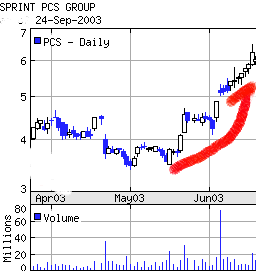
See
on the full Chart of PCS below for what happened after the signal took
place:
After giving a strong reversal U-TURN (BUY) signal on the 16th,
the stock was little idle for the next two days. This was an opportunity
for people like us to take a long position. Then on the next day the stock
jumped up again and took us to our target of 4.20. On the next day, the
stock continued its up movement and closed around 4.50 and then rested
for some time. Then after few days it restarted its journey and ultimately
it went as high as 6.50 within a month!
|
The
beauty of this signal is that it tells you to take a position on
the very day the stock is changing its course. You don't need a
computer or fancy software to find occurrence of this signal or
other signals discussed in this book. You can check for my signals
just by looking at the daily prices of the stock on some websites.
You can go Online and watch (and also download from the link at
the bottom of the page) current as well as historical prices or
charts on many website. Here is a link for viewing historical stock
prices for any stock on Yahoo! (http://finance.yahoo.com/q/hp?s=AMZN)
|
 |
|
Here
is another example...
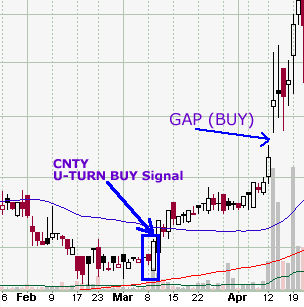
Look
at the chart of CNTY below for one more example of U-TURN (BUY)
signal. Take a note of increase in volume on the day of the U-TURN
(BUY) signal. An explosive up-trend in the prices was seen immediately
after the signal, which gave 80% return over just few weeks! Who
would not like to ride this kind of trend from the very first day
of its beginning? (You have not learnt about GAP signal yet but
come back to this page after you learn it.)
|
"Chart courtesy of StockCharts.com"
|
U-TURN
(SELL):
Now let us look at how this powerful signal works in a reversed situation.
Like the U-TURN (BUY) signal in a Bear market, U-TURN (SELL) signal is
equally powerful to indicate a change in trend when a stock is going strong
and is making new higher prices (in a Bull market). All of a sudden in
a Bull trend the stock puts up a disappointing down day and surprises
most people. Many people think this as just a Reaction and expect the
stock to resume its continued ascending movement soon; but it does not
happen most of the time when the reversal conditions of the U-TURN (SELL)
signal are met.
Here
are the conditions for the U-TURN (SELL) signal with Bearish implications
in a Bull market. Please note that the signal discussed here takes place
when the stock is in a up-trend (Bull market) but the signal actually
indicates that the stock is about to enter into a Bear market or a down
trend.
- The stock has to
be in a continued UP TREND.
- Today’s HIGH price
(TDH) has to be highest price (TOP) for the stock in last few days.
(If it is highest for last three or more weeks, we have a strong form
of a U-TURN (SELL) signal. If it is highest for last three to ten trading
days, we have a weak form of U-TURN (SELL) signal. The strong form indicates
a likely trend reversal for the current major trend; and a weak form
is related to just the start of a Reaction or the end of a Correction.).
- Today’s Open price
(TDO) has to be HIGHER than Previous Day’s High price (PDH).
TDO > PDH
The more the difference between TDO and PDH, the more powerful the signal
is going to be.
- Today’s Close price
(TDC) has to be LOWER than Previous Day’s Close price (PDC).
TDC < PDC
- Today’s Close price
(TDC) has to be LOWER than Previous Day’s Open price (PDO).
TDC < PDO
- Today’s Volume
has to be decisively HIGHER than the normal volume of the last few days
or Previous Day’s volume. If the above conditions are fulfilled, you
would mostly see a decisive jump in stock volume today. If you don’t
see a jump in the volume today, the signal loses some of its strength.
Key Points to remember:
Current Trend- Up. Strong Open. Strong Bear Day. Increase in Volume.
Stockfetcher.com
syntax: "Show stocks where Close dropped more than
.15% percent over the last 1 day and open is more than .15% above the
high 1 day ago and close is below the open 1 day ago and high reached
a new 3 week high and close is above 2 and volume is more than 20% above
volume 1 day ago and volume is above 500000"
ACTION:
There are two primary variations of this signal with regard to Condition
2. The signal can take place at the end of a major up-trend or it can
take place at the end of a Correction.
In
the first scenario, U-TURN (SELL) is a very powerful signal and has strength
to change the current major trend from up-trend to downtrend. Here you
can expect the stock price or index to go down to the tune of 20%! So
as soon as you have a U-TURN (SELL) in a major up trend, you should be
convinced of a trend reversal; and you should close Long positions and
you can also initiate fresh Short positions to take advantage of this
new emerging down-trend.
In
the second variation, U-TURN (SELL) takes place somewhere in the middle
but not after a sustained trend. So Today's High price may be the highest
price for the last three to ten days, but not for the last few weeks!
So the signal here may just mean the beginning or end of a Reaction/Correction.
So what do you do here? You should not expect as much drop in prices as
you would in the first variation, but you can make new trades to take
benefit from the price movement over the next three to ten days. If you
understand major trends and Reactions/Corrections in prices, you will
be able to distinguish these two variations and trade accordingly.
STOP-LOSS:
When to book losses in U-TURN (SELL) signals? It really depends on your
risk-tolerance but I would advise you to keep a Stop-loss at Today's High
prices (plus 1%).
Let
us see this with an example:
|
Daily
Prices with volume for TIVO
|
Here
is the chart of TIVO
|
|
7-Jul-03
|
14.05
|
14.51
|
12.75
|
12.88
|
3768100
|
|
3-Jul-03
|
13.05
|
13.75
|
12.78
|
13.5
|
1194300
|
|
2-Jul-03
|
12.34
|
13.39
|
12.23
|
13.22
|
2675400
|
|
1-Jul-03
|
12.35
|
12.35
|
11.75
|
12.22
|
1048200
|
|
30-Jun-03
|
12.75
|
12.75
|
11.75
|
12.09
|
2388100
|
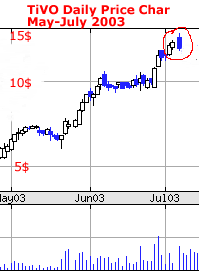
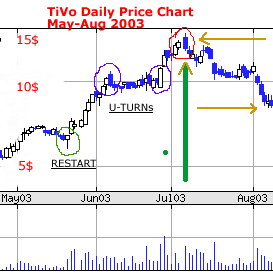
As
you see on the Chart to the right, the stock was making new high
prices day after day (Condition 1). However on July 7th,
TiVo opened at 14.05 which was higher than the 13.75 of Previous
Day’s High (Condition 3). Also Today’s High of 14.51 was the highest
price for TiVo over the last few weeks (Condition 2). After touching
a high of 14.51, it started going down during the day and closed
at a price that was lower than Previous Day’s Open as well as lower
than the closing price (Conditions 4 and 5). Volume was also very
high on the day (Condition 6).
|
|
Thus
we had a perfect U-TURN (SELL) signal on TiVo. If you were following this
signal, you would have easily sensed profit taking that happened in TiVo
on that day and also would have sensed the intensity of supply/selling
in the stock. It was obvious that despite the recent up-trend, sellers
did not mind selling positions or shorting the stock even at lower prices
during the day!
|
See
at the Chart to the right for what happened after the U-TURN (SELL)
signal occurred in the stock.
After
making a TOP on the U-TURN (SELL) day at 14.50, the stock entered
into a down trend and went down to touch 8.00 in a week.
|
|
I
would also like to mention one more U-TURN (SELL) signal on the Chart
above. If you look at the beginning of June, there was a U-TURN (SELL)
signal at a previous TOP price (slightly above 10$). This U-TURN signal
did end the up-trend but the stock did not enter into a clear downtrend
here. It just got into a Sideways-trend. Thus you can see how U-TURN temporarily
stops a major trend and starts a Reaction. Now
if you look a little further to the right (toward end of the sideways
movement), you will see a big white candle. This was probably another
U-TURN (BUY) signal (from bear to bull trend, with Bullish implications).
However the day’s low price wasn’t the lowest price for the last few weeks!
So it was a weak U-TURN (BUY) signal (Variation 2 discussed above) and
was just pointing to the end of the Reaction and a resumption of stock
price movement in the direction of the major trend- an up trend.
Some
more signals if you have familiarized yourself with the other signals
discussed in this book. You should be able to identify a RESTART signal
(discussed later) at the end of the first Reaction in the Chart above-
around the 6$ level. See how it marked the end of the Reaction and restarted
the price movement in the direction of the major trend! Also there is
also the failure of a TURN-AROUND signal on June 30th (three
days prior to the major U-TURN (SELL) signal we have discussed in the
beginning of the section).
Let
us now look at one more example of U-TURN (SELL) Signal. 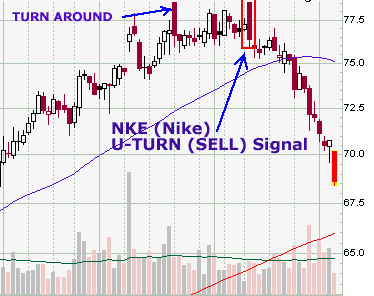
"Chart courtesy of StockCharts.com"
Look
at the chart of Nike, inc. (NKE) for the U-TURN (SELL) signal. As soon
as we had our signal, NKE showed end of its up-trend and entered into
a nice downtrend. There wasn't any bad news about the company which prompted
the down-trend but it was probably action of some influential investors
who might have seen this high price of 77$ as an opportunity to book profit
or maybe they were smart hedge funds or short sellers who had started
selling NKE!!! It does not matter for us who were behind this sell-off
but our U-TURN (SELL) signal did tell us about this beginning of the fall
in prices on the day when the stock hit its High price! We have not yet
learned about TURN AROUND (SELL) signal but you will find an instance
of that signal few days prior to U-TURN (SELL) signal on the chart. If
you notice, the TURN AROUND (SELL) signal was also effective and its stop-loss
was never triggered. Thus, after TURN AROUND (SELL) signal, when we had
U-TURN (SELL) too after few days at the same Top prices, there was money
for us in short selling NKE during April 2004!
|
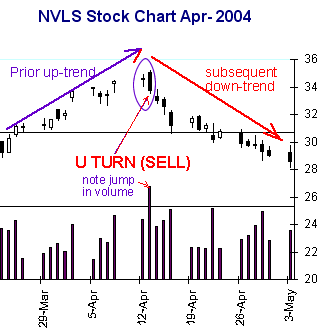
Here is one
more example of a U-TURN (SELL) signal. As shown on the Chart on
the right, NVLS stock was in a strong up trend. When it was around
the High of 35$, company came out with stellar earnings. The stock
was traded higher in after-markets. It also opened strong on the
next day but closed significantly lower with a significant increase
in volume. This was our U-TURN (SELL) signal. See on the chart,
how the stock changed its course and touched a Low price of 28$
within 2/3 weeks!
|
 |
Let
us know discuss our second major trend reversal signal- WEEKLY
REVERSAL.
If you want to look
at a sample Short-term trading signal, you can click on the
Short-term signals button on the top or click
here.
|

 U-TURN
TURN-AROUND
U-TURN
TURN-AROUND  Download Profit From
Prices eBook to your computer
Download Profit From
Prices eBook to your computer




