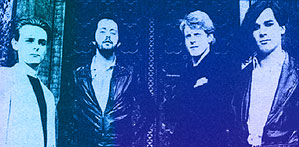
1977
Martyn Ware and Ian Craig Marsh were two computer operators
in Sheffield who both shared an intense passion for German
electronic pioneers Kraftwerk. Armed with a few months' savings,
Ware was able to buy a modest monophonic synth (a Korg 770S)
that had just become available on the commercial market at
an affordable price. Despite having never played a single
note, Marsh and Craig set themselves the task of understanding
the art of sound synthesis and it wasn't long before their
combined enthusiasm began to exceed the limits of the cheap
synth.
 The
Dead Daughters were formed for a gig at a friends 21st birthday
party in 1977 and the Korg was put to the test by Ware with
a rendition of the groundbreaking theme from the long running
BBC sci-fi series Dr Who. The
Dead Daughters were formed for a gig at a friends 21st birthday
party in 1977 and the Korg was put to the test by Ware with
a rendition of the groundbreaking theme from the long running
BBC sci-fi series Dr Who.
Marsh and Craig together with Adi Newton had all enjoyed
the experience of playing live and they decided to form a
new band called The Future where they would concentrate purely
on electronic music, something that was quite unheard of at
the time in the UK. There had been some experimentation with
synths during the 70's, but it was mostly the domain of prog
rock groups like Sky. Ware was keen to distance himself from
this style of music believing the melodic capabilities of
the synth had not been properly exploited.
1978
The Future set about recording some demos that were all mainly
instrumentals including the hypnotic track Pulse Lovers that
was a hint of things to come. Even at this early stage, the
demo tape sounded quite unlike anything that was being produced
at the time, and the band proudly travelled down to London
in the hope of getting signed but the record companies were
predictably bemused by the lack of guitars. Despite the pioneering
sound of The Future, Newton decided to move on favouring a
more traditional approach to music and formed Clock DNA. Convinced
that they were on the right path musically, both Ware and
Marsh felt they needed a vocalist rather than another musician
to replace Newton.
Martyn decided that old school friend Philip Oakey would
be ideal to front the band because they felt that Oakey already
looked 'like a pop star' with his long fringe haircut and
left of centre fashion sense. The invitation came in the form
of a note stuck on Philip's front door who was surprised and
delighted by the offer. Oakey was working as a hospital porter
at the time and had never considered performing in front of
an audience but he had admired The Future from a distance
and was impressed that they had visited record companies in
London. Initially, Ware and Marsh were unsure as to how Oakey
would fit in.
They couldn't afford another synth at the time and the only
instrument the new band member owned was a saxophone that
he couldn't play. Things would soon click into place however
when Phil heard a new instrumental that would later become
Being Boiled and it inspired him to write lyrics for the track
though he was very nervous at presenting them the next day.
After hearing Phil sing to Being Boiled, Ian & Martyn
were both amazed by the lyrics and Oakey's distinctive vocal
delivery.
With a new musical blueprint in place, the trio set about
finding a new band name briefly considering ABCD (bizarre
as fellow Sheffield musician Martin Fry would find worldwide
success with ABC just 3 years later). Finally, they decided
to take a memorable quote 'The Human League' from a sci-fi
board game called Star Force and set about recording three
new tracks on a two-track tape recorder they had just purchased.
The very first Human League demo contained Being Boiled, Circus
of Death & Toyota City all recorded in mono and it soon
caught the attention of Bob Last who ran a small record label
in Scotland called Fast Records.
Being Boiled was released in June 1978 after the League and
Bob Last had agreed a deal over the phone. Although the single
had a limited amount of copies pressed, the song succeeded
in attracting the admiration of NME whilst guest reviewer
Johnny Rotten described the group as 'trendy hippies'! Being
Boiled was completely at odds with the prevailing punk movement
of the time. The track was a stark slab of electro that would
influence many artists in years to come, memorable also for
its lyrics that linked the slaughter of silk worms with Buddhism.
Encouraged by the critical praise that followed the release
of the debut single, the group were convinced to play live
and the first gig took place on June 12th 1978 at Bar 2 in
Sheffield's Psalter Lane art college with the help of backing
tapes. Although common practice nowadays, the use of backing
tapes proved to be controversial at this time but they were
essential considering the complexity of the bass lines and
the hours spent creating the sounds on temperamental equipment
in the studio.
With all three band members being somewhat reluctant to play
live, there were worries that they had appeared static on
stage and Adrian Wright who was in the audience for that concert
agreed to become the League's Director of Visuals. Sharing
the group's love of sci-fi and pop culture, Adrian eventually
introduced four large screens where he would project slides
from cult TV shows such as Dr Who & Captain Scarlet as
well as famous images from recent history that seemed to fit
perfectly with the League's lyrics.
Adrian's visual talents were called into action almost immediately
as the group played their first London gig in Music Machine
on August 17th 1978 supporting The Rezillos (who included
future League collaborator Jo Callis). The venue had something
of a rough reputation and fearing a hostile crowd who would
scorn at the use of backing tapes & synths, the League
considered appearing on stage wearing motorbike helmets. Music
critics responded favourable, as did members of Siouxsie and
The Banshees who then invited the League to support them on
a small UK tour during December.
The band were happy to accept the Banshees offer but fearing
an aggressive reaction from punk fans, the group set about
protecting their synths from expected showers of beer bottles
by constructing fiberglass shields. Some critics mistook the
shields as a statement in modern art but previous fears about
crowd trouble proved unfounded as the League set was a resounding
success.
Some of the instrumentals were replaced with crowd pleasers
like the cover of glam rock track Rock 'n' Roll and word of
mouth was quickly spreading. After watching the League perform,
David Bowie commented that he had just seen the 'future of
pop music, whilst The Undertones featured an affectionate
dig at the 'arty' League in their memorable top ten hit My
Perfect Cousin.
1979
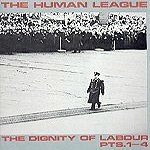 Fast
records released the second Human League single in April in
the form of a 4 track EP of instrumentals collectively called
The Dignity of Labour. Extremely experimental in places yet
ground breaking, the single unsurprisingly failed to dent
the top 75. Despite the poor chart performance, the League
began to get approached by major record companies including
Polydor but it was the promise of creative freedom from Virgin's
Simon Draper that finally tempted the League away from Fast
Records. Pleased with the support that Fast Records supremo
Bob Last had provided, the band offered him the job of Manager
and signed a recording contract with Richard Branson's innovating
label Virgin whose artists included The Sex Pistols. Fast
records released the second Human League single in April in
the form of a 4 track EP of instrumentals collectively called
The Dignity of Labour. Extremely experimental in places yet
ground breaking, the single unsurprisingly failed to dent
the top 75. Despite the poor chart performance, the League
began to get approached by major record companies including
Polydor but it was the promise of creative freedom from Virgin's
Simon Draper that finally tempted the League away from Fast
Records. Pleased with the support that Fast Records supremo
Bob Last had provided, the band offered him the job of Manager
and signed a recording contract with Richard Branson's innovating
label Virgin whose artists included The Sex Pistols.
Shortly after supporting an artist they admired a great deal
namely Iggy Pop for a European tour, the band set about recording
their debut single for Virgin. The track I Don't Depend on
You ended up being an uneasy compromise between the League
and Virgin when bosses began to worry that the record buying
public would not accept a song void of guitars. Despite initial
assurances promising artist freedom, the League were forced
to add conventional instruments to the track that included
bass guitars and drums but demanded that the track be issued
under the pseudonym of The Men. It was an artistic confrontation
that confirmed how radical the League's music had become,
the thought that record companies bosses panicked at a pure
electronic sound would surely bemuse today's younger generation
of record buyers.
After seeking assurances that similar conflicts would not
arise further down the line, The League began recording their
eagerly anticipated debut album at the Workshop in Sheffield
and was completed within 3 weeks during July before being
handed over to Colin Thurston for mixing and overdubs in London.
Reproduction with its unique electronic sound was finally
released in October followed shortly afterwards by a taster
single in the form of the quirky and irresistible Empire State
Human. Experimental yet highly engaging, the album received
lukewarm reviews and failed to make any impact on the album
charts (though it did finally chart a few years later in 1982).
Disappointed by the lack of sales, Virgin reacted swiftly
by cancelling the League's proposed UK tour in November asking
the band to support the Talking Heads instead. Reluctantly,
the group agreed releasing a press statement that revealed
their plans for the upcoming performance. With tongue firmly
in cheek, the League suggested that they wouldn't actually
be on stage for the performances and that their place would
be taken by backing tapes and a slide show hinting that they
would occasionally view the show as members of the audience.
David Byrne and co failed to see the funny side and the League
were dropped from the support slot.
|