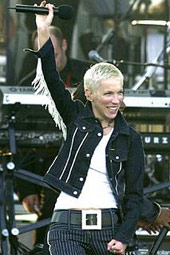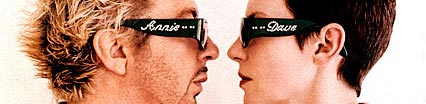
Eurythmics were one of the most successful duos to emerge
in the early '80s. Where most of their British synth pop contemporaries
disappeared from the charts as soon as new wave faded away
in 1984, Eurythmics continued to have hits until the end of
the decade, making vocalist Annie Lennox a star in her own
right, as well as establishing instrumentalist Dave Stewart
as a successful, savvy producer and songwriter.
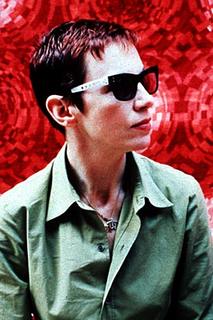 Originally,
the duo channelled the eerily detached sound of electronic
synthesizer music into pop songs driven by robotic beats.
By the mid-'80s, singles like "Sweet Dreams (Are Made
of This)" and "Here Comes the Rain Again" had
made the group into international stars, and the group had
begun to experiment with their sound, delving into soul and
R&B. As the decade wore on, the duo's popularity eroded
somewhat -- by the late '80s, they were having trouble cracking
the Top 40 in America, although they stayed successful in
the U.K. During the early '90s, Eurythmics took an extended
hiatus, as both Lennox and Stewart pursued solo careers. Originally,
the duo channelled the eerily detached sound of electronic
synthesizer music into pop songs driven by robotic beats.
By the mid-'80s, singles like "Sweet Dreams (Are Made
of This)" and "Here Comes the Rain Again" had
made the group into international stars, and the group had
begun to experiment with their sound, delving into soul and
R&B. As the decade wore on, the duo's popularity eroded
somewhat -- by the late '80s, they were having trouble cracking
the Top 40 in America, although they stayed successful in
the U.K. During the early '90s, Eurythmics took an extended
hiatus, as both Lennox and Stewart pursued solo careers.
The origins of Eurythmics lay in the Tourists, a British
post-punk band of the late '70s formed by Lennox and Stewart.
The pair met in London while she was studying at the Royal
Academy of Music. Stewart had recently broken up his folk-rock
group Longdancer and was writing songs with guitarist Pete
Coombes. Immediately after meeting, Stewart and Lennox became
lovers and musical partners, forming a group called Catch
with Coombes, which quickly evolved into the Tourists in 1979.
Though the band only was together for two years, the Tourists
released three albums -- The Tourists, Reality Effect, and
Luminous Basement -- which all were moderate hits in England;
two of their singles, "I Only Want to Be With You"
and "So Good to Be Back Home Again," became Top
Ten hits.
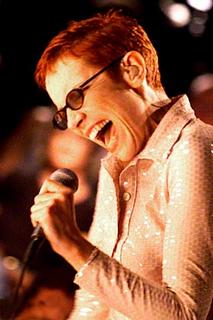 During
1980, Lennox and Stewart's romantic relationship dissolved
and, along with it, so did the Tourists. Though they were
no longer lovers, Lennox and Stewart decided to continue performing
together under the name Eurythmics and headed to Germany to
record their debut album. Featuring support from various members
of Can and Blondie drummer Clem Burke, among others, the duo's
debut, In the Garden, was released in 1981 to positive reviews,
but weak sales. Following the failure of In the Garden, Stewart
set up a home studio and Eurythmics recorded a second album,
Sweet Dreams (Are Made of This), which was released in 1983. During
1980, Lennox and Stewart's romantic relationship dissolved
and, along with it, so did the Tourists. Though they were
no longer lovers, Lennox and Stewart decided to continue performing
together under the name Eurythmics and headed to Germany to
record their debut album. Featuring support from various members
of Can and Blondie drummer Clem Burke, among others, the duo's
debut, In the Garden, was released in 1981 to positive reviews,
but weak sales. Following the failure of In the Garden, Stewart
set up a home studio and Eurythmics recorded a second album,
Sweet Dreams (Are Made of This), which was released in 1983.
"Love Is a Stranger" was the first British single
pulled from the album, and it became a minor hit in the fall
of 1982, a few months before the LP appeared. The title track
was released as a single in the spring, and it rocketed to
number two on the U.K. charts; shortly afterward, it climbed
to number one on the American charts. "Sweet Dreams (Are
Made of This)" was helped enormously by its stylish,
androgynous video, which received heavy airplay from MTV,
who had only recently become a major influence within the
music industry. After "Sweet Dreams," Eurythmics
re-released "Love Is a Stranger" and it reached
the U.K. Top Ten (number 23 U.S.), beginning a string of hit
singles that ran for a year. Touch, the duo's third album,
was released toward the end of 1983 and continued their success
throughout 1984, spawning the hits "Who's That Girl?"
(number three, U.K.; number 21, U.S.), "Right by Your
Side" (number ten, U.K.; number 29, U.S.), and "Here
Comes the Rain Again" (number eight, U.K.; number four
U.S.). During the course of 1984, Annie Lennox's theatrical
gender-bending was becoming increasingly notorious, which
helped their record sales. At the end of the year, they released
the soundtrack for the film adaptation of 1984, which received
poor reviews and sales, despite the Top Ten U.K. placing of
its single, "Sexcrime (Nineteen Eighty-Four)."
Released in the spring of 1985, Eurythmics' fourth album,
Be Yourself Tonight, boasted a tougher, R&B-influenced
sound and featured a duet with Aretha Franklin, "Sisters
Are Doin' It for Themselves." The duet became one of
three hit singles from the album, in addition to "Would
I Lie to You?" (number 17, U.K.; number five, U.S.) and
"There Must Be an Angel (Playing With My Heart)"
(number one, U.K.; number 22, U.S.). Revenge, released the
following year, followed the R&B and soul inclinations
of Be Yourself Tonight to a harder-rocking conclusion. Though
the album peaked at number 12 in the U.S. and spawned the
number 14 hit "Missionary Man," its sales were noticeably
weaker than its predecessor. In the U.K., the group was slightly
more popular -- "Thorn in My Side" reached the Top
Ten -- but it was evident that the group was past the point
of its peak popularity.
As appropriate for a group passing their commercial pinnacle,
Eurythmics began branching out into other areas. During 1985
and 1986, Dave Stewart produced a number of superstars, including
Bob Dylan, Daryl Hall, Tom Petty, and Mick Jagger. Annie Lennox
began a short-lived acting career, appearing in Revolution.
Eurythmics reconvened in 1987 to release Savage, which was
greeted with mixed reviews and weak sales. That same year,
Stewart married Siobhan Fahey, a former member of Bananarama
who had also appeared in the "Love Is a Stranger"
video; she would later be a member of Shakespear's Sister,
which was produced by Stewart. In 1988, Lennox had a hit duet
with Al Green with "Put a Little Love in Your Heart,"
taken from the Scrooged soundtrack. The following year, Eurythmics
released We Too Are One, which sold well in Britain, reaching
number one, but poorly in America, despite "Don't Ask
Me Why" becoming their first Top 40 hit since "Missonary
Man." Furthermore, the reviews were decidedly mixed on
the album.
Eurythmics quietly went on hiatus as of 1990, releasing Greatest
Hits the following year. Lennox began a solo career in 1992,
releasing Diva, an album that would eventually sell over two
million copies. Stewart continued producing records and writing
film soundtracks, as well as forming a band called Spiritual
Cowboys. In 1995, he officially launched a solo career with
the release of Greetings From the Gutter. Lennox and Stewart
re-formed Eurythmics in 1999, releasing Peace, their first
new studio album in a decade.
by Stephen Thomas Erlewine, All Music Guide
|