












|
|
|
|
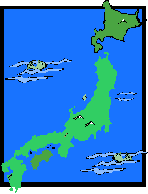
The leading industrial state of Eastern Asia and of the non-Western world, Japan rivals the most advanced economic powers of the West. It rose rapidly from a crushing military defeat in World War II to achieve the fastest growing economy of any major country in the postwar period. Today only the United States out produces it, although the industrialization of China poses a strong challenge. The Japanese people enjoy an unprecedented supply of goods. their swelling cities, paced by the giant metropolis of Tokyo, are as modern as urban centers anywhere in the world. Japanese people face the problems that most inhabitants of great cities everywhere face - overcrowded housing, inadequate waste-disposal facilities, air and water pollution, and traffic congestion. In few other places in the world do the values and traditions of the past continue to flourish so strongly alongside the ideas and practices of the present. The persisting contrast between the new and the old, the modern and the traditional, is one of the most characteristic features of present-day Japan. Japan comprises an island chain along mainland Asia's east coast. the four main islands - Hokkaido, Honshu, Shikoku, and Kyushu - stretch some 1,200 miles (1,900 kilometers) from northeast to southwest. Including the more than 3,900 smaller islands, Japan is about 1,800 miles (2,900 kilometers) long. It's maximum width is about 200 miles (320 kilometers). Japan's numerous volcanoes and frequent earthquakes are evidence of the instability of the rocks underlying the country. It has about 200 volcanoes and volcanic groups, of which about 60 have been active in recorded history. some of the volcanoes are cone-shaped and rise to the highest elevations in Japan, while others are calderas, or craters where cones once stood. To learn more about Japan click this LINK to go to a Japanese resource page. This page is best viewed with Netscape.
|