A Geographer's Look

World Population

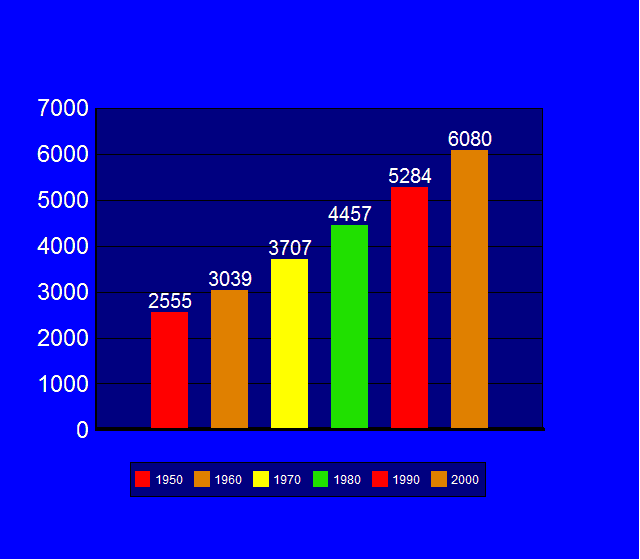
There is about 6.2 billion people living on earth right now. They inhabit about 30% of the earth's land. The population is growing rapidly and itis expected to reach about 7.8 billion by the year 2025. The population did now always grow this fast.

The reason global population is growing so fast is that birthrates have not declined as fast as death rates. A death rate is the number of deaths per year for every 1,000 people. The birthdate is the number of births per year for every 1,000 people. The natural increase is the growth or rate, of a population as the difference between an area's birthdate and its death rate. The doubling time is the number of years it takes a population to double in size.

The population distribution is the pattern of human settlement. Population distribution is related to the earth's geography. Only about 30% of the earth's surfave is made up of land and much of that land is inhospitable. high mountain peaks, barren deserts, and frozen tundra make human activity very difficult.

The population density is the average number of people living on a sqare mile or sqare kilometer of land. To find out the population density in a country, geographers divide the total population of the country by its total land area.

Migration is the movement of people from place to place. The earth's human population is moving in great numbers. Some people are moving from one city to another, or from one suburb to another suburb. Lare numbers of people are migrating from other villages or cities.

Global Cultures

Geographers also study culture. Culture is the way of life of a group of people who share similar beliefs and customs. A culture is separated from others by looking at different elements such as what languages people speak, what religions they follow, and what smaller groups form as parts of their society. This study also includes examining people's daily lives.

Language families are large groups of languages having similar roots. Seemingly diverse languages can belong to the same family. For example, english, spanish, russian, and hindi are all members of the indo-european language family.

An ethnic group is made of of people who share a common language, history, plave of origin, or a combination of these elements.

A society's goverment reflects the uniqueness of its culture. Despite differences governments of the world share certain features. Each government maintains order within the country, provides protection from outside dangers, and supplies other services to its people.

A culture region includes many different countries that have certain traits in common. They can share similar economic systems forms of government, and social groups. Their histories religions, and art forms may also share similar influences.

Cultural diffusion is the process of spreading new knowledge and skills from one culture to another.




[back to top]

Hosted by www.Geocities.ws

1