Barn | Cemetery | House | Home
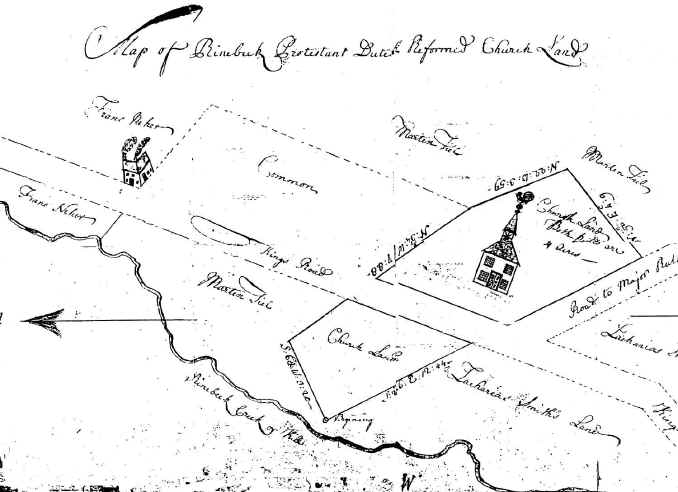
The Intersection of King's Road (Route 9) and the Road to Major Rutsen's (Wey Rd.) was the center of the original settlement of Rhinebeck. A commons, north of the church adjoins the property of Frans Neher, shown approximately 1750. Frans paid quit rent to Robert G. Livingston, a Beekman descendant until 1762 when Ludwig Elseffer acquired the property.
SITE BACKGROUNDThe property on which the house is located has a significant history. It was part of thousands of acres which Henry Beekman, Sr. obtained from the Indians. A patent was granted to him by the crown in 1703. Henry wished to settle his lands and invited German Palatines from the large group which had settled in East Camp (now Germantown, Columbia County, NY) in 1710. Some located on Henry’s land by 1712, as shown in his early rent book. His property was surveyed and lots laid out by John Beatty. Records show a log church was constructed about 1716. The present cemetery near the corner of Wey Road and Route 9 is located to the rear of the church site. This church was used by both the German Reformed and the German Lutheran congregations which were formed by the early settlers when they took up residence here. Their community became known as Rhynbeck or Rhinebeck and was centered around the church. The site of the Losee house, so near this original church puts it near the center of this settlement.
Henry Beekman died in 1716 so it became necessary for his son Henry to make formal arrangements with the Palatines who settled here. Deeds were issued in 1718. Several of the originals survive. They were actually indentures or leases which required the settlers to pay an annual rent of bushels of wheat, fowl and days riding (work for the landlord).
By 1738, Henry Beekman’s land was divided between Henry Jr. and his two sisters, Cornelia Livingston (Mrs. Gilbert) and Catharine Rutsen (who married second Albert Pawling). The land on which the church was located as well as the property for the Losee house fell to Cornelia and her husband Gilbert. Cornelia died in 1742 and her husband Gilbert died in 1746 at which time his eldest son, Robert G. Livingston inherited the land. He began a rent book in that year. This book is now in the manuscript collection at the New York Historical Society. It shows that Frans Neher (Near) lived on this land. He was listed as a shoemaker in Dutchess County Deeds Book 2. Records of a Rhinebeck miller, Henry Denker show that between 1752 and 1755 he made brass shoe buckles for the miller’s slave and also mended brass kettles. Records show that his lot was only 7 acres indicating that he earned his living as a tradesman, not as a farmer.
In 1762 Ludwig Elseffer (Ludowick Elsifer) took over the property from Frans Neher. He also took surrounding land to make a parcel of 48 � acres in total. Since he was married in 1758 to Susanna Reichert, a descendant of one of the early Palatine settlers, we may assume that at this time he made certain improvements to the dwelling which had been located there. It is believed that the house in which he lived was the section of the current house which is on the south.
Ludwig had been orphaned at approximately age foru while on the trip here from Europe. A half brother, Hendrick Shop, was his guardian until he became of age. They resided in Philadelphia. Ludwig learned the trade of saddle and harness maker in Philadelphia but came to Rhinebeck as a young man, presumably because the family had some friends or relatives living here. Since this was a tradesman's property where Frans Neher was a cordwainer (shoemaker), it seems likely that Ludwig Elseffer took over the property and plied his trade as harness maker.
A memorial window in the Old Stone Church and his 1809 gravestone on the hillside near the church (Ludwig Elseffer died Jan 15, 1809 at 74 yr, 6 mo.& 10 da.)attest to Ludwig Elseffer's importance in the community. His descendants kept the house continuously in the family until the recent death of Catherine Losee who was his great-great-great granddaughter through marriages with the Cotting and Losee families.
The house is significant because of its site, the family which occupied it for 242 years and the unaltered character of this colonial structure. An additional bonus on the site is an early barn located behind the house. This early barn, pictured on p. 15 of A Brief History of Rhinebeck., by Nancy V. Kelly, has hand hewn oak rafters 18-22 inches thick. One of the barn beams, carved with date 1770, contains initials M.D. Probably these initials are those of Martin Tiel or Diel whose name appears on the c.1750 map as owner of the property in back of the Neher parcel. On another beam is the name N. Tipple.