ORIGIN
ORIGIN
Poseidon, the patron deity of the equestrian competitions, is said to have sired the famous horse Areion with which Herakles defeated Kyknos, the son of Ares, in a horse race at Troizen. According to tradition, the earliest chariot race was between Pelops and Oinomaos, the king of Pisa. In addition, Homer includes the chariot race among the games organized by Achilles in honor of Patroclus.
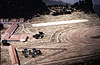 The equestrian events took place in the Hippodrome, a
wide level, open space with two pillars at the ends, one marking the start and
the finish, and the other marking the turning post. The course itself was
divided along its axis by a partition of stone or wood, called the embolon,
in which the horses and chariots ran. A distance of 4 stades (769 m) was covered
on each circuit.
The equestrian events took place in the Hippodrome, a
wide level, open space with two pillars at the ends, one marking the start and
the finish, and the other marking the turning post. The course itself was
divided along its axis by a partition of stone or wood, called the embolon,
in which the horses and chariots ran. A distance of 4 stades (769 m) was covered
on each circuit.
HORSE RACES
The horse races which were held at Olympia include:
the keles,
a race for fully grown horses with a rider (
the
kalpe (trot), or race for mares (
a
race for foals (
Chariot Races
Chariot racing has its origins from the warlike manner of the Achaeans.
A list of chariot races in chronological order:
the tethrippon,
(four-horse chariot,
the apene, a chariot
pulled by two mules (
the synoris, a
chariot pulled by a pair of horses (
the
tethrippon for foals (
and the synoris
for foals (
What was the chariot?
The chariot was a small wooden vehicle, wide enough to hold two standing men and open at the back. It rested on an axle, the ends of which were fastened with two strong wooden wheels. The strongest, fastest animal was placed on the right-hand side to make it easier to go around the turns. The horses were branded with a hot iron on the hoofs or thighs, either with the archaic letter kappa, which labeled them as koppaties, or with the letter sigma, which labeled them as samphores. Horses were also given other names, such as Boukephalas (ox-head), the name of Alexander the Great's war-horse.
Though a true war chariot carried two men, the charioteer and the warrior, both the four-horse and the two-horse chariots used in the races, only carried the charioteer.
During the race, the charioteer was concerned with using the inside of the hippodrome so as to cover the shortest distance. All charioteers strove to do this, which caused many accidents and collisions at the turning-post. This was also the point that revealed the skill and technique of the good charioteer, as well as the strength and speed of the horses.
The distance covered is not known, and it is thought that the distance varied according to the size of the race-course. The perimeter of the race-course at Olympia was 8 stades (1,538 m) and one stade and four plethra broad (320 m). The tethrippon for horses completed twelve circuits of the race-course (deduced from Pindar, who calls the race dodekadromos, or of twelve courses). The synoris for horses and the tethrippon for foals ran eight circuits, and the synoris for foals ran three circuits.
Rules of the Game
swerving in front of others was not allowed unless you were ahead, in order to prevent collisions
characteristics of a Good Charioteer
A good charioteer must be able to