 ... ...
..   .. ..
.   . .
.   . .
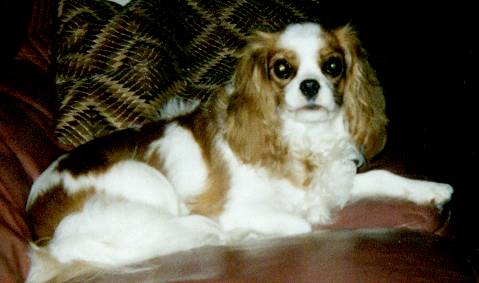
Blenheim
"Cavalier King Charles Spaniel"
More
About The Cavalier
TEMPERAMENT
Cavaliers are
very adaptable dogs, they can be equally at home
in a small unit as they can be in a large home
and grounds. They do need exercise and fresh air,
naturally, but their main aim in life is to be a
companion and to love and be loved by their human
family. They need to be an indoor dog and if
solely confined to the backyard will probably
become noisy and destructive, which is not good
for dog or owner. If you do not want a dog
indoors, the Cavalier is not for you. Both males
and females make excellent pets, both will be
clean in the house, if they have been properly
house trained. The males are sometimes a better
choice for families with children, as they
usually seem to be just that bit more playful and
forgiving of the little bumps and accidents that
can happen with children and dogs playing
together. Cavaliers usually get on well with
other household pets, providing the introduction
and adaptation period is handled tactfully. If
there will regularly be no one at home for
significant periods of time, think about having
two as company for each other whilst you are away.
....
. . .
..
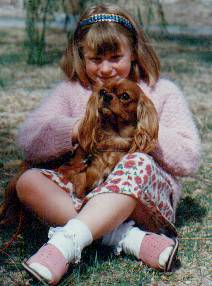
Ruby "Cavalier
King Charles Spaniel"
HEALTH ISSUES
There is no
getting away from the fact that Cavaliers are now
succumbing to heart (MVD) problems with greater
regularity now days......possibly because of more
indiscriminate and "mass" breeding by
people not interested in the welfare of the breed.
Reputable breeders are aware of these problems
and are doing their best to overcome them. There
is a lot of information on MVD available, so we
will not go into it at greater depth here.
Cavaliers can also be affected by eye, hip and
patella problems. This segment isn't to scare you
off the breed, it is just to inform you of the
problems you can encounter. Most Cavaliers are
sound, healthy little dogs, but do be selective
about where you purchase one from. Ask a lot of
questions and the better informed and caring you
think the breeder is, the more likely you are to
get a healthy, trouble free puppy.
....
. . .
..
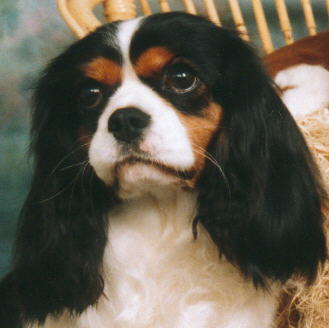
Tricolour
"Cavalier King Charles Spaniel"
"CAVALIERS"
AND "CHARLIES"
There is another
breed of dog called the "King Charles
Spaniel". Apart from sharing the same
colours and being similar in size, they are very
dissimilar in looks and temperament. The "Charlie"
is a pug nosed dog with a very domed head and are
usually more aloof and highly strung than the
"Cavalier".
....
. . .
..
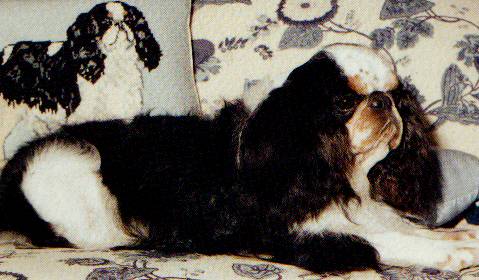
Tricolour
"King Charles Spaniel"
REGISTRATIONS
Registration
certificates are issued by the dog controlling
body of the state in which the puppy was bred.
Only the breeder can register the puppies. There
are two categories.
MAIN REGISTER
which means the dog can do all dog related
activities, including conformation showing and
can be used to produce registered puppies. They
can also be granted an export pedigree.
LIMITED REGISTER
means the dog cannot compete in conformation
showing or be used to produce registered puppies.
They also cannot be granted an export pedigree.
This registration is suitable for competing in
all forms of dog obedience, trailing, agility etc.
COLOURS
Cavaliers come
in four different colours
BLACK & TAN
RUBY
TRICOLOUR
BLENHEIM
these colours are described fully in the "standard"
below.
....
. . .
..
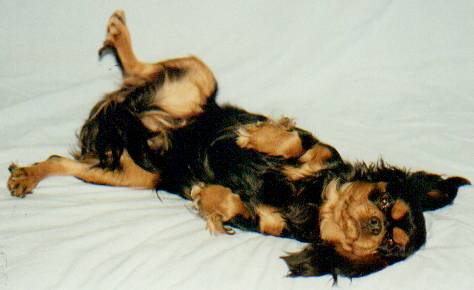
Black and
Tan "Cavalier King Charles Spaniel"
THE STANDARD
Kennel
Club, London 1994 F.C.I. Standard No 136
Toy Group A.N.K.C.
© January 1998
GENERAL
APPEARANCE - Active, graceful and well
balanced, with gentle expression.
CHARACTERISTICS
- Sporting, affectionate, absolutely fearless.
TEMPERAMENT
- Gay, friendly, non-aggressive; no tendency to
nervousness.
HEAD AND
SKULL - Skull almost flat between ears.
Stop shallow. Length from base of stop to
tip of nose about 3.8 cms (1½ ins). Nostrils
black and well developed without flesh marks,
muzzle well tapered. Lips well developed
but not pendulous. Face well filled below
eyes. Any tendency to snipiness undesirable.
EYES -
Large, dark, round but not prominent; spaced well
apart.
EARS - Long,
set high, with plenty of feather.
MOUTH - Jaws
strong, with a perfect, regular and complete
scissor bite, i.e. the upper teeth closely
overlapping the lower teeth and set square to the
jaws.
NECK -
Moderate length, slightly arched.
FOREQUARTERS
- Chest moderate, shoulders well laid back;
straight legs, moderately boned.
BODY - Short-coupled
with good spring of rib. Level back.
HINDQUARTERS
- Legs with moderate bone; well turned stifle -
no tendency to cow or sickle hocks.
FEET -
Compact, cushioned and well feathered.
TAIL -
Length of tail in balance with body, well set on,
carried happily but never much above the level of
the back. Docking optional. If docked
no more than one-third to be removed.
GAIT/MOVEMENT
- Free moving and elegant in action, plenty of
drive from behind. Fore and hind legs move
parallel when viewed from in front and behind.
COAT - Long,
silky, free from curl. Slight wave
permissible. Plenty of feathering.
Totally free from trimming.
COLOUR -
Recognised colours are:
Black and Tan - Raven black with tan markings
above the eyes, on cheeks, inside ears, on chest
and legs and underside of tail. Tan should
be bright. White marks undesirable.
Ruby - Whole coloured rich red. White
markings undesirable.
Blenheim - Rich chestnut markings well broken up,
on pearly white ground. Markings evenly
divided on head, leaving room between ears for
much valued lozenge mark or spot (a unique
characteristic of the breed).
Tricolour - Black and white well spaced, broken
up, with tan markings over eyes, cheeks, inside
ears, inside legs, and on underside of tail.
Any other colour or combination of colours highly
undesirable.
SIZE -
Weight: 5.4-8 kg (12-18 lbs).
A small well-balanced dog well within these
weights desirable.
FAULTS - Any
departure from the foregoing points should be
considered a fault and the seriousness with which
the fault should be regarded should be in exact
proportion to its degree.
NOTE - Male
animals should have two apparently normal
testicles fully descended into the scrotum.


 . . . . . . . . . . . . . . . .
|