
..   .. ..
.   . .
.   . .
CAVALIER
ACTIVITIES
Sharing an enjoyable activity between yourself
and your companion helps to build a bonding
relationship. Within this relationship are things
such as trust and confidence. Irrespective
of what you train for (Agility, Obedience or just
plain good manners etc.), the best way to
train is by utilising what is called "positive
reinforcement" techniques. This will
establish a lasting relationship of trust, affection
and confidence between you and your Cavalier.
THERAPY
DOGS
Because of their outgoing personality, Cavaliers
are perfect candidates for the Pets as Therapy
program. The program requires a series of
assessment tests, where the prospective PT dogs
are assessed for temperament and suitability for
the program. The dogs are asked to walk through a
shopping centre, cross busy roads, walk up and
down open stairs etc. They must allow themselves
to be patted and handled by various people along
the way. Then there is a supervised visit to a
nursing home, and a visit, with other dogs, to
the boardroom at the guide dog centre.
The VISPAT Program runs under the auspices of the
Guide Dog Association.
Requirements for volunteers:-
1. An outgoing, friendly and reasonably
controlled dog (so long as the handler has the
dog under reasonable control, a high level of
obedience training is not necessary).
2. Persons who can spent an hour or so about
every six weeks (plus travelling time).
Recruitment is done by word of mouth, two or
three times a year. Participants in the VISPAT
program are enrolled as voluntary workers with
the Guide Dogs Association, and are covered by
their insurance. The Guide Dogs Association
assesses each dog before it is included in the
program. This is an insurance requirement, and
ensures that the dogs have a suitable temperament.
Venues include various nursing homes and
hospitals.
FLYBALL
Flyball is a relay race between two competing
teams. Each team has four dogs. One dog from each
team (racing side by side), must go over four
hurdles, trigger a flyball box pedal, catch (retrieve)
a tennis ball and return over all four hurdles to
the start/finish line where the next dog eagerly
awaits.
....
. . .
..
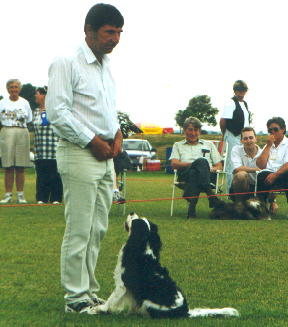
OBEDIENCE
In this day and age it is more important than
ever to consider some form of obedience training
for our Cavaliers. All dogs and their owners will
benefit from the pursuit of obedience training.
Training is available from a number of places,
your local obedience/training club, or by private
lessons. Before selecting a club or private lesson
go along and observe a training session or two.
Many clubs are now changing techniques to more
modern and positive methods. Don't be afraid to
ask questions as to the methods used. A
condition of joining an Obedience Dog Club is
that your dog is currently vaccinated. So
you will need to bring your certificate with you
when you join. Most Obedience Clubs meet on
either Saturday or Sunday, and some meet during
the week. The hour you spend each weekend with
your dog under the careful guidance of Club
Instructors or Private Trainers will enhance the
relationship between yourself and your dog.
Obedience Clubs offer a great way to socialise
not only your dog, but you also get to meet many
others with your same love of dogs. Often the
clubs have social functions which everyone in
your family can enjoy.
Many people who join Obedience Clubs to learn
basic obedience skills with their dog,
progress through the classes and compete in Club
Members Competitions, where they are able to
demonstrate the level of skill achieved with
their canine companion. A further step from here
is to join your States Canine Association
and compete in Open Obedience Trials. These
are held on most weekends throughout the
year all over the Country. This is an opportunity
to meet other owners, and their dogs, as you
compete to achieve passes at various levels,
which will enable you to achieve obedience titles.
Obedience Titles that you can achieve with your
Cavalier are:
* Companion Dog (C.D.)
* Companion Dog Excellent (C.D.X.)
* Utility Dog (U.D.)
* Obedience Champion (O.C.)
....
. . .
..
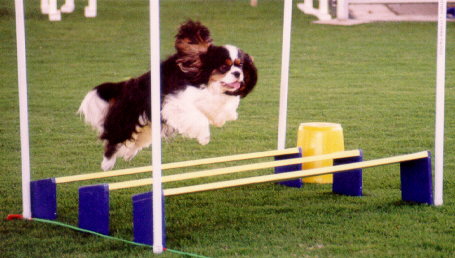
AGILITY
What is Agility?
Show jumping for horses involves a set course of
prescribed jumps, horse and rider,
electronic timing equipment and a Judge and
Steward. A course is built to each
individual Judges specifications, a time is
set for the horse to complete the course by,
and the competitors take numbered turns. After
the first round, the slower horses, and
horses with more than the limit of faults are
relegated to perform another day.
The above exactly describes Agility, with one
minor adjustment. The competitors are dogs
and the handlers run beside the dog, directing it
over, under and through obstacles. The idea
is to have dogs negotiate various colourful
obstacles. This new sport is not for the
faint hearted or the unfit.
Agility in Australia is growing in popularity as
more handlers are turning to this fun,
exciting sport that involves teamwork, precision,
speed and a faultless performance. This is a
very exciting mixture and is not easy to obtain.
The balance between dog and handler must not be
one of fear, as this reflects in the
willingness of the dog to co-operate. It must not
be one of over-excitement, as control
between the partnership, under pressure, can become
unstable. The excitement of watching an excellent
performance, is matched by the excitement of
tabulating scores, and trying to decide who is the
winner before the Judge's announcement.
Agility is a competition open to all dogs and
brings out the competitor in us all. This
desire to be the best, must always be tempered
with a care for the welfare of the dog. A
dog that is over weight should never be
allowed to start basic training. It is
educational and sporting, an activity intended to
improve the dog's integration into society.
The sport requires a good rapport between dog and
handler. Competitors therefore must be familiar
with elementary training. Whilst fast
speed of the dog is to be desired, steadiness of
work is essential to a faultless performance
of the course.
Training for Agility is available through some
Obedience/Training club, from some private
Instructors and there are now some specialised
Agility Training Clubs. Many teams once
bitten by the Agility bug go on to compete at
Open Agility trials for the following Titles:
AUSTRALIAN NATIONAL KENNEL COUNCIL (ANKC) TITLES:
* Agility Dog (A.D.)
* Agility Dog Excellent (A.D.X.)
* Agility Dog Master (A.D.M.)
* Jumping Dog (J.D.)
* Jumping Dog Excellent (J.D.X.)
* Jumping Dog Master (J.D.M.)
AGILITY DOG ASSOCIATION of AUSTRALIA Ltd (ADAA) TITLES:
*Australian Agility Dog (A.A.D.)
*Senior Australian Agility Dog (S.A.A.D.)
*Master Australian Agility Dog (M.A.A.D.)
TRACKING
Cavaliers enjoy participating in Tracking, but
they must be fit and healthy.
Basically most Tracking in Australia is a
simulated lost person scenario where a dog,
utilising it's scenting ability, locates the lost
person some time after they have gone missing.
This is performed in all types of terrain and in
all weather conditions. Some also do Tracking in
assorted Urban areas.
Many dog owners are involved in Tracking with
their dogs as a hobby (for fun) or as a sport (to
earn titles). The purpose of a Tracking test
"is to demonstrate the dog's ability to
recognise and follow human scent, a skill that is
useful in the service of mankind. Tracking, by
nature, is a vigorous, non competitive outdoor
sport. Tracking tests demonstrate the willingness
and enjoyment of the dog in its work, and should
always
represent the best in sportsmanship and
camaraderie by the people involved." Most
dog owners involved in Tracking do so because
it's an enjoyable way to spend time with their
dog and enjoy nature at the same time.
Tracking Titles you can gain with your Cavalier
are:
* Tracking Dog (T.D.)
* Tracking Dog Excellent (T.D.X.)
* Tracking Champion (T.CH.)
....
. . .
..
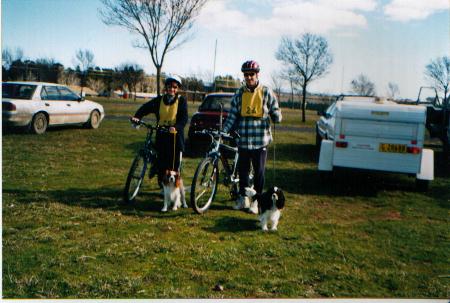
THE
ENDURANCE TEST
In today's modern lifestyle health and fitness
are of major concern. This is an activity which
can promote health and fitness, not only in the
Cavalier, but also the Cavalier's partner. This
activity unleashes the Cavalier's full physical
and aerobic potential. The Endurance Test is a 20km
event. It is broken into 3 sections - 8km, 6km
and 6km, with a short Obedience test before and
after. Veterinary check are conducted before and
after the event, and during each of the breaks.
The average speed for the dogs is 10km per hour.
Endurance Tests are held under the rules of the
Australian National Kennel Council and are
conducted by affiliated Clubs in various States.
Endurance Title you can gain with your Cavalier
are:
* Endurance Test (E.T.)
LURE
COURSING
Lure Coursing gives your dog the opportunity to
do what comes naturally....to chase, sniff the
ground, jump, pivot and chase again.They are able
to run and enjoy themselves in a safe and
controlled environment. There are no dangerous
obstacles which they can run into, and the area
is enclosed. The equipment used is quite simple
and consists of 300 metres of fishing line,
strung around several pulleys set into the ground
to form the course. A plastic bag is tied to the
line and is powered around the pulleys by a
battery-operated motor. The operator can stop the
lure at any time and can change direction as well.
Even if they don't run the whole course it
doesn't matter. It is not competitive and is used
to give your dogs a fun activity and an easy way
for you to exercise them.
CLUB
FUN DAYS
Most of the Cavalier Clubs in Australia run Pet
Fun Days, in addition to their commitments for
show dog owners. These Fun Days are designed
specifically for the owners of pet Cavaliers, and
are a great day out. The people who come along
with their dogs compete in various fun
activities, and enjoy the company of other
Cavalier owners. It is a wonderful opportunity
for current owners, and those looking for a
Cavalier, to ask committee members and other
experienced owners, advice about the breed.
Some events which may be on offer include: "Mini
Show" for pets only (no show dogs); grooming
demonstrations; microchipping; dog and owner look-alike;
fancy dress; best matched pair of Cavaliers;
various games of chance; obedience
demonstrations; photo competitions; Rescue dog
parades; and of course, a sausage sizzle or
similar. There may also be a trading table, and
doggy items for sale. All in all, these are a
great way to meet other people who appreciate the
special qualities of our beautiful breed, and
swap stories of your Cavalier's latest exploits.
Contact the Club Secretary in your State for the
latest information about Club activities.
....
. . .
..
THEATRICAL
Theatrical training increases the probability of
being used in the industry, for it is time, that
is so critical and expensive. The industry will
really only consider dogs that have been trained
to do certain things pertaining to what is needed
in certain situations. As humans go to school for
training in this industry, so do dogs. Similarly
as one trains Obedience exercises, this training
is to do the exercises that would be used in the
industry. This increases the probability of being
selected for a part in a film or commercial etc.
Even if they and their dogs are not selected, all
have a lot of fun doing something different.
Training for this type of work is not an easy
feat. It takes constant work and re-education, at
different locations, to perfect the certainty of
being able to perform under quite gruelling
conditions at times.
CANINE
DANCING
This is a fairly new dog sport in Australia, but
is becoming more popular. Basically, it is a
choreographed musical program performed by
handlers and their dogs. The object of musical
freestyle is to display the dog and handler in a
creative, innovative and original dance, using
music and intricate movements to showcase
teamwork, artistry, costuming, athleticism and
style in interpreting the theme of the music.
Heelwork-to-Music incorporates traditional dog
obedience, and the art of dressage, with the
inclusion of musical interpretation, dance
elements, and costuming with an emphasis on non-standard
obedience movements. Both Musical Freestyle and
Heelwork-To-Music routines should create a
visually exciting display which is enjoyable to
watch, and which is equally enjoyable to the dogs
and handlers executing the programs. Canine
freestyle is a showcase that truly demonstrates
the joys and fun of bonding with your dog.
PETS FOR
SCHOOLS
Some
Cavaliers do "go to school" so to
speak, to teach primary school children how to be
responsible pet owners.
The program is run by the Victorian Canine
Association (V.C.A.) in conjunction with the
State Government's Department of Natural
Resources and Environment. The program was
developed as a response to the Domestic Feral and
Nuisance Animals Act 1994, and this program is
conducted under strict guidelines. One must apply
for an Educator's position and then have your dog
temperament tested. There are a series of tests
to see if your dog copes with the stress that
noisy children at school might dish out.
With the children in a class situation, and you
with your dog, you teach the children things from
"the right pet for your family" to
registrations and safety with dogs etc. Then next
is "how to approach a dog", by teaching
and demonstration followed by all the children
having a "hands on" with your dog.
The V.C.A. supply all the educational materials
appropriate to the different ages of the
children, this so they can easy follow the class
lessons.
Here is an opportunity to teach many of our
future dog owners properly and hopefully reduce
the amount of attacks on children because "they
simply didn't know".


 . . . . . . . . . . . . . . . .
|