
Some explicit photos on
this page.
..   .. ..
.   . .
.   . .
Breeding
healthy, sound puppies with good temperaments,
and seeing them go to loving new homes, is a very
rewarding experience. Responsible, registered
breeders spend many hours poring over pedigrees,
finding breeding lines which have been tested and
cleared of major hereditary diseases (e.g. heart
disease), studying breed books, attending dog
shows, and speaking with other informed breeders,
in order to find a sire which best suits their
bitch. They seek a sire which could potentially
improve her weak points and consolidate her
strengths, in the puppies which their combined
genetic material will produce. Years of acquired
knowledge, the ability to assess a dog or bitch
objectively, and a desire to produce Cavaliers
which are healthy and match the Breed Standard as
closely as possible, will lead a responsible
breeder to their choice.
There are many
books which can provide useful information about
breeding, whelping, and rearing puppies,
including all of the Cavalier "breed"
books, listed on this website. Breeding is a very
complex subject, so we have abbreviated this page
to include the more "human" side of the
issue - some personal experiences from breeders,
and some actual facts and figures which you need
to know if you are thinking of breeding. If you
are considering breeding from your pet Cavalier,
we urge you to read on, and to contact the
breeder of your Cavalier for further advice.
EXPENSES
Many people believe breeding is a means to making
easy money. This is not the case. If a breeder is
raising their puppies in the best possible
conditions, they are putting most, if not all, of
what they receive from their puppy sales back
into their dogs. They should be testing for
hereditary diseases, to ensure the best possible
chance for those puppies to live long, healthy
lives with their new families. They are spending
money to ensure their dogs are healthy and happy,
and that puppies are raised appropriately (kept
at a comfortable temperature, in a safe, clean
and secure environment, fed nutritious food when
weaned, etc). Many breeders put aside up to $1000
for expenses, every time they breed a litter.
Sometimes, they do NOT get this back.
....
. . .
..
Whelping is
hard work.
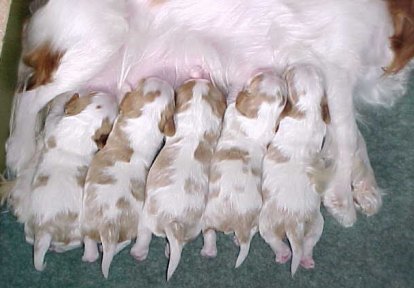
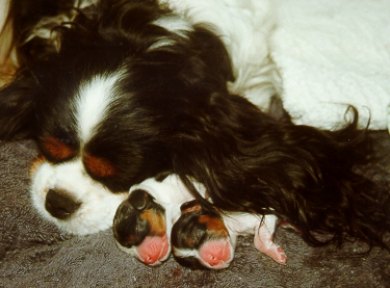
This mum is taking a well-earned break with her
new pups.
Expenses
immediately associated with breeding a litter (in
AUS$) include:
* Stud
fee - usually between $500 and $1,000
* Heated
whelping box - up to $500
* Bedding
suitable for raising puppies - $80
* Caesarean
Section (if necessary) - at least $400
* Post-whelping
check-up - $50
* Preservative
free, healthy food for mother and weaning pups -
up to $200
* Puppy
pen used at weaning time - $120
* Puppy
vaccination - $40 per pup
Added to this of
course, health testing for the parents, which can
total over $500 during their breeding life, and
any other emergency veterinary treatment, such as
outlined in the stories below. It is not our
intention to frighten you, but simply to inform
you about the genuine risks and expenses involved
with breeding. Most reputable, registered
breeders have a network of other breeders to
refer to, if they have concerns about what is
happening with their whelping bitch. They are
prepared for emergencies, and don't expect to
profit from their breeding. The following are
TRUE cases which have happened to experienced and
novice breeders alike:
ORPHANED
PUPPIES
Tarley had a normal pregnancy. She struggled a
little during the whelping, but her breeder, with
over 20 years experience, was confident that
everything was OK. Tarley was very tired the day
after the whelping, so the breeder took her to
the vet for a check-up. Everything appeared to be
normal - maybe she just overdid it a bit, and
another few days of taking it easy, with good
nutrition and warmth, and she should recover. The
following morning, Tarley was found dead next to
her whelping box, leaving behind four little
orphans. An autopsy revealed that Tarley's uterus
had enveloped in on itself, and ruptured. She had
bled to death, internally, and there was no sign
of the problem through examination.
New-born puppies
are totally incapable of looking after themselves
- they are deaf, blind, cannot walk, cannot
control their body temperature or their bowels,
and can only suckle, not eat. Tarley's puppies
were hand-reared - the breeder feeding and "toileting"
the babies every two hours, mimicking as closely
as possible the normal behaviour of a nursing
mother - day and night. It was a constant,
challenging and stressful four weeks, not to
mention the loss of her beloved girl, who had
been so dearly loved.
....
. . .
..
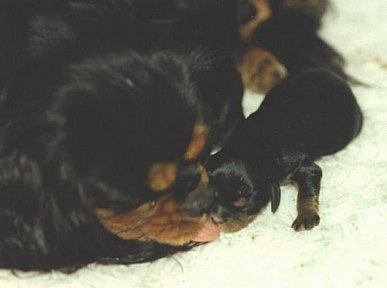
New born
pups are completely helpless.
Here, the mother cleans up the pup soon after
delivery.
ECLAMPSIA
STORY 1
Babygirl was nursing her fourth and final litter.
Her breeder had commenced weaning the babies, and
everything looked in order. Baby's eyes started
to glaze over one morning, and the breeder, with
a few years experience, suspected eclampsia.
Being 30 minutes from the vet, she rang
immediately with her suspicions, and drove down
"just in case". During the 20 minute
drive (always quicker in an emergency!), it
became obvious that Babygirl did have eclampsia -
she was unable to stand, and was very close to
complete collapse. It took a good hour and a half
before the vets were satisfied that their
emergency treatment had brought her back to
normal. The puppies were forcibly weaned
immediately. If the breeder had not known the
signs, which can be obscure, or had hesitated
just another 10 minutes (or not broken the sound
barrier during the drive!), her precious girl
would have died. A statistic of the breeding
process.
ECLAMPSIA
STORY 2
Lilli was all set for her first litter. Her
anxious novice breeder had thought of just about
everything, had read all the books, and sought
lots of advice from more experienced friends. How
hard could this be? It was certainly a nerve-wracking
experience, but the first two babies were born
without too much trouble. The last pup was born
dead and needed resuscitation. Luckily,
experienced friends were on hand to help. When
the pups were 10 days old, Lilli's panting seemed
to be worse than usual (this was a summer litter,
so she panted a lot), and she was flicking her
head. Her breeder took her to the vet, in case a
grass seed had lodged in Lilli's ears. During the
10 minute drive, Lilli collapsed into an
eclamptic coma. Thankfully, she was saved - but
how near was death, for this breeders beloved
girl? Very, very near.
....
. . .
..
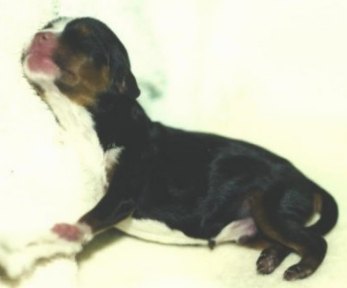
As a puppy
starts to die, it lets out faint cries,
extends it legs forward, and throws it's head
back.
This puppy died soon after the photo was taken.
PREMATURE
WHELPING
Ziggy looked very pregnant, with 10 days to go.
She had a "belly full", and the breeder
was sure that there would be a few girls to
choose from for the show ring. 1 am, and Ziggy
let out that scream that breeders have come to
dread! She had started whelping - 10 days early!
She was so scared of the pain, and this little
puppy hanging behind her, that she sat on him,
and ripped his umbilical cord out. He could not
be saved. After nearly two hours with no progress
on the next pup, her breeder rang the vet (3 am)
to warn of an impending caesarean. The trip to
the vet took 20 minutes, and after examination
and 2 shots of stimulant drugs, the pup still did
not move. Time for surgery. The caesarean was
performed (4 am), and the surviving 5 pups taken
home. They were very small and weak, could not
hold their temperatures, and whined constantly.
In spite of around the clock care, four of them
died, one at a time. Their rattly little lungs
were just too immature to sustain life. As each
of them seemed to "rally", they would
suddenly take a turn for the worst, and would be
gone. This tragedy took several days to unfold.
Ziggy was desexed soon after the birth of these
babies, to prevent the same fate falling on
subsequent litters - her own mother had done the
same thing twice, and it would not be fair to
take this risk again.
....
. . .
..
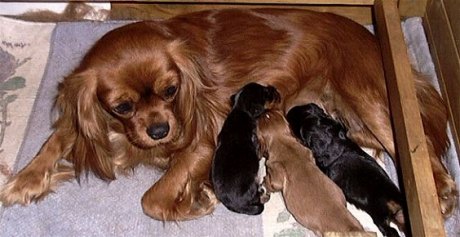
A healthy
mum and gleaming pups are a delight to the
breeder's eye.
THE BLOB
The puppy that caused Ziggy's blockage, and
possibly the early whelping was a big bag of
jelly. Literally. These pups come along every now
and then, but their origin is a little obscure.
They look like huge bags of jelly (they can be
bigger than a human hand), with bloated,
transparent bodies. Usually, they are born dead.
However, to add to the distress of this birth,
the Blob drew several breaths before she died.
TUBE FED
BABIES
Joanna had suffered a ruptured uterus after
whelping her four pups, and died from internal
haemorrhage. Her breeder gave the pups 24-hour
care, keeping them warm, stimulating them to
their "toilets" and attempting to hand
feed them. Unfortunately they would not take the
bottle, and were losing weight quickly. As the
first of the babies faded away, the breeder
commenced tube feeding. Tube feeding puppies
takes a great deal of skill, care and patience,
as it is possible to feed the tube into the lungs
by mistake, and drown the pups. The tube is
inserted at every feeding time, which is
approximately every two hours. After weeks of no
sleep, 3 of the pups were saved.
....
. . .
..
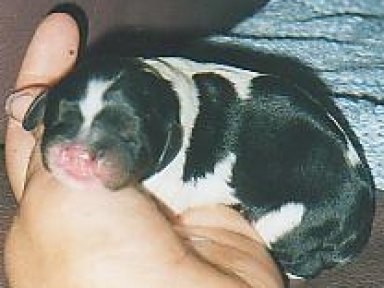
This little
puppy was born with a cleft palate and hair lip.
These deformities happen rarely,
but most of these pups will need to be euthanased
soon after birth.
OTHER
COMPLICATIONS
* Pups
born with deformities - most of these will have
to be put to sleep.
* Pyometra
- the mother develops a uterine infection and
without warning, may die, or at the very least
needs hundreds of dollars worth of intensive
veterinary care. After all that, she still may
need to be desexed, as this infection will flare
up at every season for the rest of her life.
* Bag
bursts during whelping and pup drowns in it's own
birth fluid.
* Open
stomach - pup's belly has no skin covering it,
and the intestines are exposed. These pups cannot
be saved.
* Milk
slow coming in - a nervous time for the breeder.
* No
milk - pups will need to be hand/tube fed, or a
substitute mother found.
* Toxic
milk - pups fade and die, and survivors will need
to be hand/tube fed.
* Fading
puppies - apparently normal puppies start fading
away for no obvious reason, and die regardless of
24-hour care.
* Swimmers
- pups which do not get up on their feet as
normal, and require intensive physiotherapy and
careful attention to their environment. Some
swimmers do not recover, and have to be
euthanased between 4 and 6 weeks.
....
. . .
..
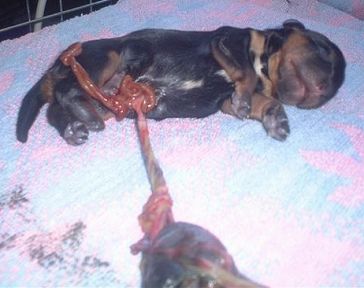
Puppy born
with midline failure -
intestines present externally at birth.
A SPECIAL
PUPPY
Considering all of the above, what does a breeder
do when they have a pup with an apparent problem?
This is the story of Tyson:
....
. . .
..
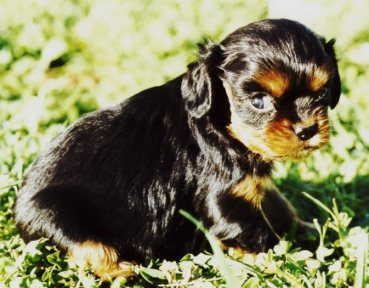
Tyson was a
little Black and Tan baby, who was born normal
size. Everything else appeared normal, except
that he only had a thin membrane covering his
belly, instead of skin. His breeder was given the
option of putting him to sleep, but preferred to
give him a chance at life - aside from the thin
and fragile membrane, he appeared perfectly
normal, and was as strong and full of life as his
littermates. The membrane was given added
strength with several stitches. Over the
following weeks, Tyson's development fell further
and further behind that of his littermates, but
he was so full of vitality and character, that
his breeder persisted with him. She had checked
for other abnormalities such as cleft palate and
open fontanel (which would indicate hydrocephalus),
but there was no obvious reason why he should not
go on to live an otherwise normal life. He seemed
interested in only three things in life - warmth,
food and cuddles. But more and more, he would run
up to stand on his breeders feet after meals,
shaking in agony, and seeming to say "Mummy,
please help me".
When Tyson was
six weeks old, and he really had stalled in his
progress, his breeder thought it time he was
checked again by the vet. That morning, before
heading to the vet, his breeder checked again for
the open fontanel - it was there now. X-rays
confirmed the worst - Tyson's brain was 1/4
normal size, and he was lucky to have survived
this long. The pain he felt after eating was
caused by the hydrocephalus. Tyson was wrapped in
crepe bandage (his "red pyjamas") to
help stabilise the weak abdominal membrane, and
allowed one last warm, sunny weekend to be with
his family. By Monday, his health had
deteriorated significantly, and he was put to
rest.
While the
breeder had the early option to euthanase Tyson,
she chose to give him a chance at life. Sadly, it
is painfully clear that life was not for Tyson.
Puppies like Tyson come along rarely, and as his
breeder can tell you, after putting in all that
love and devotion, it is heart-breaking to have
to say "goodbye".
....
. . .
..
This little
puppy faded away over several days, before dying.
IS
IT WORTH THE RISK?
Many, many litters are born without complication,
but many others have produced problems such as
these. If you love your pet bitch, and are
thinking of breeding from her, you need to ask
yourself if you are prepared to risk her health,
and if you and your family can go through some of
the expenses, experiences and traumas outlined in
these true stories. They do happen - they
happened to these breeders - they could happen to
you. Is it really worth the risk?
There are
alternatives to breeding your own pups. If you
just want another dog to keep your first one
company - how about buying another pup, or maybe
an adult? Would you consider a Rescue dog, or
maybe one from an animal shelter? If you want the
kids to see "nature at work", please
consider all of the above, and ask if there is
perhaps an alternative way to achieve this.
Breeding can be rewarding, but it can also be
very costly.
....
. . .
..
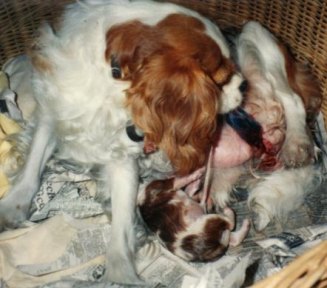
A natural
part of the whelping process -
The dam eats each placenta as it appears.
This helps to stimulate milk production.
She will also chew the umbilical cord, and clean
up the puppy.
Care must be taken at this time,
that the bitch does not chew the cord too close
to the puppy's skin,
or the puppy will bleed to death.


 . . . . . . . . . . . . . . . .
|