
..   .. ..
.   . .
.   . .
Sunny
and Puppies
CAVALIER
RESCUE
RESCUE
SERVICES
Several of the Cavalier King
Charles Spaniel Clubs in Australia run Rescue
services to help rehabilitate and/or rehouse
Cavaliers in need. They also provide an
information service to prospective owners, in the
hope that they will choose wisely, and not have
their Cavalier end up needing their services. It
may shock some people to realise that Cavaliers
need a Rescue Service, but sadly this is the case.
Some Cavaliers are lost, abandoned, abused and
neglected, just like any other breed.
Fortunately, there are organizations whose
dedication to their breed includes extending a
helping hand to Cavaliers in need. Three of the
breed clubs in Australia run Rescue Services, and
the aim of this page is to introduce you to their
services, and some of their "charges".
Generally, the Clubs have two
different areas of assistance that they offer to
Cavaliers and their owners:
Rescue
In cases
where the removal of a Cavalier from it’s
present location is urgent, a Rescue Service
helper will take the dog in, have him/her scanned
for a microchip, assess the dog’s
temperament, seek veterinary attention as
required, and generally care for the dog until a
new, permanent home is found.
Situations
where a Rescue is needed include:
*
Cavaliers coming from organisations such as the
Animal Welfare League, RSPCA, Council Pounds, or
other animal rescue organisations;
*
Cavaliers whose owners are moving overseas, or to
rental accommodation, or who have passed away;
*
Situations where the dog's life/well-being is
threatened.
Veterinary
attention will usually include:
*
A comprehensive "Vet Check" to
determine any current/anticipated health problems.
Where possible, the former owner’s vet is
contacted to determine the dog’s veterinary
history;
*
Ensuring the dog is fully vaccinated – if
this is unknown, we commence a vaccination
program from the beginning;
*
Heartworm testing, and implementation of a
Heartworm Prevention Program;
*
Worming;
*
Restoring the dog to full health if possible, or
commencing a regime of medication for chronic
illnesses;
*
De-sexing any entire Cavaliers over 6 months of
age. Owners of Rescue puppies undertake to have
the dog de-sexed at 6 months of age.
Rehouse
This
is the most often used area of the Rescue
Services, and is undertaken in the same way as a
puppy referral. Adult Cavaliers are rehoused
through telephone contact only. The Services
receive information about adults, and
occasionally older puppies, requiring a new home,
and pass on the owners phone number to potential
new owners. All arrangements between the
relinquishing and new owners are private, but new
owners are encouraged by the Clubs to have the
dog "Vet Checked", ensure it’s
vaccinations are current, and seek as much
information from the previous owner about the dog’s
history as possible.
Situations where a Rehouse is
needed include:
*
Owner unable to keep the dog, but the situation
is not urgent;
*
Ex-show and breeding dogs.
The various Cavalier King
Charles Spaniel Clubs have been very successful
in helping hundreds of Cavaliers to find new
homes. They each have their own guidelines that
have been set out to ensure the best possible
long-term outlook for all parties. Relinquishing
owners are often asked to sign a Relinquishing
Agreement, handing all responsibility for, and
ownership of, the dog to the Club. New owners
agree to return the dog to the Rescue Service
should they find they are also unable to keep him/her.
Cavaliers which have come
through the Rescue Services, and who have been
successfully placed with loving new families,
include puppies, young adults and "elderly
citizens". Many of these dogs were
surrendered to other organisations, or the Clubs,
because the owners found they were no longer able
to care for their dog. An alarming number of
Rescue Dogs were abandoned and/or neglected, and
even elderly bitches in whelp have been given to
Rescue Services.
How You Can Help
Rescuing dogs can be an
expensive and very rewarding experience. Dogs
which have been received from organizations such
as those listed above, will usually have cost the
Rescue Fund anywhere between $100 and $300 –
sometimes more. Veterinary expenses and other
costs are also met by the Rescue Fund, which is
reliant on donations from relinquishing owners (where
possible), new owners and Club fundraising
activities. If you feel you are able to donate to
one of the Rescue Funds, please forward your
donation to the contact address below. Donations
can be monetary, or in the form of flea control
products, Heartworm medication, shampoos etc.
Should you know of a Cavalier which may benefit
from one of the Rescue Services, you would like
to volunteer as a temporary carer or permanent
home, or would just like more information, please
contact any of the following:
SOUTH AUSTRALIA
CKCS Club of SA Rescue Service
CKCSC of SA: [email protected]
VICTORIA
CKCS Club of Victoria Rescue
Service
Ms Lindsay Bolden
Ph: 03 5995 9595
. NEW SOUTH
WALES
CKCS
Club of NSW Rescue Service
Phone: 1300 555 364
Email: [email protected]
Australian Capital Territory
CKCS
Club of Canberra Rescue Service
Rescue Officer: Margaret Franze
Phone: 6295 1245
QUEENSLAND
CKCS
Club of Queensland Rescue Service
.Rescue Co-ordinator
Phone: 1300 737 218
Rescue Stories
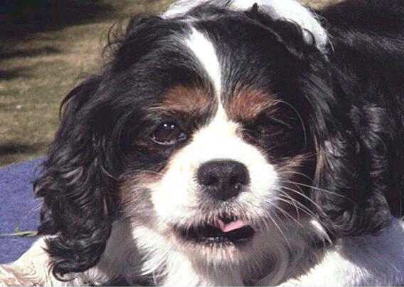
"Billy"
In early March, a local Dog
Sanctuary notified two SA Club members that they
had just collected a Cavalier from a Council
pound. The tri-coloured male had been wandering,
and remained in the Council’s care,
unclaimed, for nearly two weeks. The Dog
Sanctuary very generously donated the dog to the
Rescue Service, and the two members looked after
him while his ailments were righted. The SA Club’s
Rescue Service paid for the following veterinary
treatments for the dog, who was in appalling
condition: general check-up, vaccinations (we
must assume he was not vaccinated), heartworm
testing, de-sexing, syringing of badly infected
ears (which were stuck to the side of his face),
tooth removal, and the removal of a small lump on
his hindquarter.
They had recently had an enquiry
about older/Rescue dogs from a lady who had
previously owned a tri male. She was very keen to
take the dog on, in the knowledge that he would
need continuing treatment for his ears. She named
him "Billy", and he has now lived with
her family for several months. His new owner,
Jenny, describes him as a "delightful"
boy, and he has slotted into her household
beautifully.
It is hard to imagine how his
previous owners could have had this dog in their
home in such a poor state. The lack of condition
in his coat, and especially the filthy state of
his ears, indicate he would have been in a bad
way WELL BEFORE being picked up by the Council.
....
. . .
..
Henry
"Henry"
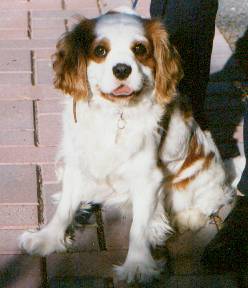
Eleven year old "Henry’s"
owner had passed away, and a neighbour was
looking after him, while the family tried to
decide what to do with him. A friend of theirs
knew of the local Rescue Service, and they were
put in touch with them. After several phone
calls, arrangements were made to collect "Henry".
His check-up revealed a very bad (and untreated)
heart murmur, so it was decided not to desex him.
He is now on medication for his heart and
arthritis, and his health has improved. Henry
went to live with an SA Club committee member and
her family, and aside from his dislike of one of
her dogs, "Henry" settled in well.
After a thorough vet check,
Henry was put onto eye medication, heart
medication and arthritis medication, along with a
special diet to help with his arthritis. He was
also put onto mobility support tablets, which
aided Henry in becoming 'Two-speed' (Slow to fast)
from 'One-speed' (Very slow). He was also de-sexed
when he was well enough.
Despite the warning that Henry
would only live for a further six months-at
maximum- Henry lived to the grand old age of
fourteen and a half. He was a much loved 'rescue'
family member, and his memories will be treasured.
"Milo"
....
. . .
..
Milo
- Will somebody love me?
The Rescue Service received a
phone call about a 5 year old Blenheim dog, from
the Animal Welfare League. The League had already
rehoused and subsequently seized this dog, whom
the staff named "Spotty", and they had
vaccinated and desexed him. A Rescue helper and
vet nurse, took him to work for a check-up, and
he was found to be in excellent health. The
reported ear infection was negligible, and his
heart was very strong. After examination, it is
believed he may be as young as 2 or 3 years. The
helper knew of a lady who may be interested, and
made contact. She decided she was not in
immediate need of a new dog, but knew of someone
who was. She gave "Spotty" to her
neighbours, whose son she knew would appreciate
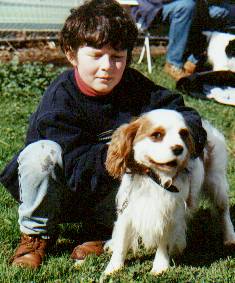
the companionship of a new dog. His new owners
renamed him "Milo". "Milo"
and the young boy developed an immediate bond.
They entered the SA Club’s "Rescue and
Rehoused parade" at the next fun day, and
were equally as proud of each other as they
trotted around the ring.
....
. . .
..
Milo
- Now I have a best friend
"Basil"
and "Moss"
Late last year, the Rescue
Service received 2 phone calls (on the same night!)
asking them to find new homes for desexed
Blenheim males, 9 ½ year old "Moss"
and 7 year old "Basil". All parties
agreed to wait a week, to see if the dogs could
be "rehoused", without having to go
through a temporary home, but the week passed
with no interest in either dog. The Rescue co-ordinator
arranged to meet the owners on "neutral
ground" (this protects the identity of the
relinquishing owner, and the location of the dog
in it’s new/temporary home). The two boys
duly arrived, and both sets of owners signed the
Relinquishing Agreements. "Basil" went
straight in to the co-ordinator’s car, but
sadly, "Moss" was in a very bad state,
and needed a good bath and de-fleaing before he
went anywhere. Both boys were delivered to their
pre-arranged temporary homes, where they were to
await permanent placement. "Basil"
settled in straight away, with a new Cavalier
friend to play with, and was placed within 4
weeks. His "Vet Check" reveals that he
is in very good health, but his carers reported a
loud snore!
"Moss"
has turned out to be a lucky old dog – he
will now, at last, see out his days with dignity!
Aside from the fleas and chronic ear infections
due to ear mites, "Moss’s" coat
was matted, so that his chin was attached to his
shoulder, it was grey with dirt and grime, he had
severe flea bite dermatitis, and had several
weeping wounds where he had scratched himself raw.
He also had an untreated "gross" heart
murmur, which was diagnosed by his previous vet,
but which the owner did not treat. The Rescue
Service’s own "vet check"
confirmed the murmur, and that his ears had
improved with just 2 days of treatment. He has
several medications, for his heart, eyes, and
ears, and is now in very good hands. We can’t
say how much longer "Moss" has, but he
will stay with his "temporary carers"
for his last little while, receiving the
attention he deserves. His expenses will be
ongoing, as he is now on four different
medications to treat his various conditions. He
really is an unassuming little dog, and deserves
the dignity with which he will see out his days.
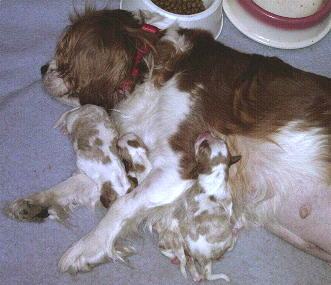
"Sunny"
....
. . .
..
One
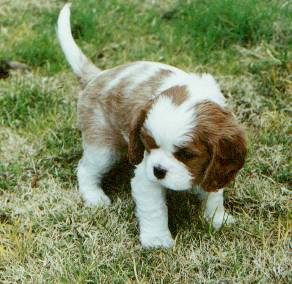
of Sunny's rescue babies
An unregistered breeder rang
with the threat that if the local Rescue Service
didn’t take her 8 year old bitch in, she
would be euthanased. Of course, they took her in,
and during the "Vet Check" a serious
heart murmur was diagnosed. "Sunny" was
entire, and had just finished a season, but her
de-sexing was delayed until the murmur could be
stabilised enough for her to tolerate an
anaesthetic. "Sunny’s" new owner
reported that her lovely new pet was putting on
weight, and it eventually became obvious why -
she had been given to the Rescue Service in whelp!
The new owner was subjected to a 1am caesarean
section, and presented with three puppies to care
for. One of the Rescue Service helpers, took
"Sunny" and her babies in, and nurtured
them until everyone was ready to leave the nest.
It wasn’t easy to place the babies, as their
mother was known to have a severe heart murmur,
which obviously had implications for the puppies.
But eventually loving homes were found for all
three. "Sunny" went back to her new
owner, was de-sexed, and put on medication for
her heart and other medical problems. Although
only for a short number of years, "Sunny"
spent the rest of her life in the loving care of
her new home, before sadly passing away in the
arms of her loving new owner.
...
There are many, many stories
about Rescue Cavaliers, and some are much worse
than these. We can only hope that by raising
awareness of responsible dog ownership and
breeding that the incidences of Cavaliers in need
of that "helping hand" can decrease.
Please be very, very careful in your choice of a
new companion.


 . . . . . . . . . . . . . . . .
|