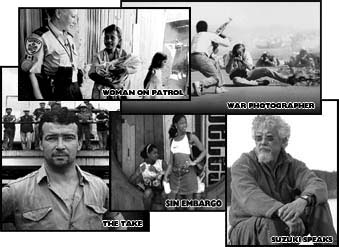
Kelowna Event Info
30 films in 72 hours!
BC�s largest social issues film festival is back in Kelowna!
Where: Okanagan University College � North Kelowna Campus
When: March 11th, 12th and 13th.
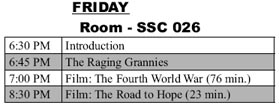
Friday, March 11th -- Opening Night starts at 6:30pm
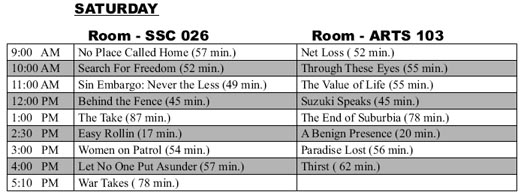
Saturday, March 12th -- Shows from 9am � 5pm (come anytime)
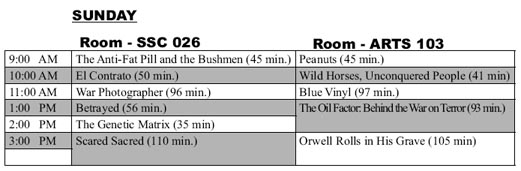
Sunday, March 13th -- Shows from 9am � 5pm (come anytime)
Cost: �Food for Flicks� OR �Pay what you can�.
For this third year, the OUC Community Development Club is happy to offer the World Community Development Education Society�s � Traveling World Community Film Festival as a Food Bank foodraising event. Admission is on a �pay what you can� basis or by the donation of non-perishable food items.
Help us spread the word, download, print and distribute our small quarter page ads by clicking HERE and HERE.
Print and distribute our poster by clicking HERE.
KELOWNA MOVIE SCHEDULE 2005. March 11, 12, and 13, 2005
(see descriptions further below)
Top
|
Penticton Event Info
What: Traveling World Community Film Festival
Where: OUC Penticton Campus (Hosted by OUC Community Development Club)
When: March 19th & 20th (films from 9AM - 9PM)
Cost: OUC Students (with school ID) - �Pay what you can�
Festival Pass - $17 (Pre-purchased)
$20 (At the door)
Day Pass - $14 (Available only at the door)
Block Pass - $7.50 (Available only at the door)
Festival Passes can be pre-purchased at the Penticton & District Multicultural Society (508 Main Street), YMCA-YWCA (749 Main Street) or The Dragon�s Den (12 Front Street) in downtown Penticton. Call (250) 492-6299 for more information.
Fundraising Efforts for�
Penticton & District Multicultural Society (PDMS) A non-profit organization dedicated to building a community based on mutual respect and full participation of people of all cultures. Annually, the organization provides English language classes and settlement services and advocacy for hundreds of immigrants, refugees and naturalized citizens. It hosts events and festivals aimed on increasing cross-cultural awareness, health, religion and culture. As well as, running the Multicultural Buddy Programs in South Okanagan elementary schools for immigrant and Canadian children participants. In partnership with schools, organizations and individuals in the community, the PDMS works to increase awareness about the contributions of immigrants, to combat racism and to promote better understanding among people of all cultures.
West African Rural Development Centre (WARD) A �Centre of Excellence� for the training of Community Development practitioners in West Africa - the WARD Centre began as a pilot project of OUC�s International Development Centre in Salmon Arm with original funding provided by the Canadian International Development Agency (CIDA) and the Association of Universities and Colleges of Canada (AUCC). The aim of WARD�s programs is ultimately poverty alleviation in all senses of the term by "increasing, in a sustainable manner, the capacity of developing countries to educate and build the human resources required to meet their priority needs". The WARD Centre was recently praised on the Knowledge Network�s - Leading Edge television series for its sustainability and effectiveness in the delivery of appropriate and relevant Community Development Training Materials, and the training of successful community animators. As WARD�s programs expand beyond their home in The Gambia, so do their positive impacts on the lives of people in West African communities. Visit The WARD Centre for more information.
For more information on the Penticton festival contact Greg by email at [email protected] or Cherry by email at [email protected] or by telephone at the Multicultural Society (250) 492-6299.
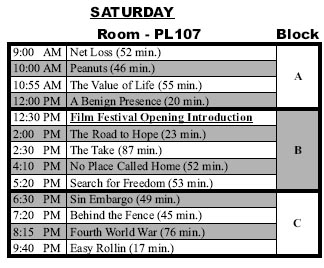
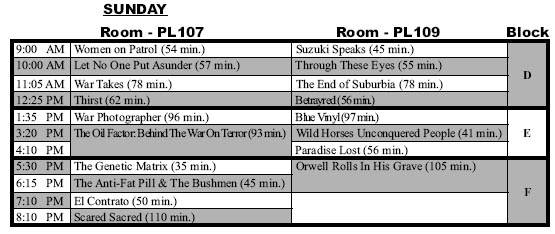
PENTICTON MOVIE SCHEDULE 2005. March 19 and 20, 2005.
(see descriptions further below)
Top
|
Film Desciptions 2005
The Road to Hope
23 min. 2004 Potters for Peace
Director: Francesca Roveda
�The Road to Hope� documents the tragedy and hope of the people of Nicaragua, from the Contra war and Hurricane Mitch to current economic injustices. Through the images and stories of Nicaraguan potters, this documentary details the training and informational exchange between Nicaraguan potters and the organization Potters for Peace. Potters for Peace has assisted in the design and production of ceramic water filters as well as developing international markets for Nicaraguan pottery. Creative alternatives are improving people�s lives. Inspiring!
The Take
87 min. 2004 NFB
Director: Avi Lewis Writer: Naomi Klein
In the wake of Argentina�s spectacular economic collapse in 2001, Latin America�s most prosperous middle class finds itself in a ghost town of abandoned factories and mass unemployment. In suburban Buenos Aires, thirty unemployed auto-parts workers walk into their idle factory, roll out sleeping mats and refuse to leave. All they want is to re-start the silent machines. But this simple act �the take �has the power to turn the globalization debate on its head. Like every workplace occupation,courts, cops and politicians can either give their project legal protection or violently evict them from the factory. The story of the workers� struggle is set against the dramatic backdrop of a crucial presidential election in Argentina. Lewis and Klein take viewers inside the lives of ordinary visionaries, as they reclaim their work, their dignity and their democracy. �The Take� is a political thriller that tackles head on the challenge coming from critics, and supporters, who ask: �We know what you�re against, but what are you for?�
See:www.TheTake.org www.zmag.org/argentina_watch.cfm
Net Loss
2003 McNabb & Connolly
Filmmakers: Mark Dworkin & Melissa Young
Decades of poor fisheries management and habitat loss have decimated many wild salmon runs in the Pacific Northwest. Now there's a new way to produce fish - raising them in giant underwater cages known as "net pens." �Net Loss� contends that fish farms have become a serious new threat to the survival of wild salmon. Filmed in Chile, Washington, and British Columbia, �Net Loss� assesses the risks and benefits of salmon farming through interviews with government and industry spokesmen, who make the case for salmon farming, and the fishers, native people, and scientists who warn of the dangers it poses and the damage it has already done.
El Contrato
50min. 2003 NFB
Director: Min Sook Lee
�El Contrato� follows Teodoro Bello Martinez, a poverty-stricken father of four living in Central Mexico, and several of his countrymen as they make an annual migration to southern Ontario to pick tomatoes under conditions no Canadian would accept. Under a government program that allows growers to monitor themselves, workers are exempted from labour laws and safety regulations. Grievances are deflected by a long line of others �back home� who are willing to take their place. Despite fear of repercussions, the workers voice their desire for dignity and respect, as much as for better working conditions. A stunning expose the exploitation of migrant workers in Canada
The Value of Life; Aids in Africa Revisited
55 min. 2004 CBC
Director: Judy Jackson Executive Producer: Michael Allder
This award-winning documentary follows Stephen Lewis on his incredible journey � a personal voyage that led him from hope to despair to hope again. In 2001, Kofi Annan had declared a war on AIDS and established a UN Global Fund to fight the disease. But then came September 11, and the world�s attention turned elsewhere. With promises of aid to Africa broken, Lewis�s optimism turned to disbelief. More than six thousand people die of AIDS every day, leaving 11 million orphans under the age of 15. In Africa, life-prolonging drugs are available to only a fraction of the people who need them. In 2003, the momentum is finally re-ignited. Endless disputes about how countries with health crises can overthrow the patents held by big pharmaceutical companies in order to access cheaper generics have been settled. The World Health Organization has pledged to have three million people on anti-AIDS drugs by 2005. That will amount to a staggering six million pills every day. It was the sheer volume of drugs needed that led Lewis and some Canadian aid agencies to challenge the Canadian government to pass legislation allowing patents to be put aside so cheaper generics can be produced. If the legislation passes, it will make history.
Women on Patrol
54 min. 2004 NFB
Director: Barry Lank
Since Indonesia occupied East Timor in 1975, the island has been devastated by horrifying violence and genocide. Canadian police constables Martine LeRoyer and Debbie Doyle have just joined the United Nations Civilian Police with a focus on
stabilizing the region. This gripping documentary follows the two women, from the capital of Dili to remote villages, chronicling the aftermath of the atrocities that haunt East Timor. Combining intimate interviews, up-close footage and diary cams, �Women on Patrol� is a riveting look at the rebuilding of a nation, and how the experience profoundly transforms these women � as police officers and as people.
The End of Suburbia,
Oil Depletion & The Collapse of the American Dream
78 min. 2004 Post Carbon Institute
Director: Gregory Greene Host: Barry Zwicker
Since World War II North Americans have invested much in suburbia with its promised sense of space, affordability, family life and upward mobility. Serious questions are now being raised about the sustainability of this way of life. With brutal honesty and a touch of irony, this film explores the �American Way of Life� and its prospects as the global demand for fossil fuels outstrips the supply. Some scientists argue that world �Oil Peak� and the inevitable decline in fossil fuels are upon us now. The consequences of inaction in the face of this global crisis are enormous. What can be done now, individually and collectively to change the way we live in community?
Fourth World War
76 min. 2003 Big Noise Films
Produced by a network of independent media
�The Fourth World War� weaves together the images and voices of the war on the ground - from the front-lines of conflicts in Mexico, Argentina, South Africa, Palestine, Korea, 'the North' from Seattle to Genova, and the 'War on Terror' in New York, Afghanistan, and Iraq. It is the story of men and women around the world who resist being annihilated in this corporate war against people. It is a story of a war without end and of those who resist. The product of over two years of filming on the inside of movements on five continents, �The Fourth World War� is a creative collage produced through a global network of independent media and activist groups; it is a truly global movement film. Featuring music from Manu Chao, Asian Dub Foundation, M�m, Moosaka, and others
No Place Called Home
57 min. 2004 NFB
Director: Craig Chivers
�I know we're poor, but it's what we are not who we are." Shot in an intimate, cinema verite style, �No Place Called Home� follows the Rice Family over the course of a year as they move in search of affordable housing. Kay Rice has just moved with husband, Karl, and her six children to a small, run-down rental house. Just as the family's circumstances are looking slightly better, things turn sour with the landlord who threatens eviction. Kay, worried that a veiled threat in a letter may mean losing her children, decides to take her landlord to court. With a photojournalist's eye, director Craig Chivers infuses �No Place Called Home� with humanity and stark realism as he illustrates the desperate struggle faced by the Rices and a growing number of working poor families across Canada.
Let No One Put Asunder
57 min. 2004 Vox Veritas
Director: Alexis Fosse Mackintosh
Al and Alex, a Vancouver couple, had been together a year and felt it was time to tie the knot. Linda and Sylvia left their home in the US to be married in Canada. Robin and Christine, parents of four children, were married on the 24th anniversary of their commitment ceremony. �Let No One Put Asunder� explores the political, religious and social issues surrounding same-sex marriage in Canada today through interviews with notable religious leaders, human rights activists, and politicians (including MP Randy White.) Against the backdrop of competing worldviews, the film follows three couples on their journeys of love, commitment, celebration and, of course, marriage.
Sin Embargo: Never the Less
49 min. 2003 Documentary Education Resources
Director: Judith Grey
After the revolution of 1959 and the US embargo that followed, the people of Cuba were left to fend for themselves. Deprived of some of the most basic goods, they scavenge the alleys and scrap heaps, giving new vitality to the discarded. Their recycled products are often remarkably ingenious and creative. Nothing can crush the spirit nor quash the desire to forge a better life for themselves and their families. Shot entirely in Cuba, �Sin Embargo� is a look into the hearts and dreams of struggling peoples and a tribute to their optimistic and resourceful determination to survive. Best Documentary, Festival de Cine de Granada, Spain 2003
Wild Horses, Unconquered People
41 min. 2004 Filmwest Associates
Filmmakers: Lionel Goddard & Susan Smitten
�Wild Horses, Unconquered People� explores the intriguing relationship between the Xeni Gwet�in, a tiny band of Tsilhqot�in Indians, and hundreds of wild horses that mysteriously roam B.C.�s rugged Nemiah Valley - described as Canada�s Nepal. For what is arguably North America�s last true horse culture, the untamed spirits are an economic and spiritual resource � a powerful icon in a century-old fight with the government and non-native entrepreneurs for control of this unconquered land.
Easy Rollin�
17 min. 2004 [email protected]
Filmmakers: Marriane Bos and Hadas Levy
A community of cycling enthusiasts in Vancouver, BC, finds funky ways to bring together their environmental and artistic ideals to promote green transportation and alternative ways of engaging within our car-congested society. Bio-Diesel and Pedal-Powered Generators are only a few examples of how to rethink the way we live and move through this world. Join us for a community-building street festival with some of the most creative and fun transportation options you�ll ever see. A humourous and light-hearted look at creative alternatives
The Genetic Matrix;
The Schmeiser Case & the Fight for the Future of Life
35 min. Council of Canadians & Dead Crow Productions 2004
Filmmaker: Ian Mauro In 1996, Monsanto released genetically engineered herbicide tolerant canola in Canada. Farmers Percy & Louise Schmeiser were
sued in 1998 by Monsanto for infringing a gene patent on this canola. Monsanto vs Schmeiser was the first case in the world arguing that a patent over a lifeform had been violated. Schmeiser was forced to turn over his entire crop and the seeds he and his wife spent 50 years cultivating. The six year �David vs. Goliath� court battle raised issues of life patents while the public discourse continues to focus on issues of food safety and labelling. Percy received the Mahatma Gandhi award for his non-violent service to humanity in 2000.
See: www.percyschmeiser.com www.canadians.org www.vshiva.net
A Benign Presence
20 min. 2004 [email protected]
Producer/ Director: Michael O'Neill; Associate Producer: Rev. Charles Brandt
�A Benign Presence� portrays in vivid cinematography the life history of the Trumpeter Swan, including the Comox Valley community's involvement in the conservation of this species. The film also conveys a sense of wonder and delight in the natural world, which gives us a sense of hope that our society can be transformed from one that is having a disruptive influence on the earth to one that will have a benign presence.
Behind the Fence
45 min. 2003 McNabb & Connolly
Director: Inigo Gilmore
Through the eyes of the Israelis and Palestinians most affected, �Behind the Fence� follows the construction of a controversial 115 kilometre security fence that is creating a new barrier between Israel and the West Bank. The aim, the
Israeli government has stated, is to prevent Palestinian "terrorists" from infiltrating into Israel. For many Palestinians however it is nothing more than a sinister ploy to grab more of their land and further reinforce the occupation. The film captures the anxiety and uncertainty in the Israeli community of Kibbutz Metzer and the neighbouring Palestinian town of Qaffin, --communities which will be divided by the fence and the destruction of the150-year-old olive grove that lies between them.
The Anti-Fat Pill and the Bushman
45 min. 2003 McNabb & Connolly
Reporter: Tom Mangold Editor: Karen O�Connor
A miracle treatment for obesity - the scourge of modern society - has been discovered on the lands of a stone-age tribe of San Bushmen, living on the edge of civilisation in Southern Africa. If the 'miracle molecule' inside the Hoodia cactus can be transformed into a bestselling anti-fat pill by Pfizer, the pharmaceutical giant responsible for Viagra, the San Bushmen stand to make millions of dollars in royalties. Tom Mangold talks to the elusive San leaders as they debate how they should spend their windfall, and tracks the plant pirates from the First World who are trying to steal the precious Hoodia.
Orwell Rolls in His Grave
105 min. 2004 BuzzFlash
Director: Robert Kane Pappas
�Orwell Rolls in His Grave� is a searingly insightful documentary on the political threat posed by a corporate media aligned with a radical right wing White House. Pappas, on a bare bones budget, assembles the "A-team" roster of media critics and then weaves their comments together with music, reflections, and documentary footage that keeps you mesmerized with its brilliant insight. This is a must see, a wake-up call that we have already entered an Orwellian world when history, context, and language are redefined daily by the government, as the media broadcasts the new version of the �truth� without question.
Blue Vinyl
97 min. 2002 McNabb & Connolly
Filmmaker: Judith Helfand
With humour, chutzpah and a piece of vinyl siding firmly in hand, Peabody Award-winning filmmaker Judith Helfand and co-director and award-winning cinematographer Daniel B. Gold set out in search of the truth about polyvinyl chloride (PVC), America's most popular plastic. From Long Island to Louisiana to Italy, they unearth the facts about PVC and its effects on human health and the environment. A detective story, an eco-activism doc, and a rollicking comedy, Blue Vinyl puts a human face on the dangers posed by PVC at every stage of its life cycle, from factory to incinerator. Consumer consciousness and the "precautionary principle" have never been this much fun. Frightening and funny! Numerous Awards including: Emmy Awards nominee (Best Documentary, Best Research);Excellence in Cinematography Award, Sundance Film Festival
Search for Freedom
53 min. 2003 Women Make Movies
Director: Munizae Jahangir
�Search for Freedom� traces the dramatic social and political history of Afghanistan from the 1920s to the present through the stories of four remarkable women: Princess Shafiqa Saroj, sister of the beloved progressive King Amanullah (1919-1929); Mairman Parveen, the first woman to sing on Afghan radio; Moshina, a war widow and survivor of a Taliban massacre; and Sohaila, an exiled medical student who ran underground schools for RAWA (Revolutionary Association of Afghan Women) during the Taliban regime. Archival footage from the early 20th century captures a time of remarkable progress and freedom for women. Defying and clarifying the image of Afghan women as mere victims, �Search for Freedom� offers a nuanced portrait of women who find choices where none are offered, who continue to find hope in the face of exile and isolation.
Through These Eyes
55 min. 2004 NFB
Director: Charles Laird
This riveting documentary reveals how an educational dream became a bitter political battle over cultural differences. In the 1960�s, Man: A Course of Study ( MACOS) was an innovative social sciences program designed to teach US children �what it was to be human.� At its core was The Netsilik Film Series, an acclaimed benchmark of visual anthropology that captured a year in the life of an Inuit family living in the remote Canadian Arctic, reconstructing an ancient culture on the cusp of contact with the outside world. But the graphic images of the Netsilik people created a clash of values that revealed a fragile
relationship between politics and education. A fiery national debate ensued between academic and conservative forces. �Through These Eyes� looks back at the high stakes of this controversial curriculum, as two cultures came into contact with people and traditions distinct from their own. Decades later, as US influence continues to affect cultures worldwide, the story of MACOS resonates strongly.
War Photographer
96 min. 2002 Filmstransit
Director: Christian Frei
This is a remarkable film about James Nachtwey ,a shy but committed man, who is considered one of the bravest and one of the most important war photographers of our time. Director Christian Frei followed Nachtwey for two years into the wars in Indonesia, Kosovo, Palestine... Christian Frei used special micro-cameras attached to James Nachtwey's photo-camera. �For me, the strength of photography lies in its ability to evoke a sense of humanity. If war is an attempt to negate humanity, then photography can be perceived as the opposite of war and if it is used well it can be a powerful ingredient in the antidote to war.� (James Nachtwey) Oscar Nomination for Best Documentary, Peabody Award, Emmy Nomination for Cinematographer Peter Indergand, Winner of many International Film Festivals.
The Oil Factor: Behind the War on Terror
93 min. 2004 Freewill Productions
Filmmakers: Gerard Ungerman & Audrey Brohy
When all of Bush's pro-war arguments have been proven wrong, is it a coincidence that Iraq sits on the 2nd largest oil reserves in the world? Is it also a coincidence that Afghanistan is key to controlling the oil reserves of Central Asia at a time when the world's oil supply is dwindling? �The Oil Factor: Behind the War on Terror� examines the link between oil interests and U.S. military interventions. It includes original footage shot over a four-month period in Iraq, Pakistan and Afghanistan as well as many interviews with a large array of personalities including Bush administration officials. The documentary explores the various underlying motives behind the so-called "war-on-terror" and offers insights into why global terrorism is thriving and why the world is becoming a more and more unsafe place. "The Oil Factor" also makes a clear assessment of today's global oil situation with sky-rocketing consumption and declining production.
War Takes
78 min. 2002 Women Make Movies
Filmmakers: Adelaida Trujillo and Patricia Casta�o
Colombian filmmakers Trujillo and Casta�o turn the cameras on themselves to portray the tough realities of civil life in the violent, war-ravaged country of Colombia. Partners in an independent media company, they struggle to balance their family, business and political lives: reporting from dangerous parts of the country; managing their company; parenting young children amid threats of violence and kidnapping; and rethinking their political views as war moves closer to the city. The film provides insight and historical background. Powerfully intimate and sometimes humorous, their chronicle reveals how life goes on in Colombia�however surreal�against the terrifying backdrop of war. Human Rights Watch Film Festival
Betrayed
56 min. 2004
Filmmaker: Elaine Briere (Award-winning director of �Bitter Paradise;
Although Canada is surrounded by three oceans, there is not a single deep-sea ship flying the Canadian flag today. Sixty years ago, Canada had the fourth-largest merchant fleet in the world. Canadian ships brought vital supplies to Allied forced in Europe during World War II. The men sailing those ships were war heroes who suffered terrible losses. Their union, the Canadian Seaman�s Union (CSU) brought the eight-hour day, sick leave and pay increases to an industry known for low wages and brutal working conditions. After the war, when the Liberal government began to privatize the merchant fleet, the CSU
strongly opposed the sell-off. The federal government and the ship-owners initiated a campaign to discredit the CSU by branding them as Communists. It was a time of fear, confusion and betrayal. This film traces the history of Canadian shipping from the international strike of 1949 to the globalization of coastal shipping in Australia by Canada Steamship Lines � owned by the family of Prime Minister Paul Martin.
Thirst
62 min. 2004 McNabb & Connolly
Directors: Alan Snitow & Deborah Kaufman
Is water part of a shared "commons", a human right for all people? Or is it a commodity to be bought, sold, and traded in a global marketplace? Thirst tells the stories of communities in Bolivia, India, and the United States that are asking these fundamental questions, as water becomes the most valuable global resource of the 21st Century. A character-driven documentary, �Thirst� reveals how the debate over water rights between communities and corporations can serve as a catalyst for explosive and steadfast resistance to globalization.
Paradise Lost
56 min. 2003 Women Make Movies
Director: Ebtisam Mara'ana
Arab Israeli filmmaker Ebtisam Mara'ana grew up in Paradise (Fureidis in Arabic), a small fishing village overlooking the Mediterranean. One of the few Arab communities remaining after the 1948 war, Paradise became culturally and politically isolated as Jewish settlements sprung up around it, and today it is a place defined by silence and repression. This thought-provoking and intimate film diary follows the director�s attempt to recreate the village�s lost history, including the story of her childhood hero Suuad, the legendary local �bad girl� who was imprisoned as a PLO activist in the 1970�s and banished from the community. The director finally meets Suuad, now living in the UK. This important film offers valuable insight into the contradictions and complexities of modern womanhood and national identity in the Middle East. DocAviv International Documentary Film Festival - Best Debut Documentary and Best Cinematography
Suzuki Speaks
45 min. 2003 Avanti Pictures
Director: Tony Papa
Earth + Air + Fire + Water = Life. In a time when people are thirsty for honesty, inspiration, meaning and global change, Dr. David Suzuki delivers the most important message of his career: what it means to be fully human in our interconnected universe. The film's stunning motion graphics weave a tapestry that transforms Dr. Suzuki's wisdom into a complete sensory experience, literally creating new worlds and new ways of seeing. �Suzuki Speaks� will leave you feeling renewed, challenged and alive. �We�ve framed the environmental problem the wrong way. There�s no environment "out there" for us to interact with. We are the environment, because we are the Earth.� (David Suzuki)
Peanuts
46 min. 2002 McNabb & Connolly
Director: Martin Harbury
When film technician Jock Brandis discovered cotton being grown in traditionally food-bearing fields in a village in southern Mali, he suggested they plant peanuts either around the cotton plants or in rotation with cotton. Peanuts fix nitrogen in the soil and they are rich in protein. But the problem, they replied, is husking them by hand. Jock promised he would return with a machine, but discovered that no small-scale machine exists. So he set about designing a hand-powered one that local people could build on the spot and fix themselves. The film follows Jock back to Mali, where he worked with local villagers to
perfect and manufacture their own peanut husker. An inspiring example of appropriate technology
Scared Sacred
110 min. 2004 NFB
Director: Velcrow Ripper Producer: Tracey Friesen
In a world teetering on the edge of self-destruction, award-winning filmmaker Velcrow Ripper sets out on a unique pilgrimage. Visiting the �Ground Zeros� of the planet, he asks if it�s possible to find hope in the darkest moments of human history. Ripper travels to the minefields of Cambodia; war-torn Afghanistan; the toxic wasteland of Bhopal; post-9/11 New York; Bosnia; Hiroshima; Israel and Palestine. This unflinching documentary captures his five-year odyssey to discover if humanity can transform the 'scared' into the 'sacred.' Confronting horror and heartbreak around the world, Ripper meets those who have suffered first-hand. And in each place, he unearths unforgettable stories of survival, ritual, resilience and recovery. �Scared Sacred� brings together powerful stories, deftly weaving haunting and luminous footage with words, memories, and an evocative soundscape. Featuring an engaging, first-person narrative, this film is an exquisite portrait of a search for
meaning in times of turmoil. Special Jury Prize at the 2004 Toronto International Film Festival
Top
Download the Program Guide(s)
Click HERE to download and print the complete program guide for the Kelowna event.
Click HERE to download and print the complete program guide for the Penticton event.
You'll need Adobe Acrobat Reader to view them.
Download acrobat at Adobe.com if you don't already have it.
Top
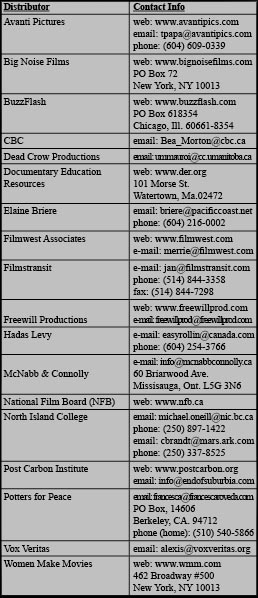
Film Distributors
Top

|