We've already mentioned that it
is a center for cooperation and communication among the people of Europe.
With this we want to show forth the common base of the European civilization.
To accomplish such a thing we try to organize exhibitions and the other spaces
in such a way that through the coexistence of examples from the history of
the European civilization to show forth our objective goal. Our next goal
is for this center to allow the free action, the initiative and the participation
of the citizens. To achieve this goal we combine our movements:
a) We wanted to free the way of
organizement and function of this building from common rules, norms and forms
that exist in such kinds of cultural centers today. The citizens must feel
free to participate. For this, there exist certain people (students and researchers)
that will be in their disposition for help. In the framework of function of
this building, the citizen can suggest the evolution of the exhibitions and
the events he wished, at the future. He can also plan his own course through
the compound. This means that there is not a certain course but many that
every visitor can plan according to his own interest. This means that the
compound is consisted of a network of many distinguished knots that each one
of them leads to many others. In the above, technology plays a key role.
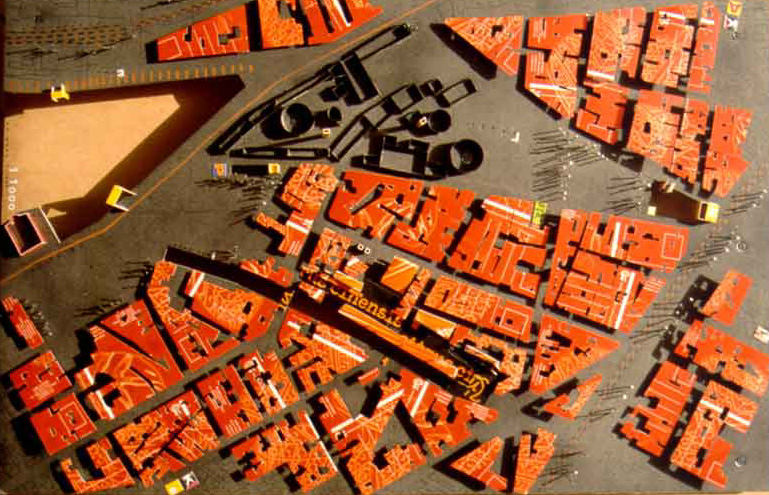
b) We chose this urban area in
such a way that it helps our objective. This area, because of its position,
its composition and its history allows us to freely move through it. To be
exact, it provokes free movement. In other words, it has a high perception
of the public, of the common.
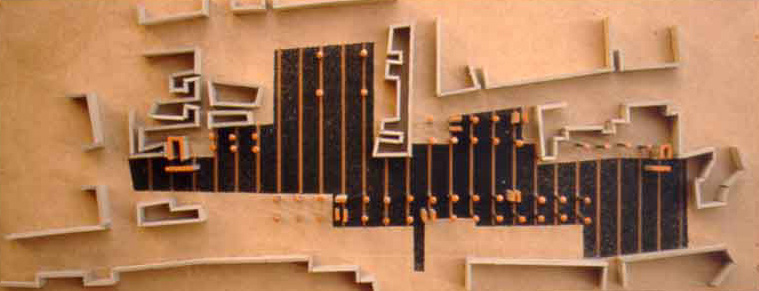
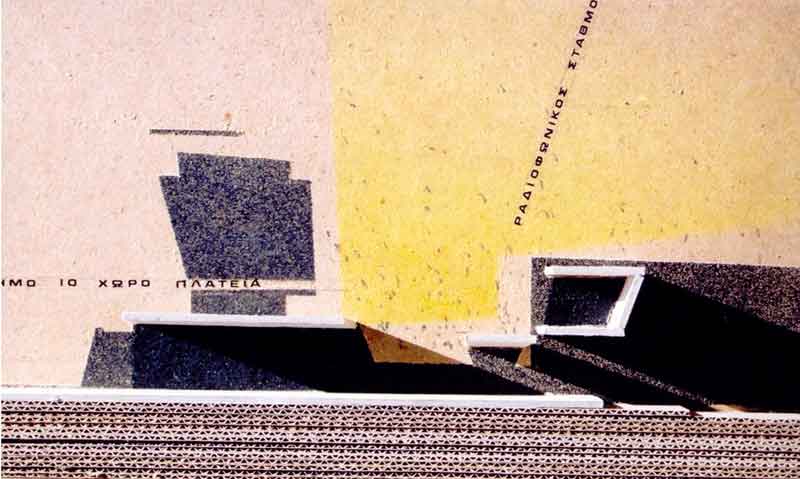
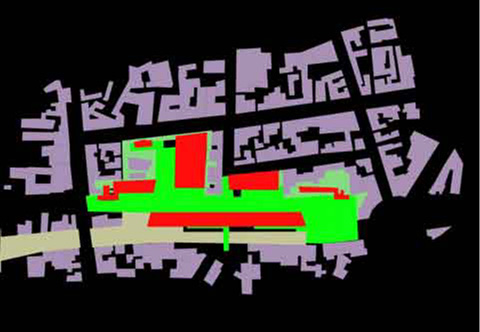
c) Within the limits of the compound
we organized an important open-air space (with its course-movement, with the
2 squares and platos). Our objective is to smoothly connect our compound with
the surrounding area, with the two basic entrances and the very important
archaeological site of Iera Odos (that we redesigned) and in a broader way
with the archaeological site of Keramikos. We also try to get a better approach
of the area's landscape.
Behind this decision of ours,
we placed "political" choice. We believe that in a public building
open-air space has an important role. Like in ancient market (Agora), it is
the place where the citizen feels free to act. It is harder for an open-air
space to be controlled by a central administration of the cultural center.
There the citizen feels more comfortable to self-act, to communicate with
his fellow citizens, to do things together. The open-air space allows a more
spontaneous action of daily life. So, we tried to create a unified desk, which
will be unfolded like an organism on the ground and under our compound.
For this reason we tried to lure
all its functions to the open-air space, to refer to it and to be fed by it.
Thus, we used ramps to lead the citizens to an uninterrupted movement through
the building.
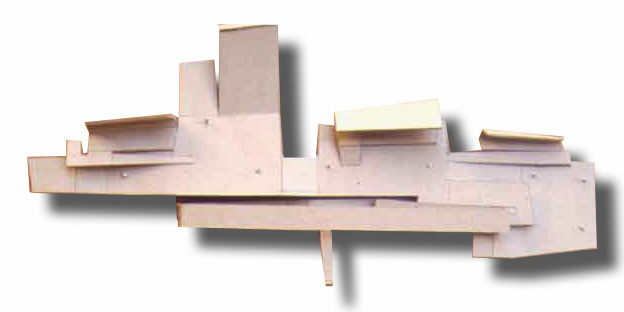
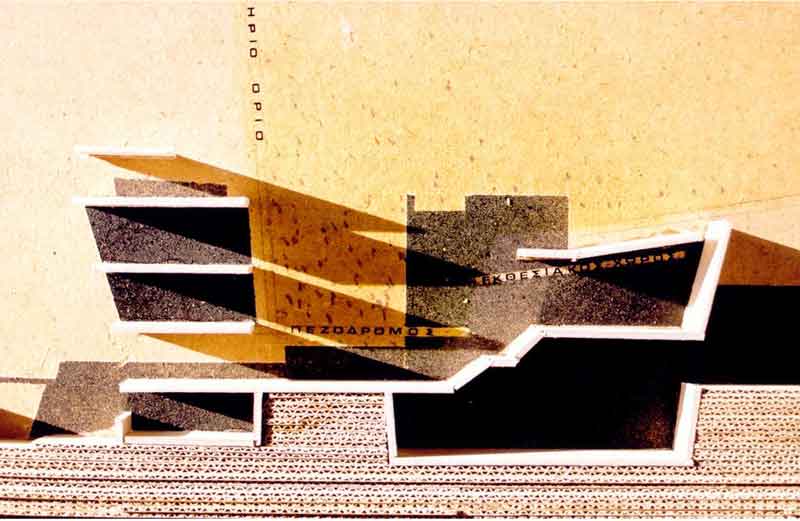
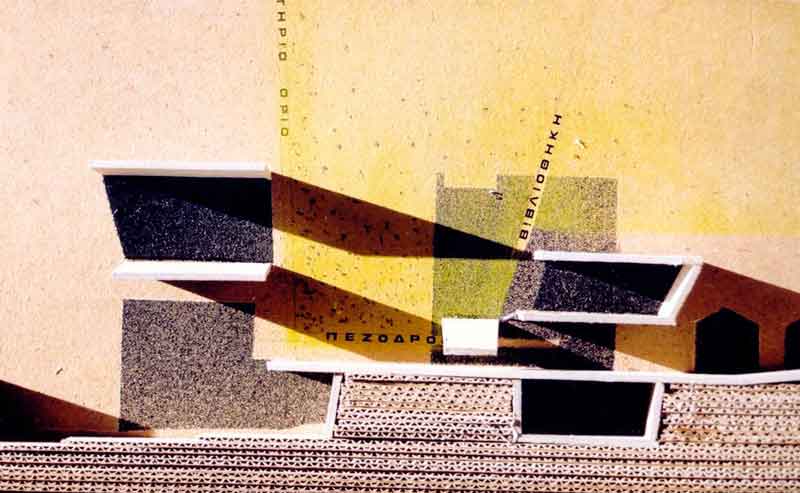
Finally, important role in our
planning play the columns that provide a rhythm (in other words, a unity for
the compound), the logic of folding that create certain references and turn
their back to spots that do not interest us and the complete form of building
that we believe it shows forth the open-air space and it fits to such kind
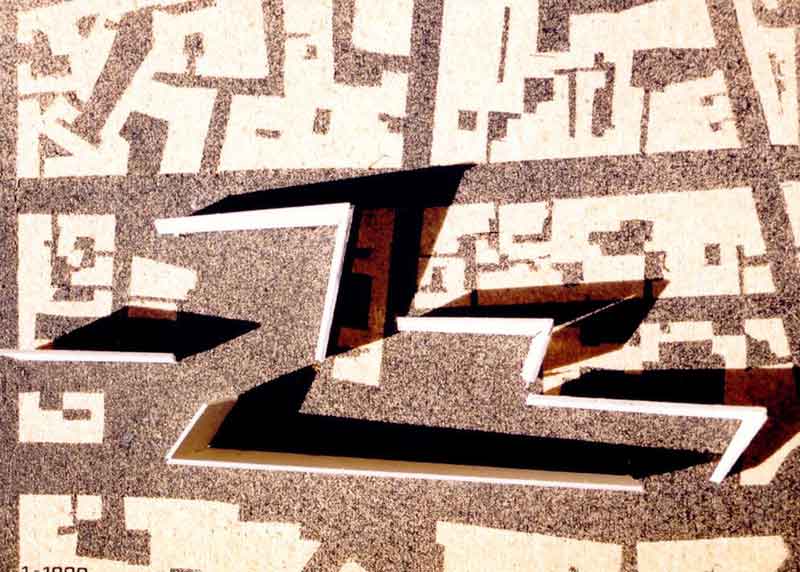
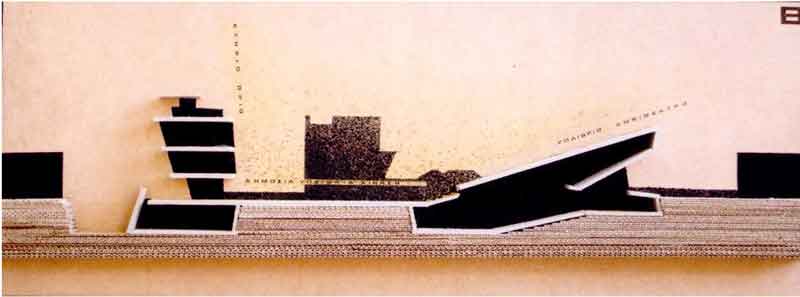
of public cultural buildings. Also, our basic choice was for a certain building
to dominate the compound, the linear building, that is the spine and the reference
point, hosts basic functions, organizes the open-air space and is debating
with the 4 spots-building that are opposite to it and are embodied in the
structure of the city. The compound is consisted of many square meters, thus
a great portion is sheltered in already existing building around the open-air
space. In this way, the functional embodiment of the compound is succeeded
in our area together with the more complete feeding of the open-air space.
Our buildings also attempt to preserve relations and heights that exist today
in the field.