 |
 |
 |
 |
 |
 |
|
 |
 |
 |
 |
 |
 |
 |
 |
 |
 |
 |
 |
 |
 |
 |
 |
 |
| Teotihuacan |
|
|
 |
 |
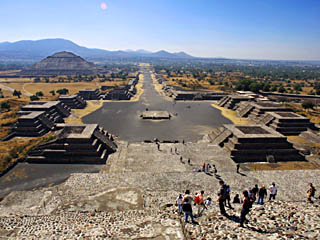
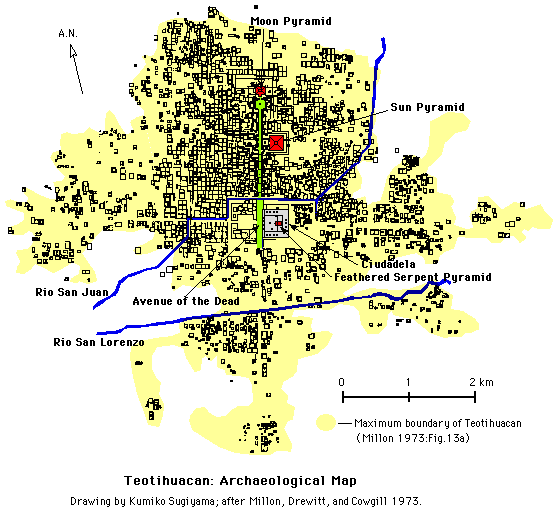
| The map shows the most expanded city limit during the Xolalpan phase, when its population is estimated to have been about 125,000 (Millon 1993:18). The construction extended over 20 square kilometers. The Avenue of the Dead was the city's primary axis, extending more than 2 km, which the canalized river San Juan perpendicularly crossed at right angles. The Teotihuacan Mapping Project, directed by Ren� Millon of the University of Rochester, calculates that over 2,000 high-walled apartment compounds, some of which have been excavated and consolidated, existed at its peak. Although the residential area seems to have extended extensively throughout the city, the monumental constructions were concentrated in its northern half. The Sun Pyramid facing west stands at the center of the northern section of the Avenue of the Dead as the principal pyramid of the city. The Moon Pyramid is located at the northern end of the central ceremonial zone. |
 |
 |
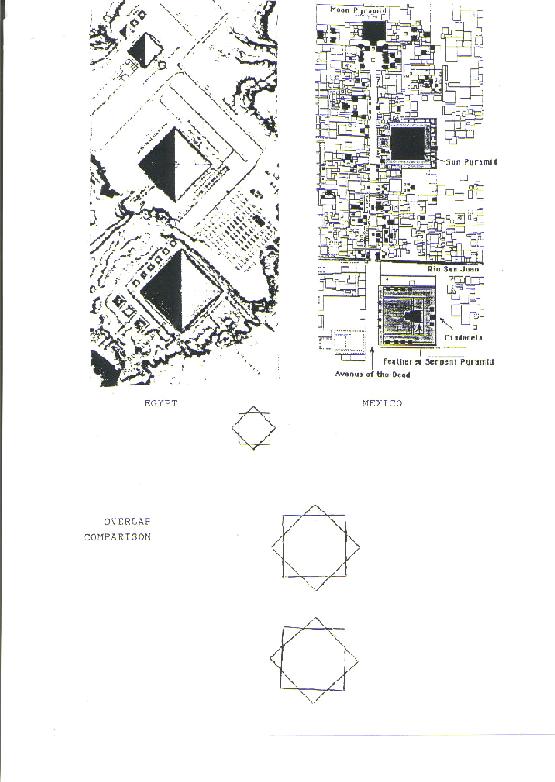
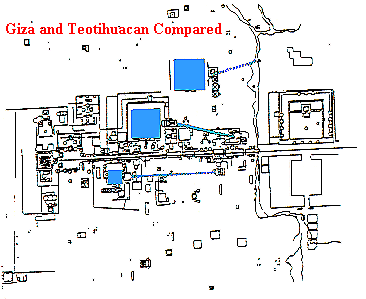
| From these few illustrations, it becomes apparent that the design of both pyramidal sites seems to obey a similar theoretical concept underlying their layout. This similarity of concept becomes even more visible when we compare both sites together and with respect to multiple sets of designs. |
| The pyramidal structures at Giza and Teotihuacan upon first appearance reveal more differences than similarities. Yet, when we graph the natural numbers (1-6-8-9; 5-12-13-10) at right angles to one another a basic design obtains that reminds us of ancient symbols in artwork and architecture: These basic designs correspond to the layout of the pyramids at Giza and Teotihuacan (Cfr., Earth/matriX, essay N�.82), revealing a possible common denominator for both of these pyramidal sites. In fact, the basic design obeys the layout of the cross-section of the Great Pyramid at Giza (Cfr., Earth/matriX, Extract N�.8). We shall offer here a summary view of the coincidence of lines in the different designs. The basic designs would appear to have a relevancy to the hieroglyphs. The basic designs, when overlaid upon the grid systems of Giza and Teotihuacan, reveal a coincidence of lines that causes one to consider such a design as having been possibly one similar to that used in the layout of the pyramidal sites themselves. Not only can one account for all of the principal pyramids, but even all of the secondary pyramidal structures obey the basic design, by forming relationships among themselves and in relationship to the main pyramids. Nothing seems to fall outside the scope of the basic design. |
| If this were the case, then possibly, the ancients understood the concept of the cube (powers), and made a translation of these numbers into geometrical designs. In fact, by considering the natural numbers to the cube, many distinctive ancient designs become more comprehensible, As we shall see in later essays, even the slanted stairways that do not seem to coincide with the slope of the walls of the pyramids in some of the maya pyramidal structures reveal a specific logic of design. The graphing of the natural numbers to the cube produce geometrical designs that many account for many of these ancient designs that at first glance appear to be haphazard and illogical. |
| In the southern section, the Ciudadela and the Great Compound stand out as exceptionally large architectural complexes in the city. The Feathered Serpent Pyramid, discussed in this web site, was the principal pyramid of the Ciudadela. Further south of them, unlike in the northern section, the Avenue of the Dead is not well defined by platforms or other architectural units, according to current topography. Further south, beyond the river San Lorenzo, on the southern Avenue of the Dead, several mounds are still visible on surface. The city had no outer defensive walls, however Millon (1993) believes that it was not an open city easy for outsiders to attack. |
| 3/3 |
 |
| 3/3 |
|