 |
 |
 |
 |
 |
 |
|
 |
 |
 |
 |
 |
 |
 |
 |
 |
 |
 |
 |
 |
 |
 |
 |
 |
| Teotihuacan |
|
|
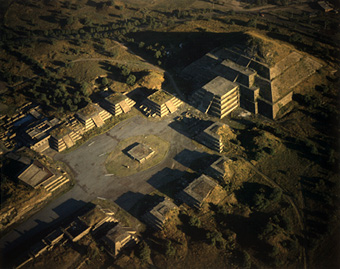
| Deep within the jungles of Mexico and Guatemala and extending into the limestone shelf of the Yucatan peninsula lie the mysterious temples and pyramids of the Maya. While Europe was still in the midst of the Dark Ages, these amazing people had mapped the heavens, evolved the only true writing system native to the Americas and were masters of mathematics. They invented the calendars we use today. Without metal tools, beasts of burden or even the wheel they were able to construct vast cities across a huge jungle landscape with an amazing degree of architectural perfection and variety. Their legacy in stone, which has survived in a spectacular fashion at places such as Palenque, Tikal, Tulum, Chichen Itza, Copan and Uxmal, lives on as do the seven million descendants of the classic Maya civilization. The Maya are probably the best-known of the classical civilizations of Mesoamerica. Originating in the Yucatan around 2600 B.C., they rose to prominence around A.D. 250 in present-day southern Mexico, Guatemala, northern Belize and western Honduras. Building on the inherited inventions and ideas of earlier civilizations such as the Olmec, the Maya developed astronomy, calendrical systems and hieroglyphic writing. The Maya were noted as well for elaborate and highly decorated ceremonial architecture, including temple-pyramids, palaces and observatories, all built without metal tools. They were also skilled farmers, clearing large sections of tropical rain forest and, where groundwater was scarce, building sizable underground reservoirs for the storage of rainwater. The Maya were equally skilled as weavers and potters, and cleared routes through jungles and swamps to foster extensive trade networks with distant peoples. The pyramids of Teotihuacan rise as high as twenty-story buildings,above the central Mexican highlands with a grandeur and mystery that stirs the imagination and inspires the soul. As a civil engineer, I have often been intrigued by the surveying and construction skills of so-called primitive societies; this site is truly exceptional. All of the buildings are aligned with the stars and the solar system from precise survey points in the nearby mountain range, using an advanced understanding of mathematics, geometry and astronomy. Little is known by traditional researchers about the pyramids of Teotihuacan (pronounced tay-oh-tee-wah-con, and simply referred to as "Teo" by the locals). Built bythe Toltecs, Teo was once a city the size of ancient Athens and Rome. It thrived as the primary center of learning and culture in America for over one thousand years, before it was abandoned about fifteen-hundred years ago. According to legend, after the fall of Teotihuacan, two major paths of sacred knowledge formed. One Toltec path went to Tula near present day Hidalgo. The magic of Tula can be compared to what our culture might term "black magic." The generally more enlightened path called the Path of Freedom went south toward Xochicalco, near present day Cuernavaca, and also eventually went into hiding. The term "Toltec" as used by the Aztecs (who came many years after the Toltecs) meant either a "great wise one" or a native healer or artist who followed a certain tradition; it was not necessarily meant to define a specific ethnic group. In fact there is evidence that Toltec society was a relatively harmonious blend of several of America's early native cultures. The Olmecs and the builders of Monte Alban in Oaxaca, with whom the Toltecs traded, revered the Toltecs and regarded them as the most highly advanced society in religion, magic and art. Yet, unlike the art of other early American societies, Toltec art depicts only two gods: the earth goddess and the rain/sky god. The fact that Toltec art does not prominently portray many gods for worship, supports the belief, common throughout America for over one thousand years, that the Toltecs were able to communicate directly with the gods in the sun, the moon and the stars. Teotihuacan means 'The City of the Gods', or 'Where Men Become Gods'. |
 |
 |
 |
 |
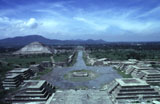 |
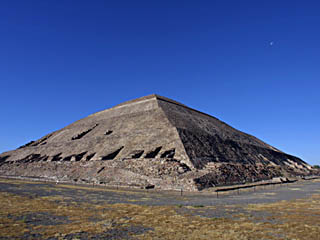
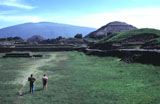
| The complex of approximately 600 pyramids of various sizes is dominated by the great Pyramid of the Sun which, it was discovered in 1971, was built over a natural cave with four chambers (cf. Sacred Caves). Mesoamerican belief saw caves as gateways to the spiritual world (called Xibalba by the Maya). The cave contained remains of offerings and may have been a focus for shamanistic rituals from a much earlier period. There can be no doubt that the Pyramid of the Sun was deliberately built over the sacred cave. Teotihuacan was probably Mexico's biggest ancient city, with perhaps 200,000 residents at its peak in the 6th century, it was virtually abandoned by the 7th century. |
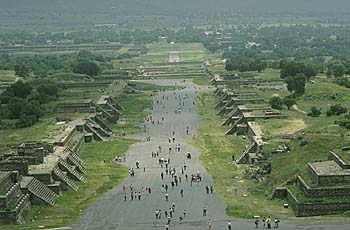
| Fifteen hundred years ago, Teotihuacan was already known the length and breadth of Mesoamerica. Every traveler to the Valley of Mexico would take time to visit the great city, if only to admire its brightly painted public buildings and stroll down the wide and imposing Street of the Dead that traversed the city's center. Teotihuacan was the largest human settlement in the Americas, with a population of at least 100,000 people. The Mesoamerican world shopped at Teotihuacan, traded with its merchants, and worshipped at its temples. Thousands of scattered villages in the Mexican highlands relied on its markets and specialist manufactures. At certain times of the year, the entire countryside would flock to Teotihuacan's plazas to participate in the annual public ceremonies that ensured the future prosperity of the great city and the people of the Valley. Yet, within a few short centuries, the city had vanished forever. Only a few crumbling pyramids and temples remained as testaments to its former glory. The earliest ceremonial buildings were erected at Teotihuacan about 100 B.C. Within a few centuries, Teotihuacan had mushroomed into a huge city dominated by the great 'Pyramid of the Sun'. This sacred, truncated edifice stood 210 feet high and 650 feet square, a vast pyramid of rubble, adobe mud, and earth all faced with stone. A wooden temple on the summit of the pyramid afforded a spectacular view of the sprawling city below. Between 450 and 650 AD, Teotihuacan reached the height of its cultural splendor and its population is estimated to have between 150,000 and 200,000 people at its maximum. Think of a city in your area with a population of 200,000 and I'm sure you'll be awed as I was by the concept that such a city existed in Mexico more than 1400 years ago. Teotihuacan was the sixth largest city in the world in AD 600. Besides the major ceremonial pyramids, there were also palaces and temples, especially near the north end of the city surrounding the plaza in front of the Pyramid of the Moon. These included the Palace of Quetzalcoatl, the Butterfly Palace, the Temple of the Feathered Conches, and the Palace of the Jaguars. When I saw the Butterfly Palace, with its magnificent stone carvings of birds and butterflies, I wondered if that wasn't an artistic reference to the belief that this was the place that men were turned into gods mentioned in the Aztec song quoted earlier. The sophistication and artistry of the Teotihuacanos can be seen everywhere in the magnificent murals and stone carvings which adorn the walls of the palaces and apartment compounds. The artwork is beautiful, refined, elegant and stylish. Another fascinating feature of some of the pyramidal structures is that they contain a broad, thick layer of mica, which had to be brought from Brazil, over 2000 miles away! If you know anything about mica, it's very flaky and fragile, yet it was brought in very large pieces from great distances (and without wheeled vehicles). Then the mica was used on an inner layer of the pyramid, not where it could be seen. Why? One characteristic of mica is that it is used as an insulator in electronic and electrical things. Was that its purpose here? Another mystery of Teotihuacan. The rest of the city of Teotihuacan consists of residential compounds (ancient apartment complexes) about 200 feet on a side with an sunken, open courtyards at the center bordered by four platforms and rooms or apartments beyond. Often there was a platform or altar in the center of the courtyard. Imagine a Spanish hacienda-style house, with a covered walkway around an open atrium in the center and rooms beyond the walkway. There must have been a great number of traders and artisans living and working in quarters of this sort. A few of the residential compounds that flank the Avenue of the Dead have been excavated, but most lie crumbled under a thin covering of earth for as far as the eye can see from the top of the major pyramids (with present-day farms, shops, and homes on top of the land). to return someday. |
| Some anthropologists believe the crisis may have been a lessening of the food supply caused by a drying out of the land and a loss of water sources to the area. They speculate that this might have been brought about by a combination of natural climactic shift towards aridness that appears to have happened all over Mexico during the Classic period and the residents having cut all the timber in the valley. Originally there were cedar, cypress, pine, and oak forests; today there are cactus, yucca, agave, and California pepper trees. This change in vegetation indicates a big climate shift. Although Teotihuacan presents a puzzle to archaeologists because it was a huge city that appears to have arisen without antecedents, the single most important fact which archaeologists have learned about the Classic period in Mexico was the supremacy of Teotihuacan. As the urbanized center of Mexico, with high population and tremendous production, its power was imposed through political and cultural means not only in its native highland habitat, but also along the tropical coasts, reaching even into the Maya area. |
| One of the decorative murals depicts the Teotihuacan Spider Woman, the goddess that was thought to be responsible for the creation of the present universe, and may have been the supreme deity of the Teotihuacanos. She bears a close relationship, if not identity, with the Spider Grandmother who play such an important role in Pueblo and Navajo creation mythology in the American Southwest. This is particularly interesting because many anthropologists believe that the great desert expanses of northern Mexico precluded much exchange between the cultures of the American Southwest and those further south in Mexico. The city met its end around 700 AD through deliberate destruction and burning by the hand of unknown invaders. It was mainly the heart of the city that suffered the torch - the part that we visited - the palaces and temples on each side of the Avenue of the Dead from the Pyramid of the Moon to the Citadel. Although a century earlier, around AD 600, almost all of Teotihuacan's influence over the rest of Mesoamerica had ceased, indicating some sort of internal malaise or decline before the destruction. Away from the Avenue of the Dead, the city continued to live on for another two centuries, although the population of Teotihuacan sunk to only a quarter of its former total. Some sort of crisis overtook all the Classic civilizations of Mesoamerica (including the Maya) two centuries later, forcing them to abandon most of the cities. |
| It's trading and tribute empire was comparable with the Aztec empire that eventually followed it. All other Mexican states were partly or entirely dependent upon it for whatever achievements they attained. When Teotihuacan fell, around 650 AD, the unifying force in Mesoamerica was gone, and with it widespread inter-regional trade. The Late Classic period saw increasing fractionalization among cultures. In the place of great states, petty kingdoms and militarism arose. From the highpoint of civilization at Teotihuacan, wars became the rule of the day, and for those unfortunate enough to be captured, sacrifice to the gods. Military empires, such as the Toltecs in the twelfth century AD (and later the Aztecs, starting in fourteenth century AD), which grew up from these warring factions were the cultures met by the Spanish in 1519 and largely eradicated by 1521. Probably the reason that the Spanish were able to conquer the Aztecs in such a short amount of time had less to do with their skill as soldiers and more to do with the fact that the Spaniards physically resembled the descriptions in Aztec legends of the god Quetzalcoatl. |
| Quetzalcoatl, while symbolized as a feathered serpent, appears also to have been an historic figure - the man credited with bringing civilization, learning, culture, the calendar, mathematics, metallurgy, astronomy, masonry, architecture, productive agriculture, knowledge of the healing properties of plants, law, crafts, the arts, and peace to the native people. He is pictured as a quite different physical type than the natives - fair skinned and ruddy complexioned, long nosed, and with a long beard. He was said to have arrived by boat from the east, and sailed off again years later promising to return someday. |
 |
| 2/3 |
|
| 2/3 |