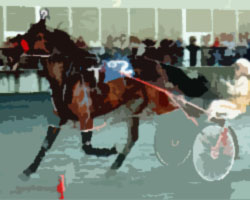
Harness racing in America is dominated by
the Standardbred, the world's fastest harness horse. Standardbreds have some Thoroughbred blood,
and are called 'standardbreds' because only those that could pace or trot faster than the standard time
for a mile were allowed to breed. This highly selective breeding has resulted in a horse made
specifically for harness racing.
There are two kinds of harness races. In the old days, most harness races were done at the trot,
a two beat gait where the diagonal legs of the horse move together. Very few horses were naturally
able to pace, which is a gait where the legs on the same side of the horse move together.
With the invention of hobbles, a device that forced a horse to pace, pacing became more popular and
in fact there are more pacers and pacing races than trotting today.
Both pacing and trotting have their own Triple Crown. The Pacing Triple Crown consists of the
Messenger, the Cane Pace, and the Little Brown Jug. The Trotting Triple Crown consists of the
Hambletonian, the Kentucky Futurity, and the Yonkers Trot.
Harness horses are started as yearlings, and
begin racing as two year olds. As with all racing horses, their official birthday is on January first of
the year they were born regardless of what actual day they were foaled. Harness horses are often
raced every week as opposed to every few weeks, and this wear and tear can shorten their racing
career and limit their ability to have a second career.
During a race, a horse that breaks stride, such as a trotter that begins to gallop, must be pulled
back to allow the other horses to gain an advantage before they can reenter the race.
This is why there are more pacers than trotters
today. It is simply very difficult to train a horse to trot as fast as most horses can gallop, and
keep that gait without breaking. Since pacers must pace due to the hobbles, it is far easier to just
hobble them and make them go as fast as they can. A big misconception about pacers is that they
cannot be ridden and will always pace. However, real free legged pacers, who will pace without being
hobbled, are very rare. Most horses will trot and retain their natural gaits when they are not
hobbled.
After their racing careers are over, Standardbreds face a far more difficult future than their
Thoroughbred cousins. While the best retire to breeding, the rest are left at a disadvantage.
Many people willingly adopt Thoroughbred and Quarter Horse ex-racehorses, but few are willing
to take on a Standardbred ex-racehorse. Many believe they are unrideable or hard to train, cannot
jump, cannot canter, and cannot do the same things other horses do. This huge misconception has
kept people from adopting Standardbreds, and many face a dismal, short future.
 Harness racing in America is dominated by
the Standardbred, the world's fastest harness horse. Standardbreds have some Thoroughbred blood,
and are called 'standardbreds' because only those that could pace or trot faster than the standard time
for a mile were allowed to breed. This highly selective breeding has resulted in a horse made
specifically for harness racing.
Harness racing in America is dominated by
the Standardbred, the world's fastest harness horse. Standardbreds have some Thoroughbred blood,
and are called 'standardbreds' because only those that could pace or trot faster than the standard time
for a mile were allowed to breed. This highly selective breeding has resulted in a horse made
specifically for harness racing. 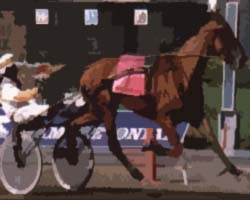 Harness horses are started as yearlings, and
begin racing as two year olds. As with all racing horses, their official birthday is on January first of
the year they were born regardless of what actual day they were foaled. Harness horses are often
raced every week as opposed to every few weeks, and this wear and tear can shorten their racing
career and limit their ability to have a second career.
Harness horses are started as yearlings, and
begin racing as two year olds. As with all racing horses, their official birthday is on January first of
the year they were born regardless of what actual day they were foaled. Harness horses are often
raced every week as opposed to every few weeks, and this wear and tear can shorten their racing
career and limit their ability to have a second career. 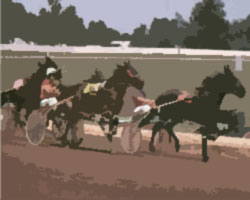 This is why there are more pacers than trotters
today. It is simply very difficult to train a horse to trot as fast as most horses can gallop, and
keep that gait without breaking. Since pacers must pace due to the hobbles, it is far easier to just
hobble them and make them go as fast as they can. A big misconception about pacers is that they
cannot be ridden and will always pace. However, real free legged pacers, who will pace without being
hobbled, are very rare. Most horses will trot and retain their natural gaits when they are not
hobbled.
This is why there are more pacers than trotters
today. It is simply very difficult to train a horse to trot as fast as most horses can gallop, and
keep that gait without breaking. Since pacers must pace due to the hobbles, it is far easier to just
hobble them and make them go as fast as they can. A big misconception about pacers is that they
cannot be ridden and will always pace. However, real free legged pacers, who will pace without being
hobbled, are very rare. Most horses will trot and retain their natural gaits when they are not
hobbled.