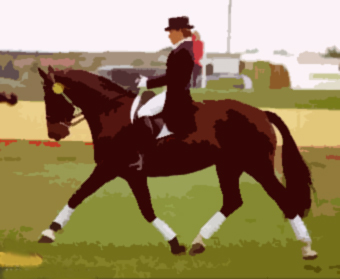
Dressage is often likened to dancing.
Competitions consist of a horse and rider performing a test, which is a series of moves, gait
changes, circles, and lines. Tests are scored by how supple and responsive the horse is, with
good scores for fluid, relaxed, forward movement.
A dressage horse must be able to collect and extend at all gaits, to drive from behind, to change gaits without
losing impulsion, and to perform difficult movements with seeming ease. Riders must be well
schooled to give subtle cues, to have independant control over their natural aids, and to perform
flawlessly while seeming to be giving no signals.
Upper level dressage incorporates several difficult movements. Most famous are those called
'airs above the ground', made popular by the Lippizaner stallions.
These are the leaping, rearing, and jumping
movements performed by the Spanish Riding School. Most dressage horses do not
perform these movements.
However, they do perform other very difficult feats. The piaffe is done at the trot, where the
horse has impulsion and candence but moves forward very little. The passage is a trot done
with a very slow cadence, so that the horse's legs seem to hesitate before each step. The
pirouette can be done at the trot or canter, when the horse moves with regular rhythm but moves
their front end in a circle around one hind leg, which must touch the ground in the same place
at every stride. Tempi changes are done when a horse canters and changes leads at every stride,
which requires an incredible amount of balance and skill and resembles skipping.
Most riders will agree that dressage training is beneficial for both horse and rider no matter
what discipline they may do.
 Dressage is often likened to dancing.
Competitions consist of a horse and rider performing a test, which is a series of moves, gait
changes, circles, and lines. Tests are scored by how supple and responsive the horse is, with
good scores for fluid, relaxed, forward movement.
Dressage is often likened to dancing.
Competitions consist of a horse and rider performing a test, which is a series of moves, gait
changes, circles, and lines. Tests are scored by how supple and responsive the horse is, with
good scores for fluid, relaxed, forward movement.  These are the leaping, rearing, and jumping
movements performed by the Spanish Riding School. Most dressage horses do not
perform these movements.
These are the leaping, rearing, and jumping
movements performed by the Spanish Riding School. Most dressage horses do not
perform these movements.