
from projects at Altimira Observatory
(most of these are PDF files, so you'll need Adobe Acrobat Reader to see them)

oca_bob at yahoo.com
Disassembling a NexStar GPS: Here's how I took my 11" Celestron apart, and successfully put it back together, with noticeably improved tracking performance.
Double Stars at Altimira Observatory: Paper from the Summer '08 Journal of Double Star Observations that includes the solution to a couple of "lost or misplaced" double stars.
CCD Measurements of Visual Double Stars Paper presented at the 2008 Symposium of the Society for Astronomical Sciences -- a useful tutorial for measuring separation & position angle from CCD images.
Measurements of Visual Double Stars: The amateur's CCD imaging set-up is perfect for measuring the separation and position angle of double stars! Here's a report from the Journal of Double Star Observations. There are thousands of such systems that haven't been observed for several decades. If we don't check on them occasionally, how will we know what they're doing?
"Lessons from Bohemia" (asteroid photometry techniques) This was presented at the 2004 Big Bear Symposium of the Society for Astronomical Sciences.
"Photometric Study of 371 Bohemia" The Minor Planet Bulletin (Vol 31 No 4, October-December 2004)
"Light curve of 755 Quintilla" The Minor Planet Bulletin (Vol 32, No1, Jan-Mar 2005)
"A Successful Observation..." It's not surprising that there are planets in orbit around stars beyond our Sun, but I was amazed to learn that I could see the signature of one of them from my backyard observatory! A note for the Newsletter of the Society for Astronomical Sciences.
"Astronomical Hazards" Here is an edited transcript of reminscences from the members of the Minor Planet Mailing List about observatories, people, and the days when astronomers were men who climbed tall structures in the dark.
"Light curve of 147 Protogeneia" The Minor Planet Bulletin (Vol 32, No 2, Apr-June 2005). Due to a previously-unrecognized correlation between orbital mechanics and meteorology, it appears that the presence of a near-zero-phase-angle asteroid dramatically increases the probability of cloudy nights in southern California!
An International Collaboration: Xi-Liang Zhang combined his data with mine to refine the lightcurve and shape aspect-ratio of asteroid (147) Protogeneia. The results were published in the Chinese Journal of Astronomy and Astrophysics.
"Instrument Calibrations & Characterization" An important piece of advice (from one of the professional astronomers at SAS-2003) is "know your equipment, and what it can -- and cannot -- do". This report describes the tests and experiments that characterize the baseline performance of my equipment.
"Second-Order Atmospheric Extinction" Good news for photometry from low-altitude sites: second-order atmospheric extinction is small in B-band, and negligible in V and R bands even at my low-altitude location.
Light curves of (1021) Flammario and (2105) Gudy Reported in The Minor Planet Bulletin.
Discovery report: GSC 0376-0596. I was doing differential photometry on an asteroid, and saw that once of my comparison stars' brightness was fluctuating rapidly and regularly. Arne Henden thinks it's a delta-Scuti type variable star, with unusually large amplitude. I think it's pretty cool that a backyard astronomer can be the first to recognize a variable star, more-or-less by accident! It's also pretty neat that my data shows that the star's color changes a little during its cyclic pulsation (presumably due to temperature change).
Creatures of the Night: A report for the Sirius Astronomer -- the newsletter of the Orange Country Astronomers
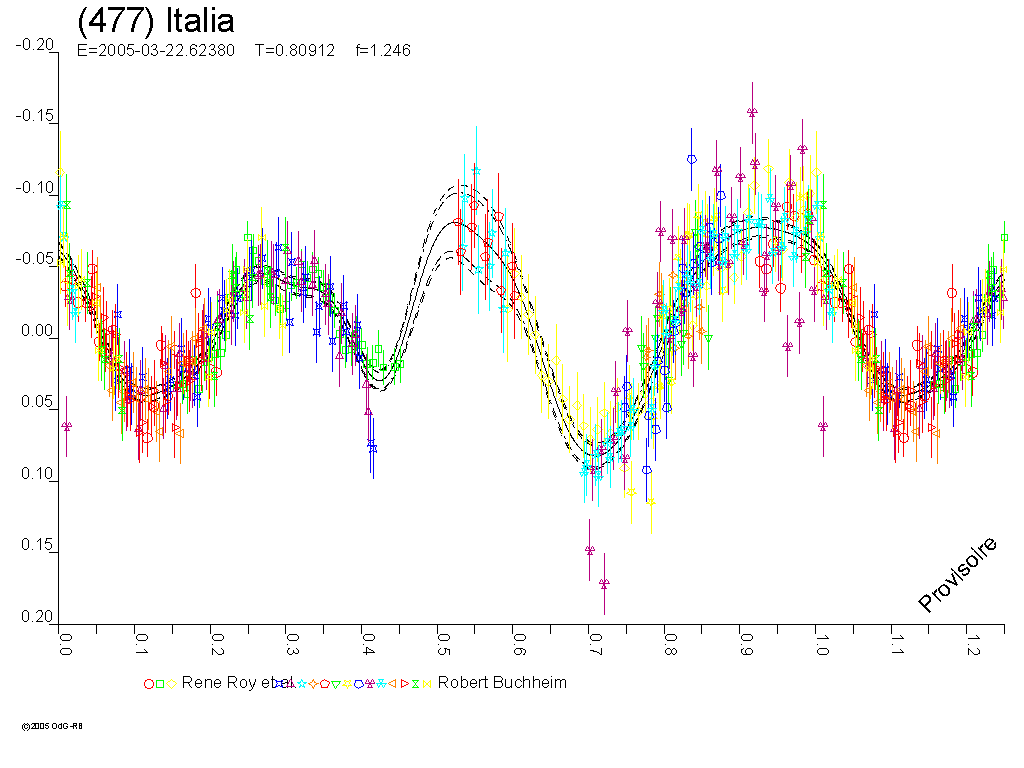
Light curve of (477) Italia: This was a tricky project! After devoting 6 nights to monitoring this object, I still didn't have a light curve that looked certain. I shared my data with Raoul Behrend (Geneva Observatory), and he was able to combine it with data from Rene Roy (France) and Kouhei Kitazato (Japan), to determine that the light curve period was long (19.42 hours), and odd-shaped (three-peaks, instead of the more usual two peaks). Refer to Dr. Behrend's website for the details: http://obswww.unige.ch/~behrend/page2cou.html
Epsilon Aurigae & a cure for Scintillation: The upcoming (2009) eclipse of eps-Aur presents a challenge because the star is so bright that it will saturate many photometric systems. Here's an approach to resolving that challenge with an aperture mask with three sub-apertures.