Nemesis
The Goddess Nemesis Rules
NEMESIS - HUMANITY'S 'CONSCIENCE'
Nemesis was the goddess of divine indignation and
retribution, who punished excessive pride, evil
deeds, undeserved happiness or good fortune, and the
absence of moderation. She was the personification of
the resentment aroused in both gods and mortals by
those who committed crimes with impunity, or who
enjoyed undeserved luck.
True to her name, which variously may be translated
as 'she who distributes or deals out'; 'due
enactment'; or 'divine vengeance', Nemesis was a
feared and revered goddess. With a discriminating eye
she directed human affairs in such a way as to
maintain equilibrium on earth. Happiness and
unhappiness were measured out by her, with firm care
being taken that happiness was not too frequent or
too excessive. If this happened, Nemesis could bring
about abrupt and catastrophic losses and suffering.
As one who kept extravagant favors by Tyche (Luck,
Fortune) in check, Nemesis was regarded as an
avenging or punishing divinity. Tyche was often
irresponsible in handing out Luck and Fortune,
indiscriminately heaping gifts from her horn of
plenty, or depriving others of what they had. But woe
be to the individual favored by Tyche who failed to
give proper dues to the gods, became too full of
himself and boasted of his abundant riches, or
refused to improve the lot of his fellow humans by
sharing his luck! Indignant Nemesis would step in and
snap the fool back to reality, in short order
humiliating him and causing his downfall.
Along with Dike and Themis, wise goddesses of
Justice, Nemesis was one of the assistants of Zeus,
the king of the Olympian gods who was regarded as the
founder of law and order. Her home was at Attic
Rhamnus, site of a magnificent sanctuary dedicated to
the feared goddess of divine vengeance.
About sixty stades from Marathon as you go along the
road by the sea to Oropus stands Rhamnus. The
dwelling houses are on the coast, but a little way
inland is a sanctuary of Nemesis, the most implacable
deity to men of violence. It is thought that the
wrath of this goddess fell also upon the foreigners
who landed at Marathon. For thinking in their pride
that nothing stood in the way of their taking Athens,
they were bringing a piece of Parian marble to make a
trophy, convinced that their task was already
finished.
Of this marble Pheidias made a statue of Nemesis, and
on the head of the goddess is a crown with deer and
small images of Victory. In her left hand she holds
an apple branch, in her right hand a cup on which are
wrought Aethiopians. As to the Aethiopians, I could
hazard no guess myself, nor could I accept the
statement of those who are convinced that the
Aethiopians have been carved upon the cup because of
the river Ocean. For the Aethiopians, they say, dwell
near it, and Ocean is the father of Nemesis.
Pausanias, Description of Greece
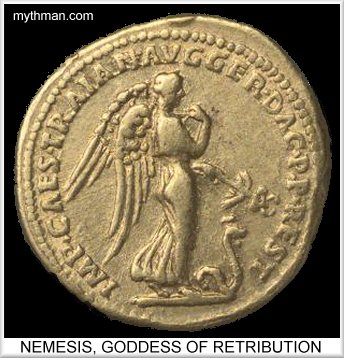
Beautiful Nemesis initially was portrayed without
wings, but in later descriptions she appeared as a
winged goddess. In her left hand she held an
apple-branch, rein, lash, sword, or balance. Her
symbols and attributes were like those of Tyche: a
wheel and a ship's rudder.
"Alexandros [the Great] was hunting on Mount
Pagos [near Smyrna], and that after the hunt was over
he came to a sanctuary of the Nemeseis, and found
there a spring and a plane-tree in front of the
sanctuary, growing over the water. While he slept
under the plane-tree it is said that the Nemeses
appeared and bade him found a city there and remove
into it the Smyranians from the old city … So
they migrated of their own free will, and believe in
two Nemeses instead of one, saying their mother is
Nyx, while the Athenians say that the father of the
goddess in Rhamnos is Okeanos.”
-Pausanias, Description of Greece 7.5.3
Nemesis was also known as Adrasteia, which means
'inescapable', or 'Tracing Goddess'. You could say
that Nemesis/Adrasteia was the ancient Greeks'
conscience, for the goddess of retribution
personified moral reverence for the natural order of
things and provided a deterrence to wrongful action.
She was also called Rhamnusia or Rhamnusis, in honor
of her sanctuary in Rhamnos.
Nobody wanted to be hounded by Nemesis, and even to
this day her name means:
1.A source of harm or ruin: "Uncritical trust is
my nemesis."
2.Retributive justice in its execution or outcome:
"To follow the proposed course of action is to
invite nemesis."
3.An opponent that cannot be beaten or overcome.
4.One that inflicts retribution or vengeance.
(source: http://dictionary.com )
Thus, you'll often read or hear quotes such as:
"This is that ancient doctrine of nemesis who
keeps watch in the universe, and lets no offense go
unchastised." --Emerson.
The
Story of Narcissus
A famous example
of the retribution of Nemesis is the story of
Narcissus. This man was the beautiful son of the
River Cephissus and the nymph Liriope. He was so
handsome that all women who beheld him at once fell
in love with him. The vain Narcissus, however, only
had eyes for himself (you could say he suffered from
"I" strain...) and rebuffed all admirers.
One such admirer was the nymph Echo, who saw
Narcissus and at once fell in love with him. But the
beautiful youth couldn't be bothered with the smitten
one, who slowly pined away, leaving just the echo of
her voice.
Nemesis saw this and condemned the vain Narcissus to
spend the rest of his days admiring his own
reflection in the waters of a pool. Eventually
Narcissus died and was transformed into the flower
that bears his name.