Home
Facts
Join our Club
Members
News
Events
Showing Tips
Classifieds
The Racing Greats
The Ridden Greats
| | Standardbreds
can do more than just harness racing...they make a fantastic a first horse and
you won't find a better, more reliable friend! Information
taken from www.horsewyse.com.au
What's
the difference between a trotter and pacer?
There are two types of Standardbreds – the trotter and the
pacer. When a horse 'trots', it uses the diagonal set of legs (such as
near side foreleg and offside hindleg) for each stride. Imagine a horse
stretching out and trotting at the speed of a galloping horse...that's
what a racing Standardbred 'trotter' is doing.
The 'pace' is where the horse uses both legs on the same side of the
body, at the same time, to propel itself along. Try it yourself – walk
along using the same arm and leg on the one side of your body. It's an
odd feeling isn't it? Now try doing it when you're running and that's
what a racing Standardbred 'pacer' is doing.
|
What
are the white marks along a Standardbred's neck?
This called a 'freeze brand' and it tells you via symbols which
Country the horse was born in, the year it was born and its registration
number with the harness racing register. Australian Standardbreds also
carry a freeze brand but overseas, they are mostly given a tattoo inside
their lip.
The HRNZ
web site can help you to understand what the brand symbols mean as
well a find out your standardbreds pedigree and race career information.
Is
it true that Standardbreds can only trot or pace?
No, a Standardbred is a horse first and can canter and gallop
just like any other horse. It's sometimes true that a Standardbred that
has come straight off the track (retired from racing) and is a pacer may
find it a little difficult to trot or do a three beat canter at first,
because it's using a different set of muscles and been tranied to pace
at speed. However with time and training they learn to use new sets of
muscles and supple up a little more.
Another interesting fact is that all horses can pace and sometimes
you'll see young foals of any breed pace a little, just to test out and
use different muscles.
|
Can
Standardbreds canter in circles?
Yes...you'll even see Standardbreds competing in dressage
competitions. Again, horses that have not been taught, or are recently
off the track will take a bit more education but they will learn to
canter in a circle, just like other horses.
What colours do they come in?
Standardbreds mostly favour bay colours, plus some chestnuts,
blacks and greys. Then there are the striking 'coloured' Standardbreds
that are now eligible to compete in Pinto show classes. |
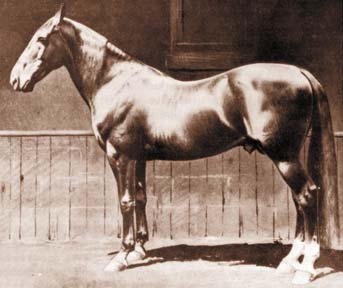
Hambletonian Himself |
What
are the origins of the breed?
The Standardbred evolved in 1849 when a man named William Rysdyk
purchased a crippled mare who had a 'cat hunched' foal at foot for
US$125. The foal was a colt named Hambletonian (pictured below left) and
although he was described as ugly, his ancestor was a horse named
Messenger who traced back to the three main Thoroughbred foundation
sires the Byerley Turk, Darley Arabian and the Godolphin Arabian.
In an era before cars, America relied on horses for transport, both
ridden and in harness and it was a bonus if that horse could also be
used to compete in the sport of weekend race meetings. So the idea of
increasingly fast carriage horses evolved and through selective
breeding, the Standardbred emerged.
As well as Thoroughbred bloodlines, Hackney, Morgan, Cleveland Bay,
Arabian, Barb and Canadian Pacer were used to produce a fast, strong
horse with staying power. Hambletonian went on to become the foundation
sire of the Standardbred and he can be traced back in the bloodlines of
almost 99% of today's registered Standardbreds. He passed on an ability
to trot and pace at high speeds and sired around 1,300 foals. Before
Hambletonian came on the scene and to help the selective breeding
process, only horses who could run a standard mile in less than two
minutes 30 seconds were allowed to race...hence the 'Standardbred' name.
What can Standardbreds do after racing?
Believe it or not you'll see Standardbreds competing in dressage,
endurance, showjumping, eventing, trail riding, Pony Club and Adult
Riders...in fact in almost every discipline except thoroughbred racing!
Many trail riding establishments use Standardbreds because they are
generally calm and reliable horses. The Standardbred is also one of the
preferred horses used by Riding for the Disabled.
They are very hardy, mostly due to the fact that a Standardbred in race
training will be exercised for up to 14 kilometers a day in one session,
when in race training. Many people own a Standardbred because it may
have been their first horse, it may have been less expensive to purchase
or they needed a horse they could learn on. There are quite a few adult
riders and Pony Club members who own a Standardbred and they have
probably all found how powerful the bond between them and their horse
becomes.
Where can I get a Standardbred?
You might want check out our classified page on this website, we
often advertise those looking for homes. You can also see Standardbreds
advertised in websites like Trade Me, Equine Trader HRNZ Market Place or
magazines and newspapers or get information from your nearest Harness
Racing Club or local trainer. |
|
 NORTH
ISLAND STANDARDBRED CLUB
NORTH
ISLAND STANDARDBRED CLUB