|
|
Solid Fuel Rockets :
|
|
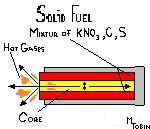 There are two types of conventional rockets. The first and oldest type is
the solid fuel rocket. Solid fuel rockets have fuel that is in a solid
state. The engine consists of the fuels around a hollow core. This hollow
core acts as the combustion chamber and nozzle for the rocket. Solid fuel
rockets are usually small and use a from of gunpowder, which is a mixture
of potassium nitrate (KNO3), Carbon (in the past usually in the
form of charcoal, but has been substituted for more pure form of carbon.)
and solid sulfur. When these burn the KNO3 produces oxygen
causing the carbon and sulfur to burn. The energy released from this
reaction creates a lot of heat very quickly, causing the gasses produced
from the reaction to expand rapidly. This rapid movement of the gas
particles causes a forward impulse force in the form of thrust.
There are two types of conventional rockets. The first and oldest type is
the solid fuel rocket. Solid fuel rockets have fuel that is in a solid
state. The engine consists of the fuels around a hollow core. This hollow
core acts as the combustion chamber and nozzle for the rocket. Solid fuel
rockets are usually small and use a from of gunpowder, which is a mixture
of potassium nitrate (KNO3), Carbon (in the past usually in the
form of charcoal, but has been substituted for more pure form of carbon.)
and solid sulfur. When these burn the KNO3 produces oxygen
causing the carbon and sulfur to burn. The energy released from this
reaction creates a lot of heat very quickly, causing the gasses produced
from the reaction to expand rapidly. This rapid movement of the gas
particles causes a forward impulse force in the form of thrust.
|

|
|
Liquid Fuel Rockets :
|
|
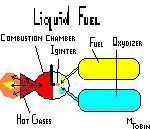
The second type of conventional rocket is the liquid fuel rocket. Liquid
Fuel Rockets are a lot more efficient than a solid fuel rocket, mainly
because they can be built lighter because you don�t need the hollow core
of the solid fuel rockets. Liquid rockets usually have two separate tanks
for holding the reactants. One usually contains the combustible fuel (i.e.
kerosene) and the other usually contains the oxidizer. (Usually liquid
oxygen.) The fuel can be anything that is a liquid that will burn, and give
off a gas and lots of heat energy.
 Some of these substances include
Gasoline, kerosene, nitrogen, and even hydrogen.
Some of these substances include
Gasoline, kerosene, nitrogen, and even hydrogen.
In a liquid fuel rocket engine the fuel and oxidizer are pumped into the
combustion chamber, and are then ignited either by an igniter (a alcohol
burner in Goddard�s rocket) or just by the heat energy produced by the
reaction before it. Either way once the activation energy is reached the
combustion begins giving off tremendous heat energy, causing the resulting
gases to expand being forced out the nozzle of the chamber again causing
thrust. Because all of the products of the reactions are gases in a liquid
fuel rocket that can sometimes be as harmless as water, liquid fuel rockets
are considered to be cleaner than solid fuel rockets.
|
|
|
|
The Chemistry Relation :
|
|
All Conventional rockets all work on the same basic principle; they all
use heat from a chemical reaction to produce heat that causes the gases
that are produced from the reaction to expand causing pressure to build up
in the combustion chamber, causing the gases to reach a high escape
velocity generating a thrust.
We can figure out approximately much pressure is built up in the combustion
by: 1) Using Hess� Law or the values given to us for how much heat energy
is produced in the reaction. 2) then using our calorimetric equation (q = m ∙ C ∙ Δ T)
and solve for Δ T and then by using the Combined gas law
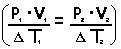
and solve for the P2 we can find the pressure inside the
combustion chamber. The using physics equations you should be able to find
the thrust.
|
|
|
|
The Chemistry Relation :
|
|
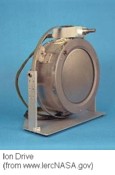 An ion drive is a much more complicated system to explain and understand, but once you
know how it works it is much easier build and maintain. An ion drive uses a �cathode� or
and electron gun, that shoots a stream of electrons, (much the same as in your television
set) which is shot towards an anode, a positively charged ring and a magnetic field
(either produce by a magnet or an electromagnet). This beam of electrons is used to
ionize the propellant, by giving the atoms of the propellant electrons to make them
stable. The ions are drawn into the extraction grid, (Looks like two or three section
of a screen door that has a lot of high voltage current running through it.) the gird
draws in the ions and shoots them out into space with an extremely high velocity
generating a forward thrust. The ions are then shot again by neutralizer in order to
keep the spacecraft from gaining a charge.
An ion drive is a much more complicated system to explain and understand, but once you
know how it works it is much easier build and maintain. An ion drive uses a �cathode� or
and electron gun, that shoots a stream of electrons, (much the same as in your television
set) which is shot towards an anode, a positively charged ring and a magnetic field
(either produce by a magnet or an electromagnet). This beam of electrons is used to
ionize the propellant, by giving the atoms of the propellant electrons to make them
stable. The ions are drawn into the extraction grid, (Looks like two or three section
of a screen door that has a lot of high voltage current running through it.) the gird
draws in the ions and shoots them out into space with an extremely high velocity
generating a forward thrust. The ions are then shot again by neutralizer in order to
keep the spacecraft from gaining a charge.
|
|
|
|

