
It is generally accepted that gunpodwer (the primary fuel of rockets until the early
20th century) were invented around the ninth century in China and was first
used in rockets around the 13th century, but were mainly used as weapons and
for cerimonial purposes (fireworks). Sometime around the 14th century it is
believed that the arab people broght gunpowder and rockets to Spain and from there it
made it�s way to the other countries of Europe, where the fomula of gunpowder was
documented and improved upon by Robert Bacon to make it a more effective explosive.
 (which also made a more efficent rocket fuel.) Because Europeans didn�t commonly use
rocket for weapons, rockets didn�t really advance after that for another six hundred years.
(which also made a more efficent rocket fuel.) Because Europeans didn�t commonly use
rocket for weapons, rockets didn�t really advance after that for another six hundred years.
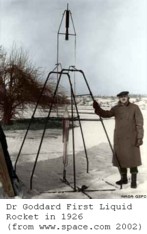
But in 1909 Dr. Robert H Goddard, a New England Physics Professor and a pioneer in rocket
technology had an idea to make a rocket that did not use solid fuel but fuel that was in a
liquid form. He came to the conclusion that a rocket that used a liquid fuel would be burn
faster and hotter than a solid fueled rocket. It took him seventeen years of theoretical
and experimental work, but on March 16 1926 Dr. Goddard�s idea became a reality when he
launched the first liquid fueled rocket. And from that time on rocket fuel technology grew
in leaps and bounds with new and even more efficient fuels being discovered. Because it
used a liquid fuel instead of a solid fuel it was much more efficient and rockets became
noticed as a from of weaponry
 and was quickly developed further. By the 1960 rockets had
grown to be hundreds of feet high and could travel more than half way around the world and
even into space.
and was quickly developed further. By the 1960 rockets had
grown to be hundreds of feet high and could travel more than half way around the world and
even into space.
Along with the increase in size and the increase in range, new types of fuel were also
developed. The fuel changed to more combustible types of fuel, from the gasoline that was
used to power Dr. Goddard�s rocket to Kerosene used in the Saturn V rocket that Carried
people to the moon, and later even hydrogen was used to power the Space Shuttles. Now
Conventional rockets have almost reached their limits, an the space programs are
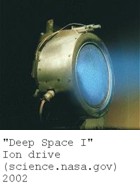
desperately searching for more efficient was to move something in space. And so in 1998
the first ion drive rocket engine was put into the �Deep Space I� probe, other sources of
power are also being considered, such as fission powered rockets and fusion powered rockets.


