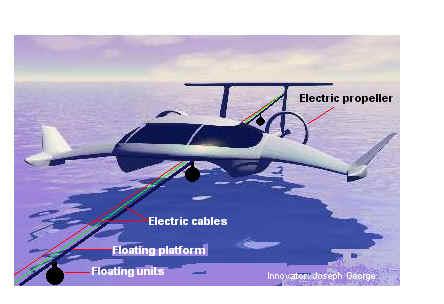
Scientists developed Ground Effect Craft (G.E.C) because our world is getting
smaller and as a Global community people are calling out for faster, more
efficient means of sea transport for both cargo and people. A ground effect
craft can meet these challenges. It is nearly as fast as Aircraft but uses much
less energy to fly, it can land and take off from water or land. It flies but
doesn't need an airport and it can carry passengers or cargo. Studies indicates
that a properly configured Ground Effect Craft can operate at up to 40% less
fuel burn than an equivalent sized and loaded aircraft, this makes fast cheap
marine transport a viable alternative to air transport, in an ever increasingly
cost conscious global market place.
Construction of floating platform on the sea/ lake surface:
On costal region: On the costal regions, the amplitudes and activities of
the waves is maximum, but the depth of the sea will be lower. Because of the
depth is lower, we can construct concrete supporting stands from sea bottom and
can wire electrical cables through that supporting stands even if increasingly
activated waves are present in these regions.
Distant sea: Amplitudes and activities of the waves will be lowered
and the sea will be more stable in the remote regions. In a more stable distant
sea, we can construct floating platforms and can wire electric cables through
the floating platforms.
Spacing of the installation of floating platforms and wiring of electric
cables through the platforms:
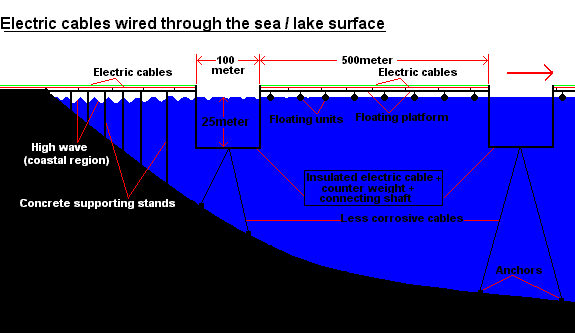
The length of a floating platform is about 500meter, width is about 1feet and
height from the sea surface is about 1meter. The electric cables are wired
through above the platform. After the 500meter long floating platform, the
electric cables are going to the next 100 meter of distance through (insulated
cable) about 25meter below the sea surface. After 100meter, the floating
platform and the electric cable are reappears to the sea surface to 500meter.
Then, after the 500meter long floating platform, the100meter of electric cables
are again going through 25meter below the sea surface and so on (see.fig). Since
the distance between two floating platforms are 100meter, ships and boats can
pass through the spaces.
The connecting shaft and counter weight:
The 100meter of insulated electric cables between two floating platforms are
wired through a 100meter long connecting shaft (25meter below the sea surface).
The connecting shaft connects two floating platforms together and also working
as a counter weight. The counter weight maintains the floating platforms always
in straight vertical.
Floating platform:
The floating platforms are constructed with low weight, less corrosive
material or good strength air bags. A 500meter long floating platform is
constructed with a number of small floating units. Each units are connected with
turning pair mechanisms. With the help of the turning pairs that fixed
in-between every floating units, the wave / wind energy will be absorbed
by the floating platform. Every units can oscillate or slightly slide in both
direction individually, when waves or winds are present, but it will not affect
the total alignment of the floating platforms. The connecting shafts are tied to
the sea bottom.
Tying of the connecting shafts to the sea bottom:
The connecting shafts are tied to the sea bottom to both sides with the help
of anchors.
Anchors:
The anchors can be made with concrete blocks with sufficient masses. Hooks
are provided on the anchors for tying the corrosion resistant cables to that. The
anchors can simply drop to the sea bottom from ships.
Electric cable: Onepair( phase & neutral) of electric cables are wired through the floating
platform (see.fig).
Rechargeable battery inside the vehicle:
Rechargeable batteries are provided inside the vehicles. The rechargeable
batteries delivers electric energy when the vehicle flies the100meter of
distances between every floating platforms.
Electric contact: Spring electric wire with two internal cables (for
phase & neutral) are provided from the bottom of vehicle. The electric
contacts provided on the other end of the spring electric wire will mesh with
the electric cable, that wired on the floating platform when the vehicle flies
near above of the floating platform. When the electric contacts meshes to the
electric cables, the electric power will be transmitted to the rechargeable
battery inside of the vehicle and also to the electric propellers of the
vehicle. When the electric contacts touches to the electric cable, the electric
propellers consumes electric energy directly from the electric cables and also,
the batteries will be charged. The spring electric wire maintains the contact
with the electric cables when the vehicle moves upward or downward direction or
slightly both sides, with the help of its expansion or contraction.
Working:
When the spring electric contacts touches to the electric cables and the
electric propellers are turned on, the propellers will rotate. Now the craft
will move on the sea surface. As the velocity increased to the lift velocity,
the craft will take off from the sea surface. After the 500meter of distance,
the floating platform ends. Now the electric propellers consumes electric energy
from the batteries inside the vehicle. Then, after the 100meter of distance, the
floating platform and electric cables will reappears and the craft consumes
electric energy from electric cables and the batteries will be recharged and so
on. When the craft maintain to fly in near surface of the sea (about 1meter),
because of the ground effect the craft will fly with high efficiency. When the
rotations of the electric propellers were lowered, the craft will land on the
sea surface.
Electric sea plane (flywheel model).
The rechargeable batteries inside the craft can be replaced with flywheels
with sufficient mass.
The flywheels:
Two flywheels with sufficient mass are rotating in opposite directions in
same speed. When two same mass flywheels rotates in opposite directions in same
speed, the torque of the flywheels cancels each other.
Working of the flywheel model:
When the electric contacts touches to the electric cables, the electric
propellers consumes energy directly from electric cables, and also the flywheels
rotates at high speed and stores mechanical energy in it. When the power
interruption occurs after 500meter (in the absence of floating platform and
electric cables), the flywheels delivers the required mechanical energy to the
propellers. When the floating platform and electric cables are reappears after
the 100meter of distance, the electric contacts will again touches to the
electric cables and the electric propellers consumes energy directly from the
electric cables and also, the flywheels again stores mechanical energy in it and
so on.
Comparisons between battery model and flywheel model:
a) The time required for the recharging of the batteries will be
comparatively long period. A long floating platform in the sea/ lake will cause
long obstacles to the ships or other transportation systems. But in the cause of
flywheels, the time required for store mechanical energy in it will be less than
batteries and so the length of floating platform can be minimized.
b) Weight of the batteries will be larger than flywheels and this increased
weight will cause low efficiency.
c) The efficiency of recharging of the batteries will be less than the
storing of mechanical energy in properly balanced flywheels.
d) Life of the rechargeable batteries will be less than flywheels.
Potential uses and applications:
Passenger Transport:
1) Inter island, 2) International (in distant future), 3) Water taxi.
Cargo transport:
1) Sea food, 2) high value exports.
Advantages:
a) Since the passengers / goods and the Electric- Ground effect craft 'weight
ratio' is minimum, it will be more efficient.
b) Since the craft is flying through the near surface of the sea, because of
the 'ground effect', the power conception reduces considerably.
c) Velocity of the craft can be increased nearly as fast as Aircraft.
d) Expenses for making the floating platforms on the sea surface will be very
less than the construction of under sea tunnels.
e) The Electric- Ground effect craft will be very suitable for fast
transportation through vast lakes.
Disadvantages:
a) Chances of the destruction of the floating platforms because of high
winds, high waves, floating icebergs etc and also thereby maintenance charge.
b) Construction of floating platforms on the sea with high depth will be
difficult.
c) Danger of high voltage electric cables below the craft.
d) The construction of floating platforms through a busy water
way may cause traffic difficulties for normal transportation systems.
e)
The requirement of the step upping of the line voltage in long distance path.
 [Main directory] [Energy
from land tidal force]
[Energy
from snow/ice fall]
[Wave energy
extractors]
[Wind
barrier system for generating Hydrogen]
[Tide
barrier system] [Energy
from capillary effect in the presents of solar light] [Vacuum
refrigerator] [Wing
levitated train] [Electric
sea plane] [Thermo
electricity in outer space] [Electro
magnetic flying disc] [Researcher
and inventor]
[Main directory] [Energy
from land tidal force]
[Energy
from snow/ice fall]
[Wave energy
extractors]
[Wind
barrier system for generating Hydrogen]
[Tide
barrier system] [Energy
from capillary effect in the presents of solar light] [Vacuum
refrigerator] [Wing
levitated train] [Electric
sea plane] [Thermo
electricity in outer space] [Electro
magnetic flying disc] [Researcher
and inventor]