The History of theatre in Kalamazoo

The City of Kalamazoo has undergone many colorful
changes since Titus Bronson founded Kalamazoo. From 1890-1900 Kalamazoo was
called the "Celery City" because of the predominance of celery fields in the
area. From 1900-1917 Kalamazoo earned the nickname of the "Paper City". During the Great Depression of the 1930's, the
city owed almost no money to the federal government, giving rise to the name,
the "debt free city". In 1959, Kalamazoo installed what is believed to be the
first downtown pedestrian mall, and the city became known as "Mall City".
the nickname of the "Paper City". During the Great Depression of the 1930's, the
city owed almost no money to the federal government, giving rise to the name,
the "debt free city". In 1959, Kalamazoo installed what is believed to be the
first downtown pedestrian mall, and the city became known as "Mall City".
These nicknames have been remembered, but the forgotten
name might have listed Kalamazoo as "the Theater City". Between the 1860's and
the 1930's, the city underwent an insurgence of the building of nickelodeons,
film, vaudeville, and live theatres which could justify adding one more name to
the list being, 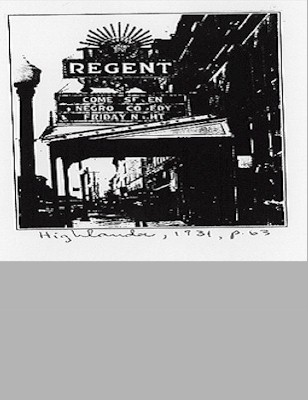 Kalamazoo
"The Theater City".
Kalamazoo
"The Theater City".
It was not until the opening of the Opera House that Kalamazoo had a "real" theater. In a Gazette article from June 1930, Kalamazoo is described as a growing city, as demonstrated by its demands for extended amusement; this demand was met by a Mr. Wikes Mclave, who promised to present a first class performance every weekday night for an admittance of 10 and 20 cents. It was during this period in America's history that new forms of entertainment were coming across the country by way of the railroad.
The first of these were called Tom Shows, based on the play Uncle Tom's Cabin, which was first produced in 1852. By the end of the nineteenth century there were almost four hundred Tom shows playing throughout the country. Tom shows is a theatrical term for a touring production of Uncle Tom's Cabin. The Academy of Music was host to one of these Tom shows. An article from the Kalamazoo Gazette says "that one night before the curtain went up, one of the dogs was supposed to run barking across the stage for food, but stopped in the middle happily wagging its tail, which sent the audience into great laughter".
The next national theater movement, which influenced Kalamazoo, was vaudeville. A vaudeville or variety show consisted of a series of unrelated specialty acts most of which were comedy routines. Vaudeville first appeared in Kalamazoo beginning in 1843, when performances were staged at the courthouse. It was not until 1907, when the Majestic Theater opened on South Street that Kalamazoo had its own vaudeville house. On opening night, a motion picture was shown which proved to be "not up to standard". The live acts included Mr. & Mrs. Franklin Colby, whose "European Novelty offering", featured their latest invention, electrical Swiss bells. William H. Window did a skit called "The Bride-elect." A critic called the skit "excruciatingly mirth-provoking." The headlining act was the American Florence Troupe of acrobats, consisting of: three women, two men and a boy.
On May 8, 1882, the Academy of Music opened with the eminent tragedian, John McCullough, supported by a powerful company. Parquet dress circle seats sold at $5.00 and gallery seats went for $1.00. The first week of entertainment included Gilbert and Sullivan"s "Patience". In 1897, the audience at the Academy saw what was to be the downfall of the academy and other theatres like it. The device created by Thomas Edison known as the Vitascope this was the beginning of what would be later turned the motion picture or movie as it is called today. Later, the Academy, was renamed the Regent, but was destroyed by fire in June of 1930.
As it was just mentioned, the 1890's brought about the birth of movies. Edison's Vitascope was an attempt to make a series of photographs of people moving quickly, appearing to be natural movement. These movies were first exhibited as peep shows in penny arcades and billiard-rooms. You would put a penny in a slot and look through a peephole and watch a girl dance or a baby take a bath. The Palace of Amusement was just such one of those places, not an actual theater but operated with amateur productions and novelty gimmicks. This venture would last three years from December 1903 to March 1906. One of the shortest lived of these theaters, was the Greatest Life which opened in a storefront. Showing films with published advertisements from Dec 22, 1904 to Jan 4, 1904, a whole 12 days.
From that time, the age of film reigned in the next phase of theater construction in Kalamazoo. The next group of theatres to be built came almost within a three-year period from 1907-1910, and included the Bijou, Colonial, Grand, Uptown, Capitol, Royal, Queen, and Fuller. They all ran as film houses which was becoming the new media that people wanted to see, taking the place of live theatre and nickel arcades. This trend would last well into the roaring twenties when Vaudeville and movies or talkies as they were called competed for a share the spotlight. The movies required expensive new equipment which meant that the price of admission would go up and more and more movies would be shown this could strongly be attributed to the demise of vaudeville.
In July 1927, the State Theater was built for the express purpose of Vaudeville and film. Before long this classic atmosphere theatre was run as a film house for most of the twentieth century. However, a change in management ended all that. It is now being used a concert hall for popular forms of musical entertainment. The building of the State ended the theater explosion that Kalamazoo experienced during this time period.
Although the days of Tom shows, Vaudeville, and "talkies are gone it is possible to convey that Kalamazoo could be still be considered a theatre city. It can boast of seven operational theatres within the city limits. Starting with the State which is the only theatre still being used as a form of entertainment. The New Vic, the Kalamazoo civic, the API, the whole art, Chenery or old central high school. All which in one way or another as actual form of theatre retaining Kalamazoo's title as the Theatre City.