On Sacred Ground
Lost in such ecstasies in this old spot
I feel that rapture which the world hath not,
That joy like health that flushes in my face
Amid the brambles of this ancient place...
JOHN CLARE
Those of you familiar with legend and lore of all civilisations will be aware of the three categories of God and Goddess that exist therein. Many of these Gods will have parallels among the deities of other cultures... sea gods, horse goddesses and virgin births are all commonly found in the literature and memory of many ancient civilisations, and may even form the basis of the most common religions today. Let us consider these three categories:
Firstly, the Stellar Gods or Gods of the Underworld. These commonly deal with primal instincts of birth and death; many of us are familiar with tales regarding visits to the Underworld, such as the trips of Orpheus and of Oisin. Then, the Solar or Planetary Gods, who concern themselves with the powers of divine creation. Many legends concern Gods and Mortals creating children, such as Nemglan the bird-god with Mess Buachalla, Leda and Danae; and Zeus begetting Castor and Pollux. Similar stories exist in Christian literature, not only that the Christian God created the universe and everything in it, but also produced his son by mortal (virgin) birth. The third type of God is described as a Lunar or Land God, and covers all those not yet accounted for. These may be Gods of non-creative powers, such as War (like Mars) or Harvest, or they may have a special interest in a particular community or living thing, like Rhiannon the Horse-Goddess and her counterparts.
In any case, all three categories concern themselves directly or indirectly with nature: the land gods certainly so, and in the most direct fashion, whilst the stellar and solar gods concern themselves with the creation and destruction rather than conservation and preservation of natural states. In fact, we should realise that to all ancient civilisations the land itself was a living, sacred entity. There was no intellectual separtion between 'religious' and 'living' or 'true': all life, acts and relationships were essentially religious as a matter of simple fact rather than form. Formalised religious sites included the sacred groves set up by Druids and the shrines and temples of the Roman Celts, as well as wells and springs being signs of the presence of Gods. Yet these were merely the centres of an ongoing regard for creation, through which energies created by worship could function to their full extent. There is a story of Roman legionaries attempting to take over the Druidic sanctuary on Anglesey, a small island in North Wales, who were temporarily paralysed by the chants and curses of the black-clad Druidesses - no doubt the shock at the sight of the frenzied women made them falter, but they still felt it necessary to neutralised the religious strength of the grove by steeping it in the blood of their victims once the battle was over. Such basic sites and rites were recognised by all cultures in all lands.
In any case, the Druids regarded certain living things as special and relevant to them, and the best examples of these are outlined briefly below.
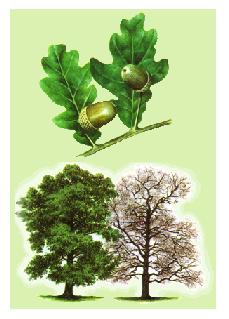
The Pendunculate or English Oak (Quercus robur)
Along with the Sessile Oak (Quercus petraea), these are the only oaks native to Britain and therefore more common on the island. Two species are easily confused - the leaves and acorns are similar in shape, yet are the key to the easiest way to tell them apart. The English Oak leaves have lobed, stalkless leaves and stalked acorns, while the Sessile's leaves are stalked and its acorns unstalked. Single and groved trees vary in shape from each other: an oak which has grown alone will have a short trunk spreading quickly into many sturdy branches, while close-grown oaks may have up to 20m of stright, branchless trunk. Therefore even in areas of heavy felling or ridden with disease, it should still be possible to tell how many such trees were once present. English Oak plantations in ringed formations on hillocks were the most popular Druidic grove setting, as it enabled rituals to be contained within, along with a certain degree of defendability and inaccessibility for privacy.
|
 |
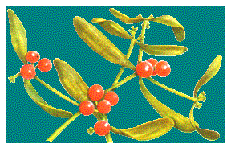 |
Mistletoe
An attractive parasite, but a parasite nevertheless, Mistletoe growing in a tree saps the food produced by its host and absorbs it directly, as it has lost the capacity to produce all the food it needs to survive. In doing so, the mistletoe damages the tree it grows on, usually through depriving it of its own food, and can occasionally kill young, less-developed trees. Druids, however, see it as a positive sign: that a God has sent a blessing upon the tree it grows on, and so harvesting mistletoe is a rite rather than an act of conservation. Still, it helps the tree too... especially if it happens to be an oak. Its berries can be red or white: Druids generally are said to have preferred the white-berried variety, as it symbolised peace and purity rather than being blood-coloured.
|
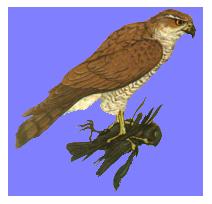
The Hawk
Most usually the Goshawk in the British Isles, though occasionally the American Sparrowhawk. The Hawk, like the Eagle, was perceived as a bird of great wisdom, and therefore the Druid prophets in particular held great interest in the ways of the Birds of Prey, hoping perhaps to learn from them. Legends speak of various sorcerors and seers turning themselves into birds of prey to pay visits on enemies, such as the bard Taliesin, and mistaken identities very often led to the accidental injury or death of the bird in question, for example the near fatality of Lleu Llaw Gyffes. Therefore the birds are held in high esteem.
|
 |
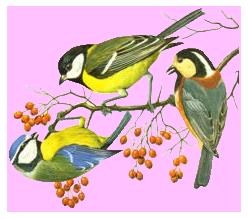 |
Small Birds
Whilst being of seemingly little value to a Druid's wisdom or strength, small birds were often lauded for having particular powers over humans: in particular that of song. The bards and poets admired the capacity of birdsong to sooth the angry and warring, and perceived its power to be strong enough to wake the dead and lull the living to sleep. The blackbird and robin, common species in the British Isles since long ago, have especially delightful songs, and recent attempts to decode blackbird 'speech' have resulted in an ultra-complex series of layers of communication. Maybe from them we could learn something of wisdom still.
|