The Operating System

Operating System (OS), in computer science, the basic software that controls a computer. The operating system has three major functions: It coordinates and manipulates computer hardware, such as computer memory, printers, disks, keyboard, mouse, and monitor; it organizes files on a variety of storage media, such as floppy disk, hard drive, compact disc, and tape; and it manages hardware errors and the loss of data.
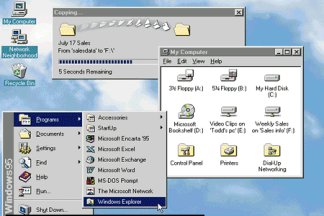

Operating systems control different computer processes, such as running a spreadsheet program or accessing information from the computer's memory. One important process is the interpretation of commands that allow the user to communicate with the computer. Some command interpreters are text oriented, requiring commands to be typed in. Other command interpreters are graphically oriented and let the user communicate by pointing and clicking on an icon, an on-screen picture that represents a specific command. Beginners generally find graphically oriented interpreters easier to use, but many experienced computer users prefer text-oriented command interpreters because they are more powerful.
 Operating systems are either single-tasking or multitasking. The more primitive single-tasking operating systems can run only one process at a time. For instance, when the computer is printing a document, it cannot start another process or respond to new commands until the printing is completed.
All modern operating systems are multitasking and can run several processes simultaneously. In most computers there is only one central processing unit (CPU), (the computational and control unit of the computer), so a multitasking OS creates the illusion of several processes running simultaneously on the CPU. The most common mechanism used to create this illusion is time-slice multitasking, whereby each process is run individually for a fixed period of time. If the process is not completed within the allotted time, it is suspended and another process is run. This exchanging of processes is called context switching. The OS performs the "bookkeeping" that preserves the state of a suspended process. It also has a mechanism, called a scheduler, that determines which process will be run next. The scheduler runs short processes quickly to minimize perceptible delay. The processes appear to run simultaneously because the user's sense of time is much slower than the processing speed of the computer.
Operating systems are either single-tasking or multitasking. The more primitive single-tasking operating systems can run only one process at a time. For instance, when the computer is printing a document, it cannot start another process or respond to new commands until the printing is completed.
All modern operating systems are multitasking and can run several processes simultaneously. In most computers there is only one central processing unit (CPU), (the computational and control unit of the computer), so a multitasking OS creates the illusion of several processes running simultaneously on the CPU. The most common mechanism used to create this illusion is time-slice multitasking, whereby each process is run individually for a fixed period of time. If the process is not completed within the allotted time, it is suspended and another process is run. This exchanging of processes is called context switching. The OS performs the "bookkeeping" that preserves the state of a suspended process. It also has a mechanism, called a scheduler, that determines which process will be run next. The scheduler runs short processes quickly to minimize perceptible delay. The processes appear to run simultaneously because the user's sense of time is much slower than the processing speed of the computer.
Operating systems can use virtual memory to run processes that require more main memory than is actually available. With this technique, space on the hard drive is used to mimic the extra memory needed. Accessing the hard drive is more time-consuming than accessing main memory, however, so performance of the computer slows.

The operating systems commonly found on personal computers are UNIX, Macintosh OS, MS-DOS, OS/2, and Windows '95. UNIX, developed in 1969 at AT&T Bell Laboratories, is a popular operating system among academic computer users. Its popularity is due in large part to the growth of the interconnected computer network known as the Internet, the software for which initially was designed for computers that ran UNIX. Variations of UNIX include SunOS (distributed by SUN Microsystems Inc.), Xenix (distributed by Microsoft Corporation), and Linux. UNIX and its clones support multitasking and multiple users. Its file system provides a simple means of organizing disk files and lets users protect their files from other users. The commands in UNIX are not intuitive, however, and mastering the system is difficult.
DOS (Disk Operating System) and its successor, MS-DOS, are popular operating systems among users of personal computers.
The file systems of DOS and MS-DOS are similar to that of UNIX, but they are single user and single-tasking because they were developed before personal computers became relatively powerful. A multitasking variation is OS/2, initially developed by Microsoft Corporation and International Business Machines (IBM).
Few computer users run MS-DOS or OS/2 directly. They prefer versions of UNIX or windowing systems with graphical interfaces, such as Windows 95 or the Macintosh OS, which make computer technology more accessible. However, graphical systems generally have the disadvantage of requiring more hardware-such as faster CPUs, more memory, and higher-quality monitors-than command-oriented operating systems.

Operating systems continue to evolve. A recently developed type of OS called a distributed operating system is designed for a connected, but independent, collection of computers that share resources such as hard drives. In a distributed OS, a process can run on any computer in the network (presumably a computer that is idle) to increase that process's performance. All basic OS functions-such as maintaining file systems, ensuring reasonable behavior, and recovering data in the event of a partial failure-become more complex in distributed systems.
Research is also being conducted that would replace the keyboard with a means of using voice or handwriting for input. Currently these types of input are imprecise because people pronounce and write words very differently, making it difficult for a computer to recognize the same input from different users. However, advances in this field have led to systems that can recognize a small number of words spoken by a variety of people. In addition, software has been developed that can be taught to recognize an individual's handwriting.
|