Number systemNumber Systems, in mathematics, various notational systems that have been or are being used to represent the abstract quantities called numbers. A number system is defined by the base it uses, the base being the number of different symbols required by the system to represent any of the infinite series of numbers. Thus, the decimal system in universal use today (except for computer application) requires ten different symbols, or digits, to represent numbers and is therefore a base-10 system.
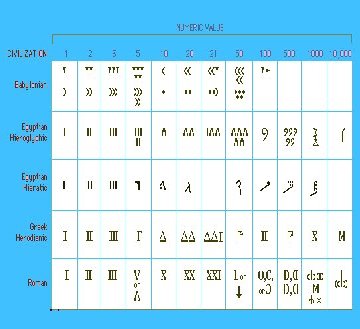 Throughout history, many different number systems have been used; in fact, any whole number greater than 1 can be used as a base. Some cultures have used systems based on the numbers 3, 4, or 5. The Babylonians used the sexagesimal system, based on the number 60, and the Romans used (for some purposes) the duodecimal system, based on the number 12. The Mayans used the vigesimal system, based on the number 20. The binary system, based on the number 2, was used by some tribes and, together with the system based on 8, is used today in computer systems.
Binary systemThe binary system plays an important role in computer technology. The first 20 numbers in the binary notation are 1, 10, 11, 100, 101, 110, 111, 1000, 1001, 1010, 1011, 1100, 1101, 1110, 1111, 10000, 10001, 10010, 10011, 10100. The zero here also has the role of place marker, as in the decimal system. Any decimal number can be expressed in the binary system by the sum of different powers of two. For example, starting from the right, 10101101 represents (1 � 20) + (0 � 21) + (1 � 22) + (1 � 23) + (0 � 24) + (1 � 25) + (0 � 26) + (1 � 27) = 173. This example can be used for the conversion of binary numbers into decimal numbers. For the conversion of decimal numbers to binary numbers, the same principle can be used, but the other way around. Thus, to convert, the highest power of two that does not exceed the given number is sought first, and a 1 is placed in the corresponding position in the binary number. For example, the highest power of two in the decimal number 519 is 29 = 512. Thus, a 1 can be inserted as the 10th digit, counted from the right: 1000000000.
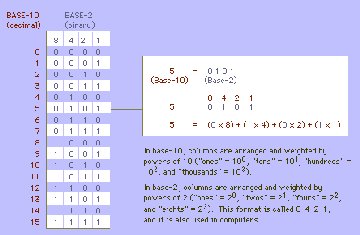 In the remainder, 519 - 512 = 7, the highest power of 2 is 22 = 4, so the third zero from the right can be replaced by a 1: 1000000100. The next remainder, 3, consists of the sum of two powers of 2: 21 + 20, so the first and second zeros from the right are replaced by 1: 51910 = 10000001112.
Arithmetic operations in the binary system are extremely simple. The basic rules are: 1 + 1 = 10, and 1 � 1 = 1. Zero plays its usual role: 1 � 0 = 0, and 1 + 0 = 1. Addition, subtraction, and multiplication are done in a fashion similar to that of the decimal system:
Because only two digits (or bits) are involved, the binary system is used in computers, since any binary number can be represented by, for example, the positions of a series of on-off switches. The "on" position corresponds to a 1, and the "off" position to a 0. Instead of switches, magnetized dots on a magnetic tape or disk also can be used to represent binary numbers: a magnetized dot stands for the digit 1, and the absence of a magnetized dot is the digit 0. Flip-flops-electronic devices that can only carry two distinct voltages at their outputs and that can be switched from one state to the other state by an impulse-can also be used to represent binary numbers; the two voltages correspond to the two digits. Logic circuits in computers (see Computer; Electronics) carry out the different arithmetic operations of binary numbers; the conversion of decimal numbers to binary numbers for processing, and of binary numbers to decimal numbers for the readout, is done electronically. In the remainder, 519 - 512 = 7, the highest power of 2 is 22 = 4, so the third zero from the right can be replaced by a 1: 1000000100. The next remainder, 3, consists of the sum of two powers of 2: 21 + 20, so the first and second zeros from the right are replaced by 1: 51910 = 10000001112.
Arithmetic operations in the binary system are extremely simple. The basic rules are: 1 + 1 = 10, and 1 � 1 = 1. Zero plays its usual role: 1 � 0 = 0, and 1 + 0 = 1. Addition, subtraction, and multiplication are done in a fashion similar to that of the decimal system:
Because only two digits (or bits) are involved, the binary system is used in computers, since any binary number can be represented by, for example, the positions of a series of on-off switches. The "on" position corresponds to a 1, and the "off" position to a 0. Instead of switches, magnetized dots on a magnetic tape or disk also can be used to represent binary numbers: a magnetized dot stands for the digit 1, and the absence of a magnetized dot is the digit 0. Flip-flops-electronic devices that can only carry two distinct voltages at their outputs and that can be switched from one state to the other state by an impulse-can also be used to represent binary numbers; the two voltages correspond to the two digits. Logic circuits in computers (see Computer; Electronics) carry out the different arithmetic operations of binary numbers; the conversion of decimal numbers to binary numbers for processing, and of binary numbers to decimal numbers for the readout, is done electronically.
Logic gatesSwitching and timing circuits, or logic circuits, form the heart of any device where signals must be selected or combined in a controlled manner. Applications of these circuits include telephone switching, satellite transmissions, and digital computer operations.
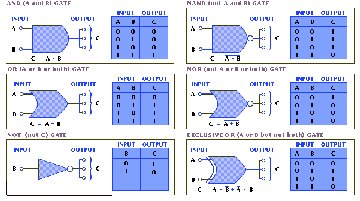
Digital logic is a rational process for making simple "true" or "false" decisions based on the rules of Boolean algebra. "True" can be represented by a 1 and "false" by a 0, and in logic circuits the numerals appear as signals of two different voltages. Logic circuits are used to make specific true-false decisions based on the presence of multiple true-false signals at the inputs. The signals may be generated by mechanical switches or by solid-state transducers. Once the input signal has been accepted and conditioned (to remove unwanted electrical signals, or "noise"), it is processed by the digital logic circuits. The various families of digital logic devices, usually integrated circuits, perform a variety of logic functions through logic gates, including "OR," "AND," and "NOT," and combinations of these (such as "NOR," which includes both OR and NOT). One widely used logic family is the transistor-transistor logic (TTL).
Another family is the complementary metal oxide semiconductor logic (CMOS), which performs similar functions at very low power levels but at slightly lower operating speeds. Several other, less popular families of logic circuits exist, including the currently obsolete resistor-transistor logic (RTL) and the emitter coupled logic (ELC), the latter used for very-high-speed systems.
The elemental blocks in a logic device are called digital logic gates. An AND gate has two or more inputs and a single output. The output of an AND gate is true only if all the inputs are true. An OR gate has two or more inputs and a single output. The output of an OR gate is true if any one of the inputs is true and is false if all of the inputs are false. An INVERTER has a single input and a single output terminal and can change a true signal to a false signal, thus performing the NOT function. More complicated logic circuits are built up from elementary gates. They include flip-flops (binary switches), counters, comparators, adders, and more complex combinations.
To perform a desired overall function, large numbers of logic elements may be connected in complex circuits. In some cases microprocessors are utilized to perform many of the switching and timing functions of the individual logic elements (see Microprocessor). The processors are specifically programmed with individual instructions to perform a given task or tasks. An advantage of microprocessors is that they make possible the performance of different logic functions, depending on the program instructions that are stored. A disadvantage of microprocessors is that normally they operate in a sequential mode, which may be too slow for some applications. In these cases specifically designed logic circuits are used.
Recent Developments
The development of integrated circuits has revolutionized the fields of communications, information handling, and computing. Integrated circuits reduce the size of devices and lower manufacturing and system costs, while at the same time providing high speed and increased reliability. Digital watches, hand-held computers, and electronic games are systems based on microprocessors. Other developments include the digitalization of audio signals, where the frequency and amplitude of an audio signal are coded digitally by appropriate sampling techniques, that is, techniques for measuring the amplitude of the signal at very short intervals. Digitally recorded music shows a fidelity that is not possible using direct-recording methods. Digital playback devices of this nature have already entered the home market. Digital storage could also form the basis of home video systems and may significantly alter library storage systems, because much more information can be stored on a disk for replay on a television screen than can be contained in a book.
Medical electronics has progressed from computerized axial tomography, or the use of CAT or CT scanners (see X Ray), to systems that can discriminate more and more of the organs of the human body. Devices that can view blood vessels and the respiratory system have been developed as well. Ultrahigh definition television also promises to substitute for many photographic processes, because it eliminates the need for silver.
|