|
|
Now that all territory on planet
Earth has been mapped out and divided, the next best place to occupy is the solar system
and beyond-right? Wrong. Tackling such a vast unknown expanse while ignoring the many
plights here on earth does not seem reasonable. Without a doubt, it is human nature to have
a desire to explore, to claim and to conquer. However, it is also human nature to be
selfish. For NASA, these two aspects of human nature go hand in hand. Do we intend on
keeping in check the costly ambitions of science? Today, we must take a minute to
understand that is a limit to our thirst for excessive knowledge for there are still many
issues on the present ground on which we stand.
Somehow, the issues
with NASA boil down to money. During Kennedy's presidency, NASA cost more than 4% percent
of federal spending in the mid-1960s, about $15 billion. During former George Bush's
presidency, it grew to $500 billion, a quarter of the today's U.S. budget. On February 1,
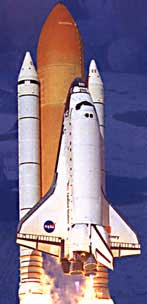
2003, fiery balls of debris fell to earth, the remains of approximately $2 billion carrying
seven priceless lives. The cost of four shuttle flights per year ($430 million or more for
each flight) could support healthcare companies in producing beneficial innovative drugs.
NASA's annual budget is equal to the cost of Bush's beginning-to-end crusade against AIDS
in Africa. Finally, a single human life is beyond consideration-to compare anything else to
life is like trying to grasp the end of the universe, a universe NASA is trying so hard to
reach.
Another money matter is the shuttle. With the futuristic
(and impractical) goal of weekly flights, the shuttle was designed-three decades ago-to
carry as much as 50,000 pounds of cargo. Today, the $500 million shuttle flies about five
times per year and has never carried the maximum 50,000 pounds. With excessive size comes
cost. NASA also designed the shuttles to be manned. This means providing a wide range of
daily needs. For example, although it may seem like a minute concern, the astronauts'
supply of bottled water costs taxpayers almost half a million dollars each day.
NASA present objective is unclear. Kennedy's goal was to beat the
Soviet Union to the moon. Although it was a goal established by an egotistical aspiration,
at least we were aiming for something more than a billion dollar joyride. Also, the space
station does not require manned probes for scientific experiments. "Life
science"-the study of human response to space-is the only remaining research that
involves a crew.The past years of space flight were distinct for their original
achievements: putting a man in space, in orbit, on the moon; creating the world's first
reusable spacecraft and sending unmanned probes to other planets. Unfortunately, the hype
is over.
With the alert of terrorism and bitter resentment from other nations, America
must prioritize. The approaching war is obviously worth more time, money and effort than
space exploration. To send more shuttles into space means turning our backs to the
responsibilities on earth. Neglect brings unpleasant consequences, especially if it
involves war. No one is forcing human space exploration. On the other hand, this impending
war is an inevitable national problem; therefore, we must focus all our concentration and
awareness on it.
Without question, the day that Columbia and its
crew were lost was indeed a tragic moment. Many say that this incident teaches a lesson
that we must never give up, but there are also many who perceive this event as an accusing
finger pointing towards NASA. Space should not become a costly sanctuary from earth's
problems. Before edging forward into an uncharted stretch of mysteries, we must look behind
us to mend the damages already present in mankind's conquest. NASA must realize today that
the sky, short of space, truly should be the limit.
|
|
|
NASA has served the nation and the world in its perpetual
quest for greater knowledge of the universe. The space program works to satisfy human
nature™s desire to explore. Through the years we have been presented with breathtaking
images of cosmic phenomena-all made possible by NASA. How stifling would it be to confine
ourselves to an infinitesimal scintilla in an unimaginably large universe?
Founded in 1958, NASA has built up countless achievements and accom plishments that
would all be destroyed if the program were discontinued. NASA™s poignant history
includes the space race, putting the first man on the moon and the building of the
International Space Station. Memories of President Kennedy™s speeches on the NASA
program would become nothing more than just thatŠmemories, if the program were terminated.
Furthermore, the scientific research conducted by the NASA space
program benefits all humankind. Experiments done in zero gravity shed new light on subjects
ranging from cancer research to the greenhouse effect. Lawrence DeLucas, director of the
Center for Biophysical Sciences and Engineering at the University of Alabama, asserted,
isWe would be wasting a wonderful opportunity to see how gravity affects every system on
Earth if we did not do this kind of research.lO
On a more tangible
level, NASA™s countless iespin-offl. technologies have evolved into vital, commonplace
appliances and goods. Blood pressure and oxygen sensors used in hospitals were first
developed by NASA. New suits first worn by astronauts can regulate patients™
temperatures. Current running shoes, golf balls, smoke detectors and innumerable other
commodities were also made possible through NASA™s research.
The largest argument against NASA seems to be its costly nature. However, its estimated $13
billion annual funding pales in comparison to the $20 billion spent on alcohol and $16
billion on tobacco products by Americans every year. Moreover, it has been estimated that
for every dollar spent on the space program, the American government receives seven dollars
in personal and corporate income taxes from increased jobs and economic growth spurred by
NASA.
Ultimately, the NASA program has created benefits that far
outweigh any downsides. NASA is directly responsible for releasing commercial products that
in many senses revolutionized the world. For the lives and money that the Columbia tragedy
cost America, the space program has saved countless others through its research and
technology. While it would never be correct to call the deaths of the Columbia™s crew
meaningless, the discontinuation of the NASA space program would be an incredible injustice
by rendering their deaths a lost cause.
 |
. |
|











 On February 1, 2003,
  the Columbia Exploded.