 |
| DOUBLE REED |
|
 |
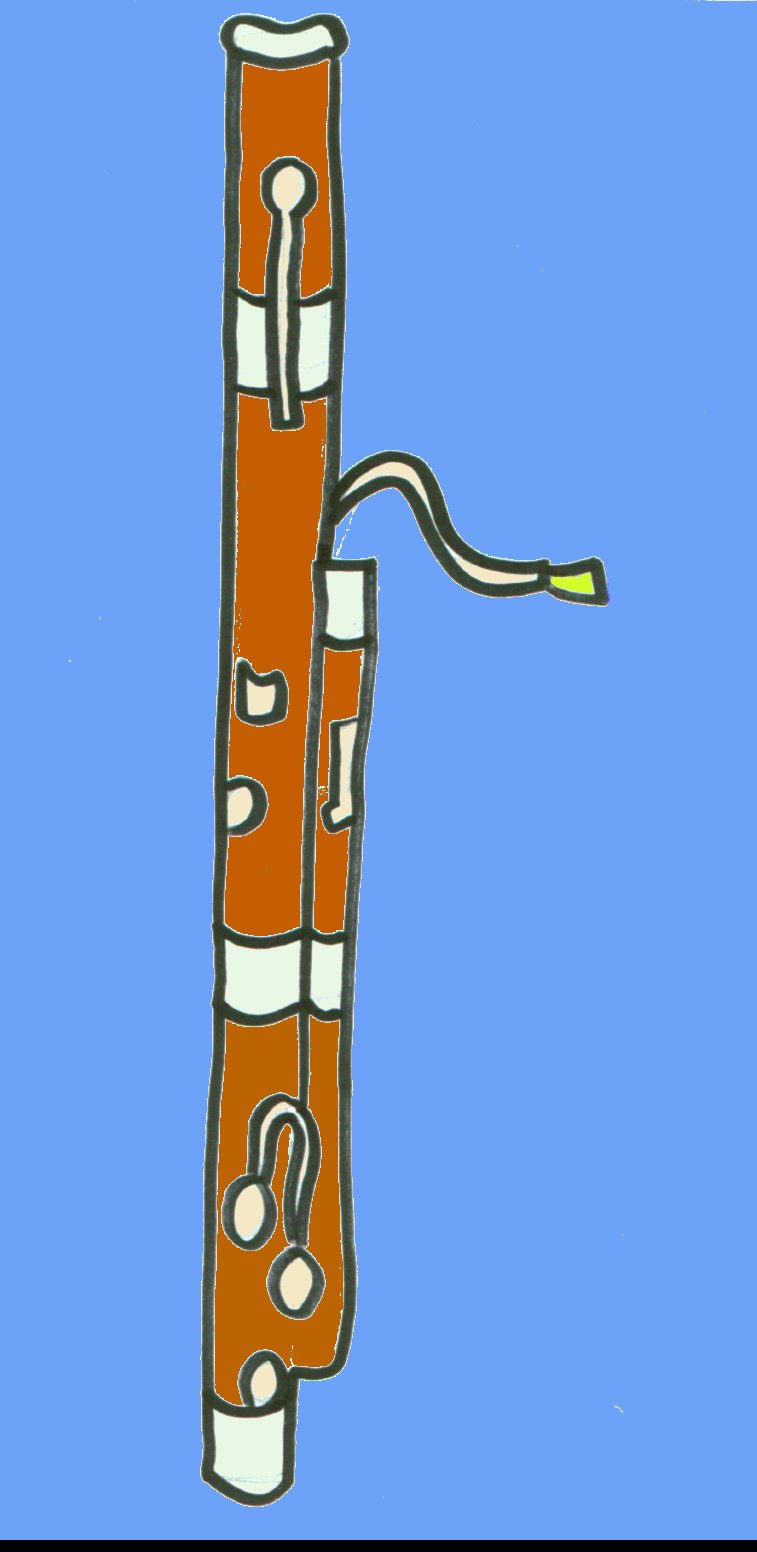
| The bassoon (picture on the right) is the biggest of the woodwind instruments. It dates from the 16th century, and it is made of a long wooden tube, doubled back on itself. Many people don't realise that the name "fagotto", which is Italian for bassoon, actually means "bundle of sticks!" The bassoon has a wide range of notes - the lowest is the B flat below the bass clef, and the highest goes up to the D on the 4th line of the treble clef. It has a very distinctive sound. The double bassoon, or contrabassoon, is built an octave lower, and is made of wood or metal. |
| The oboe has one of the longest histories, stretching back to Ancient Egypt. The modern instrument, however, is developed from an instrument called a shawm. The oboe has a conical shaped bore, and, like the bassoon, a double reed. Although higher notes can be played, it is generally accepted that the range is from the B flat below middle C, to the G an octave above the G over the treble clef. Oboe family also includes the Cor Anglais, which is a large oboe with a bulging-shaped bell on the end. They became popular in the Romantic period. |
| DOUBLE REED Two pieces of cane - the thicker ends bound round a metal tube, while the thin upper ends practically meet. they do, however, leave a small gap through which the players breath is forced. |
 |
 |
 |
 |
 |
 |
 |
 |
 |
 |