 |
|
|
|
|
|
|
|
|
|
|
|
|
|
|
|
|
|
|
|
|
|
|
|
|
|
|
|
|
|
|
|
|
|
|
|
|
|
|
|
|
|
|
|
|
|
|
|
|
|
|
|
|
|
|
|
|
|
|
|
|
|
|
|
|
|
|
|
|
|
|
|
|
|
|
|
|
|
|
|
|
|
|
|
|
|
|
|
|
|
|
|
|
|
|
|
| Muses Review Book Reviews - Winter 2005 February |
|
|
|
Current Issue-Winter 2005-Feb
Editor's Message
Poem Reviews
Book Reviews
Interviews
Poems
Nominees
Advertisements
|
|
|
|
Title of chapbook: Mundo y Palabra / The World and The Word
By: Rhina P. Espaillat |
|
|
|
|
|
 |
|
|
|
|
ISBN: 1-882291-79-4
Format: Paperback
Pages:
Price: $8.00
No. of poems: 19 poems
Printed by: Oyster River Press
Address: 20 Riverview Road, Durham, New Hampshire 03824
Date of release:
|
|
|
|
|
|
Home
Frontpage
About Us
Submissions
Adverise
Donate
Resources
|
|
|
|
|
|
|
|
|
|
|
Title of chapbook: Mundo y Palabra / The World and The Word
By: Rhina P. Espaillat |
|
|
|
|
|
Chapbook Review By: Charles P. Ries |
|
|
|
Word Count: 1,100 |
|
|
|
Beneath the form, tone, and themes of all poets is geography. The kettles and moraines of this undulating landscape are their words. This geography is the childhood, parents, language, city and culture of each poet. These are the surfaces on which their words fall. After reading Mundo y Palabra / The World & The Word, I felt comfort in Rhina P. Espaillat's geography. It was a clear, kind and familiar place to visit. |
|
|
|
"This is a chapbook centered largely on the exploration of bilinguality." she told me, "as an experience that alters your perception of language and thought. The theme, for me, is intimately tied to family, early conversation, learning between generations, the links of language and memory that join - or may join - the generations. That's why my parents and grandmother are pictured on the cover, and why several poems are about parents and children, and the ties between them." |
|
|
|
This central theme is well illustrated in her poem "Map Lesson": |
|
|
|
"Map Lesson"
by Rhina Espaillat |
|
|
|
My grandson takes my hand and puts it down |
|
|
|
on one coast, then the other. Let's go east |
|
|
|
to west, I tell him, starting from our town: |
|
|
|
straddle the Mississippi, shaggy beast |
|
|
|
back dull with flood silt; here's where the plains |
|
|
|
spill out to scrubby foothills, rise to looming |
|
|
|
mountains that snag clouds and keep the rains |
|
|
|
from - touch this patch- desert; beyond, consuming |
|
|
|
California tide by tide, another ocean. |
|
|
|
He tries the route alone now, finger, eye |
|
|
|
transmuting letter into highway, motion |
|
|
|
of water, hum of cities wheeling by. |
|
|
|
I watch him take possession, claim the land |
|
|
|
perilous inch by inch. I take his hand. |
|
|
|
Mundo y Palabra/The World & The Word is this Dominican Republic-born poet's fourth book of poetry. Her previous collections have won her the prestigious T.S. Eliot Prize in 1998 and Richard Wilbur Award in 2001. Born in 1932, she says, "I began writing so young that I don't remember ever not writing. My first poems were in Spanish, of course, and they had to be written down for me by my grandmother, because I made them up before I could write. But after I arrived in NYC at the age of seven, I learned English quickly and began writing in my second language when I was eight. My first published poems appeared in the "Ladies' Home Journal"; when I was sixteen, still a junior in high school." |
|
|
|
There is a gift that some Spanish language poets have of being able to embroider silk on water. Their immersion into this language which is so innately of song and rhyme and fantasy allow these same qualities to appear in their writing.It is never too sweet, or too sentimental. And while I love the Spanish language and many of its poets, I have never found an attraction to what is called formal poetry (rhymed and metrical). To me such poetry lacks immediacy and surprise, and it creates distance between the reader and the words. Yet Espaillat surprised me and slowly guided me into her gentle, wise terrain bounded by meter and rhyme in "Gravida": |
|
|
|
Gravida
by Rhina Espaillat |
|
|
|
Look how she tilts, self-loving and sedate |
|
|
|
as a small ship riding a painted storm: |
|
|
|
forward and back at once she bears her freight, |
|
|
|
tentative in big boots. I picture, warm |
|
|
|
in her young body, how the child is curled, |
|
|
|
oblivious of December, traffic, sleet, |
|
|
|
the blown useless umbrella, night, the world, |
|
|
|
as she maneuvers both across the street. |
|
|
I make the effort -- less of memory |
|
|
|
than of old muscle -- to remember how |
|
|
|
the same blood-heavy wisdom once taught me |
|
|
|
to love my body more than I do now, |
|
|
|
to move for what I carried day by day, |
|
|
|
to tilt into the storm a while, her way. |
|
|
|
Not shocking, but perfect - like a clear, clean note. This is a skilled, mature writer. I asked her if she was academically trained and she told me, "If by academically trained you mean, did I first learn prosody in college, no, I didn't. I picked up the fact that poetry has a beat, like music, from hearing it read aloud by the people I grew up with. When I heard free verse, I picked up the fact that other things were being done with sound to create a different kind of music, but that, in each case, the poet was trying to reach my ear first, and simultaneously my imagination, through visual language and appeals to the other senses, and through the music and imagery, to reach my mind and heart. By the time I learned the names of the poetic feet and other prosodic devices in high school, I knew how to use them, if I wanted to." |
|
|
|
Still, I see almost no poets working in a formal style published in the majority of the non-academic small press poetry magazines I read. I wondered if they were prohibited admission by editors favoring a more organic poetry, or if poets who wrote in form found the content of such magazines too scruffy and cluttered for their liking? I wondered if poetry was divided into two great clans, one being academic and measured, the other being free-spirited and passionate. I asked Espaillat about this: "I don't break down what I read into 'academic' or 'outsider' or 'formal' or 'informed' or any other kind of poetry, I simply read it as a human utterance that may or may not speak to me. One of the joys of poetry is the way it has, sometimes, of speaking intimately to strangers about one another so that the ancient and the current meet, and distance disappears. I've loved poetry all my life, and can't remember a time when it wasn't part of my life. It's too old a love, too ingrained a habit to be disturbed at all by the 'poetry wars,' or literary politics,or wrangles over how it 'should be done,' as if the poet decided that, when most of us know that poems decide that, one by one, if we listen." |
|
|
|
Mundo y Palabra / The World & The Word is wise and perfect and modulated. It sings and dances just as does its author. It mirrors Espaillat's love of family, culture and diversity. And while I highly recommend this collection of poems, I more strongly suggest you meet Rhina P. Espaillat, the way she intends you to, through her written words. |
|
|
| ____________ |
|
|
| Charles P. Ries lives in Milwaukee, Wisconsin. His narrative poems, short stories and poetry reviews have appeared in over ninety print and electronic publications. He has received two Pushcart Prize nominations. Samples may be found by going to: http://www.literati.net/Ries/. |
|
|
| Find Web Home of Charles P. Ries at http://www.literati.net/Ries/ |
|
|
|
|
|
|
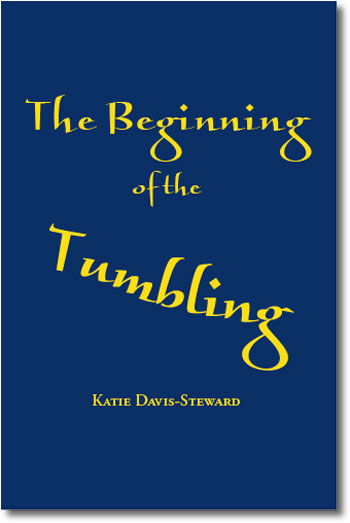
Title of Book: The Beginning of the Tumbling
By: Katie Davis-Steward |
|
|
 |
|
|
|
|
|
|
ISBN: 141203770-0
Format: paperback
Pages:109
No. of poems: 97 poems
Book size:: l x w = 9"x 6"
Price: 15US$, 19Can$, 12.35Euro, 8.56 UK lbs
Printed by: Trafford Publishing Address: Victoria, British Columbia, Canada
Date release: 2004
Where to buy this book: [email protected] |
|
|
|
|
Title of Book: The Beginning of the Tumbling
By: Katie Davis-Steward |
|
|
|
Book Review By: Andrew C Angus |
|
|
|
Katie seems to have a very sharp memory because all her 97 poems in her book are practically memories of different stages of her life- childhood, teenager, college life and marriage life. Some of the poems reveal painful memories, poignant memories, pleasant memories and funny memories.
Her poems include anecdotes about relationships with her siblings, parents, grandmother, her husband and her dogs. Her poems also include memories of experiences as a writer or poet at work.
I reviewed this book for three months. While reviewing her book, I was surprised to read some of her poems deal with sensitive issues like rape, sex abuse and even incest. I started to wonder if these poems are based on her real life or some other girls' life or simply fictional events.
I decided to interview Katie and asked her with an optional question about her poems that deal with sensitive issues of rape and sex abuse. I asked her is if these poems are based on other girl's experiences. Katie revealed in the email interview that those poems are not fictional and not based on other girl's experiences but based on her real life. Katie said that she is not bothered by my question and she wanted to answer my question.
Katie is not afraid to tell the world in her poems that she is a victim of incest and abandonment by her father. Her book of poems reveal that she is a survivor of a dark episode of her life. She is now up and optimistic about the future at 27 years old.
This book is unique because of its sensitive topics. Nevertheless, this book will inspire victims of sex abuse or incest or rape that life must go on despite a painful past. Normal people who never experienced sex abuse will also find her poems interesting and see that Katie is a fighter and will not allow her dark past to destroy her spirit and will to fulfill her dream to be an established writer.
What also makes this book of poems unique is that the book is like an autobiographical memoir in free verse.
I strongly recommend this book to people who likes to read biographical memoirs and to women who are victims themselves of sex abuse. This book will remind us of people like Oprah who was one a victim but now a successful talkshow host and businesswoman.
Katie will be our featured poet for the month of March 2005. You can also read her sample poems featured in the Fall 2004 and Winter 2005 edition of Muses Review. You can also read her book ads in this on-line literary magazine.
Here is a sample poem about her pleasant memories in college:
Centralized Storm
Bruce had just finished cleaning the rub
in the house in Pittsburgh I was renting
with some friends while I was in college.
It was typical weekend night while he
was visiting. We were all getting ready
to go to the club. Everyone was about
half-ready except I had finished. I went
down the stairs, and as I was making the
right towards the living room, I heard rain-
inside the house. I screamed, "It's raining
in the living room.... and on my couch!"
Everyone ran down the stairs as the ceiling
started to collapse down. One final waterfall
and it stopped before the tub had a chance.
to fall through. (It stayed in place until the
repairmen came.) I was the only one not
laughing that night because it had stormed
right on my couch, and had the nerve to do
it right in front of my face.
Not all of Katie's poems are painful memories. Some are actually pleasant and funny memories. (End of review)
(Book reviews posted on Feb 27, 2005 Sunday) |
|
|
|
|
|