|
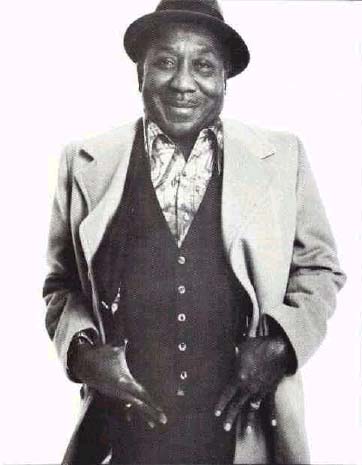
In 1968 Mckinley Morganfield
released an album that has been possibly the most derided and
dismissed album of his (or any other blues artist’s) career, Electric
Mud. He reportedly hated it with a passion, and it is now agreed
that it was a cynical exercise in attempting to corner the “Psychedelic”
Blues market.
It worked, however, and sold well to the young, suckled on the second-hand
blues potion of the British Invasion. I bought it at 14 years of age and
it was the first time I’d heard some of those songs.

Leadbelly was the closest my parents got to the blues,
although my father muttered darkly about someone called Robert Johnson
when early Rolling Stones hits came on the radio.
1968 was a big year in music and politics. Paris was in flames, and in
Chicago the Democratic Convention saw the first full-scale battles between
the Amerikan State and its young.
Down in Memphis watching the world on TV, Elvis Presley
realised that he was being passed by. His vapid screen image in the movies
had isolated him from his fans. Attendance at the now stereotyped films,
and sales of his product, were in free fall. He decided to turn it around,
and planned what became known as the Comeback Special. It would be the
first time he had appeared on Television since Frank Sinatra’s
welcome home show in 1960. The song that he chose to open the show with
was a relatively obscure Lieber & Stoller number from the soundtrack
of “King Creole”, the last film he did before
his army service.
|
|
The filming took place at a time
when he was actually supposed to have been already serving, but frantic
representations from Hal Wallis the producer, (and others)
gained him a deferral until the completion of shooting.
The song is staged in the film as a demonstration of the Character’s
ability to sing, thereby diverting the gangster (Walter Matthau)’s
attention from a growing relationship between the Elvis character and
the gangster’s girl. It might have been staged and rehearsed, but
the performance is the last and perhaps only time it was possible to really
see Elvis in the light of what the live audiences experienced in his early
days. All his TV appearances on Ed Sullivan and Milton
Berle were calculated to promote the act to Middle America by censoring
the rawness and aggression that so electrified the south during his ascension
as a live performer in the years 55-57. The character in King Creole is
a “bad” boy; the troubled youth so informed by Brando and
Dean that was the touchstone of the teenage revolution, and he delivers
the song with a power and sense of menace that tells you all you need
to about the phenomenon. It’s a magic piece of footage, and since
he never toured outside the Continental USA, and TV was still a luxury
item anywhere else if it existed at all, stood as probably the best indication
of what all the fuss was about for the rest of the world.
And the Song ? “Trouble” was a stomping blues
with brass backing that was virtually identical to a group of songs that
came out of Chicago 3 or 4 years previously, and they weren’t written
|
|
by nice Jewish boys with an ear for a good tune.
I am not disparaging Lieber & Stoller, they wrote
and produced some seminal works, as Doc Pomus and Mort Shuman.
Their classic 1961 Elvis hit “His Latest Flame” mixed
the Bo Diddley beat with a rockabilly sensibility that
harked back to the Sun era when he needed it, and the list of songs that
they supplied to black artists is rightly legendary.
That stomp, variously attributed to a work-song pattern, or Muddy
Waters swiping Bo Diddley’s beat and slowing it down, is
one of the most influential devices in rock and blues.
I am unable to source any earlier manifestation of this than Willie
Dixon’s Hoochie Coochie Man, although there it remains
part of a 12-bar pattern and is resolved by use of the 4th and 5th notes
of the scale. This is the case with “Trouble” and also The
Coasters’ “ Riot in Cell Block No 9”
another Lieber & Stoller composition. Willie Dixon was
fond of the feel himself, (which is fair enough, he seems to have invented
it) and reworked it into a b-side for Chuck Berry called
‘I’m A Man” which was immediately remoulded
by Muddy Waters into the towering electric blues masterpiece
“Mannish Boy”, (credited to both Bo and Muddy).
This became the template for endless other artist’s riffs and was
still “Bad to the Bone” by George Thorogood
and the Destroyers among God knows how many others. ...to be continued.......next
edition !
Greg Manson
is a local resident and bass player in local funky act ‘Pussyfoot’
|