CJ-5
CJ-6
CJ-7
CJ-8
XJ
YJ
TJ
JK "07 Wrangler"
Home
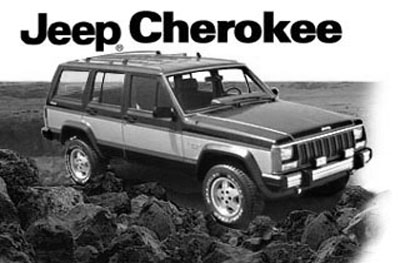
The XJ Cherokee was introduced in 1984 as the first unibody Jeep. It was to be replaced by the larger Jeep Grand Cherokee in 1993, but the continuing popularity of the original Cherokee caused the company to rethink this decision. Designs of the XJ Cherokee date back to 1978 when a team of American Motors (AMC) and Renault engineers drew several sketches. A few clay models were based on the existing SJ Cherokee. Early sketches of the XJ Cherokee had a European influence, and most of the styling cues were done by AMC engineers. The ongoing debate suggests that Renault sketch artists were involved right after the 1979 partnership with AMC. A former Renault engineer would come on board and design what is known to XJ Cherokee enthusiasts as the Quadra-Link suspension. Both two- and four-door versions of the XJ Cherokee were offered throughout its lifetime, each having exactly the same track and wheelbase measurements as the other. Two-door models, however, received both longer doors and front seats that could fold forwards to assist in rear passenger entry and exit. This was in addition to extended-length rear windows that did not open, although an optional rear vent window was available on some models. Its appearance has led some to mistakenly believe that the two-door models are a short wheelbase version of the four-door. A variation on the Cherokee from 1984 through 1990 was the Jeep Wagoneer. It was sold in two trim levels: the Wagoneer and the Wagoneer Limited. Both Wagoneers were distinguished from the Cherokee by the four headlights. The Wagoneer Limited came with vinyl wood trim on the sides. This version was the first to be sold in Europe; it was launched in 1992 in some markets, 1993 for the United Kingdom. Early versions had the 4.0 L six-cylinder engine only: the 2.5 L engine did not arrive in Europe until 1995. The Jeep XJ has remained a popular choice by off-roading enthusiasts due to its potent off-roading capability in stock form. Its popularity has resulted in strong ongoing aftermarket support in the form of a wide variety of products and upgrade availability. Used XJs are inexpensively available throughout North America and serve as a solid basis for a capable off-road vehicle. After 13 years of production, 1997 saw the Cherokee receive updated exterior and interior styling. Both the two- and four-door bodies remained in production, receiving a steel tailgate (replacing the fibreglass one used previously), slightly more rounded edges, and a new taillight design; the interior was similarly updated with an all-new design and instruments, and a stiffer bodyshell brought improvements to Noise, Vibration, and Harshness measurements. Both the 4- and 6-cylinder engines were offered through the 2000 model year, though only the straight-six was available in 2001. For the 2000 and 2001 model years, all six-cylinder XJs received a distributorless ignition system using coil-on-plug ignition replacing the 'traditional' system previously used; coupled with better exhaust and intake porting, this gave a minor increase in power over the previous models. Transmission, axle, and transfer case choices were carried over from the previous models. The (XJ) Cherokee line was eventually replaced in 2002 by the Jeep Liberty (KJ), although the Liberty is called the Cherokee in most foreign markets.
