Reviews
Mercadian Masques
Nemesis
Newest Set
Magic TalkMagic Talk
Tons of articles about Magic and it's sets. Aspects, features, and opinions are all there.
Tutorials
Tutorial Index
An extensive fully detailed tutorial on Magic. Organized by subject.
Deck Building 101
Step-by-step guide as to how to build a killer deck

Get Paid to Surf the Net!!
|
 Find Software:
 |

CREATURES
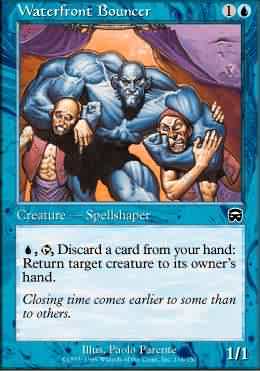
The guy on the left, Waterfront Bouncer, is a example of a creature. It's a Spellshaper, that's what it says in the middle (next to creature), and its power and toughness is 1/1. The power of the creature is how much damage the creature could do in this case it's 1 so the creature can deal 1 damage if it attacks and doesn't get blocked. Now the toughness is a bit tougher to explain. Follow me through very carefully.
The toughness is how much damage a creature can take before dying. The Bouncer has a toughness of 1 so it would die when it blocks anything with a power over 1. When a creatures blocks it also deals damage to the attacker. Are you still with me? No? Well here's an example. If I attack with the Bouncer, which is a 1/1, and you block with a 2/1 creatures then both creatures dies. Why you ask? You might be thinking that since the 2/1 creature is bigger it should survive right. This isn't the case. Damages are simultaneosly dealt. That means the Bouncer's 1 damage is dealt the same time as the 2 damage the 2/1 creature. Since both creatures have a toughness of 1, that means they can only take 1 or more damge before dying, they both die.
Are you still with me because if you're not you can always e-mail me for more info. In another scenario if I attack with a 3/3 creature and you block with a 2/5 creature then what happens? The correct answer, if you've understood anything I said, is nothing. The 3/3 creature couldn't deal enough damage to to kill the 2/5 creature because its toughness is 5. In the same way the 2/5 creature couldn't kill the 3/3 creature because it only deals 2 damage when the 3/3's toughness is 3.
Another thing you have to know is that creatures can't do anything that requires it to tap when it comes out. This is called summon sickness. It'll be unfair if you could attack on the first turn. Blocking doesn't cause a crerature to tap but attacking and regenrating does cause a creature to tap.
Summon Sickness
A creature has summon sickness on the first turn it comes into play. What's summon sickness you ask, well summon sickness prevents a creature from tapping on the first turn. This includes attacking, regenerating, etc. This promotes fair play because you have a chance to destroy creatures with regenrtion. Some creatures have this ability called haste that makes it able to attack on the first tur
How Long Does The Damage Last?
That's a good question. Okay, you've dealt the damge, now what? Well the damage only last for 1 turn. If your opponent attacks and you block and your creature survives then the damage the creature does will go away. That means if your 4/4 creature blocks a 2/5 creature, the 2 damage that was dealt to the 4/4 will disappear on your turn.
Walls
Creature Abilities
 and discarding a card. Some of these abilities are super powerful and some are just plain sucks. How do you judge if a creature is good or not, well that counts on your experience of whether that card is useful or not. Well let's get back to the subject okay. There are many things a creature could do but some of the most known abilities a creature has are first strike, trample, regeneration, flying, and the most recent one, "when a creature comes into play untap blah blah blah lands". Now the last one has been abused the most and people should know that you couldn't get "infinite" mana off of it. You could read my explanation if you don't know what I'm talking about.
Flying
This is a very simple concept to comprehend. A creature with flying can block creatures as normal but creatures without flying cannot block creatures with flying. If you read it twice you might be able to understand it. Okay, a creature with flying can block anything, that part you understand. A creature without flying can't block a creature with flying because, here's when common sense is need, if you use animals to represent flying and non flying creatures you'll get it. A bird is flying and a dog is a nonflying creature. The dog can't reach the bird because it's in the air but a bird could reach the dog. Understand now? Only flying creatures can block flying creatures. The battle takes place in the air so only flying creatures could play.
First Strike
Now this is a ability a lot of creatures have. This ability involves two steps in the attacking and blocking damage distribution. Didn't understand a word I was saying right? Well me too. Remember how the damage is done, well creatures with first strike have the advantage. If a 2/2 creatures with first strike, such as the Black Knight, attacks and another 2/2 creature without first strike, such as the Grizzly Bear, blocks then you would assume they both die because of simultaneously damage dealt to each of the creature right? Wrong. The Black Knight with first strike deals the damage first and the Grizzly Bear dies. In other word, creatures with first strike gets to do the damage first before the other creatures deals its damage. If the damage is enough to kill the creature then the creature dies before it deals its damage. The Black Knight kills the Grizzly Bear because the 2 damage got to the Grizzly Bear first. What about when a creature with first strike blocks? It's the same thing, if the Grizzly Bear attacks and your Black Knight blocks then the Bear will still die because the Knight will always deal its damage first. Now I wonder what will happen if both creatures have first strike? Well then they deal their damage as if they were ordinary creatures because both have first strike and one can't deal damage before another one. It just won't be fair. For a final tip first strike only makes a creature able to deal damage first, it does not increase the power of the creature. A 1/1 first strike creature cannot possibly kill a 2/2 creature without first strike. It just doesn't work that way. First strike is a very powerful ability and you should include some if possible.
Trample
A very powerful ability found mostly in green creatures. Creatures with trample can deal damage to the opponent even when it's blocked. How could this be you ask. Well imagine this, a 6/6 trampling creature attacks and a 3/3 creature blocks it. The 6/6 of course kills the 3/3 creature but it only took 3 damage to kill it. What happened to the 3 damage unused? Well if a creature with trample uses the leftovers to give to the opponent. In this case the 3 extra damage goes to the opponent. this 6/6 trampler killed the 3/3 and did 3 damage to the opponent. This is a very powerful ability and only creatures with trample get use the extra damage on the opponent. A creature without trampling can't use the extra damage on the opponent.
Regenration
One of my favorite ability of creatures. This makes a creature extremely hard to kill and a great blocker too. Regenration is a ability that allows a creature to regenrate itself, that means if a creature receives enough damage to kill it, it could regenrate and not die. A creature that regenrates must tap as a side affect not as a part of the cost, that means a creature can regenrates as many times as it wants because you could still tap a creature that's already tapped. You can only regenrate when a creature is about to die, not the turn after that, and a creature in the graveyard cannot regenrate and come back to life. Also a creature that's buried or sacrificed cannot be regenrated. Fog of Gnats is a black creature with regenration that reads " : Regenerate Fog of Gnats". If it just reads Rengenrate then it regenrates itself and not another creature. This is a great ability for creatures in a defensive deck because it takes a while to kill these guys.
Protection
Creatures with protection are amazingly powerful. They are largely immune to affects to that thing (usually a color). Creatures with "protection for black" for example cannot be affected or damaged by black sources.They are:
black creatures cannot be assigned to block it
all damage dealt to it by a black source is reduced to 0
it cn't be targeted by black spells, abilities, or enchantments.
That means almost nothing from black can touch your creature. Of course there has to be exceptions to be fair. Spells and abilities that don't target your creature or don't dealt any point damage can get to your creature. For example if a creature reads "protection from white" and you cast a Wrath of God, which buries all creatures, then your creature dies. This is because it doesn't target your creature and it doesn't dealt any point damage, it only buries it. If a creature has "protection from black" and you pop your Pestilence, which is a black card that deals X damage to each creature and player, then your creature is immune to the damage because even though it doesn't target your crerature it deals point damage and any point damage is reduced to 0.
Also note that if your protection from a color creature is in the graveyard then the ability wears off and it could be targeted. Another thing are enchantments. If your creature has "protection from green" and a green enchantment is put on it then the enchantment goes to the graveyard.
Haste
Haste is a creature ability that removes summoning sickness. With haste a creature can attack on the first turn which makes it a pretty powerful ability. Some creatures have haste and returns back to your hand at the end of turn. An example is Viashino Sandstalker. That combination makes it even deadlier.
"Free Creatures"