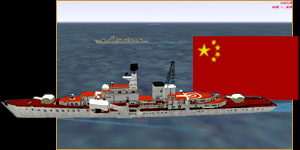
Long before Europeans dared to venture far from their coasts and brave the ocean, China had the technology to create large ocean-going vessels. Chinese fleets sailed as far as India, establishing the beginnings of a maritime trade route.
 Then,
suddenly, China abandoned its nascent navy and turned inward. Centuries
later, European ships would reach Chinese shores and destroy its solitude
and way of life. It was only with China's emergence as an economic
superpower in the 1980s that there again came a rise in its naval
ambitions. Long consigned to a coastal supporting role for ground forces,
the People's Liberation Army Navy (PLAN) began evolving toward a
blue-water force. In 1985 China purchased a scrapped Australian aircraft
carrier, dismantling it and studying it. Studies were also made of laid up
Soviet Navy carriers that had been scrapped or left incomplete. In 1993,
plans were announced for the construction of three such ships by Chinese
industry, with the first to set sail in 2010 at the earliest. Regional
neighbors were alarmed by the sudden growth of China's submarine and
destroyer fleets, accompanied by statements in government journals
emphasizing the need for a naval forward defense strategy. With almost 180
major warships in service and plans for domestic construction of many
more, the turn of the century will see the region-and the world-focus more
and more upon China and its ambitions.
Then,
suddenly, China abandoned its nascent navy and turned inward. Centuries
later, European ships would reach Chinese shores and destroy its solitude
and way of life. It was only with China's emergence as an economic
superpower in the 1980s that there again came a rise in its naval
ambitions. Long consigned to a coastal supporting role for ground forces,
the People's Liberation Army Navy (PLAN) began evolving toward a
blue-water force. In 1985 China purchased a scrapped Australian aircraft
carrier, dismantling it and studying it. Studies were also made of laid up
Soviet Navy carriers that had been scrapped or left incomplete. In 1993,
plans were announced for the construction of three such ships by Chinese
industry, with the first to set sail in 2010 at the earliest. Regional
neighbors were alarmed by the sudden growth of China's submarine and
destroyer fleets, accompanied by statements in government journals
emphasizing the need for a naval forward defense strategy. With almost 180
major warships in service and plans for domestic construction of many
more, the turn of the century will see the region-and the world-focus more
and more upon China and its ambitions.
Major Combatants
Surface Ships
Sub-Surface