







| LATEST NEWS |
| On Sept 9, 2002 Dr. Tooth went live with
his first website! We are excited to be up and running and hope
you find what you are looking for. If so, tell us. If not,
please tell us!

|

|
|
|
What
To Do in Emergencies ...
If a Tooth is
Knocked Out
Susan was
rollerblading. She got going a little too fast, and before
she could slow down, collided with a tree just off the
trail. When she cleaned the bark off her face, she found
that her front tooth was laying on the ground. What should
she, and you, do? Just a few years ago, this would have
probably resulted in the loss of the tooth. But now, Dentists can
quickly eliminate the pain and often save the tooth. Although this
is a serious dental injury, replantation of a tooth is a
relatively simple process that your Dentist is highly prepared
for.
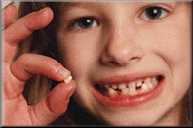 Important: As a
parent, you should prepared IN ADVANCE for a situation like this,
and you should educate your children on what to do as well. Important: As a
parent, you should prepared IN ADVANCE for a situation like this,
and you should educate your children on what to do as well.
- Find the tooth.
- Try to place it back into
the socket immediately, without cleaning the tooth.
- If practical, contact your Dentist, by wireless phone or pay
phone, to let them know you are on your way with a dental
emergency.
- Get to your Dentist as soon as safely
possible. Hold the tooth in place until you reach your
dentist. Time is of the essence! The longer the
tooth is out of its natural environment the less likely that your
Dentist will be able to successfully replant the tooth. You probably
have no more than 30 minutes or 60 minutes for a replantation
procedure.
Why should you put
the tooth back in the original socket? This increases the amount
of time the tooth remains "viable" or alive, and
maximizes the chance that it can be saved. If, however, you
are unable to temporarily place the tooth back in the original
socket, then try to wrap the tooth in a wet cloth, or put it in a
glass of water.
Remember, as
mentioned above, please don't wash the tooth. What may
appear to be dirt, could actually be soft tissue that is needed to
successfully replant the tooth. Also, in your rush to get to
your dentist, PLEASE DON'T FORGET THE TOOTH!
Click on
the following links to learn more about the handling and treating
of dental emergencies.
|

Some
people, regrettably, only visit to their family Dentist
as a reaction to a specific problem: pain. Perhaps you
have had a dull ache that has gotten worse. Maybe
drinking hot or cold liquids causes discomfort. Or a
long neglected filling has fallen out.
Although
the temptation may be to ignore dental pain as long
as possible, it should be taken very seriously. The
human body has a very large number of nerve endings and
blood vessels in the face. Damages to these vulnerable
structures could result in a potentially live-threatening
condition. Also, the longer you wait, the better the
odds of the tooth or surrounding structures becoming permanently
damaged. Put another way, if a filling falls out and
is immediately replaced, the procedure is quick, easy, and
cost effective. If you wait until your tooth's structural
integrity has been compromised due to the missing filling,
and your Dentist has to reconstruct the entire tooth, the
process is much more involved, requiring special materials,
and time, resulting in a much more expensive procedure.
This is
a good day and age with respect to dental care. It
wasn't too long ago when the answer to most dental
emergencies was to extract the tooth/teeth. Now,
thanks to new diagnostic technologies, techniques to
increase the comfort of patients, and repair damaged teeth,
you can expect much better results that just a few years
ago. For example, rather than extracting a tooth, now,
in many cases, the tooth can be restored with synthetic
materials that are virtually indistinguishable from a
natural tooth. Also, now, most dental pain can be
dramatically reduced or completely eliminated in just a few
moments.
When
To Call Your Dentist
Dr.
Tooth tells his patients: If your teeth or gums hurt, then
you should consider the situation a dental emergency.
Don't wait until the pain is unbearable. Don't try to
"tough it out". Time is your enemy; if you
choose to delay seeking treatment for a dental emergency the
final result may not be as good. Quick treatment will maximize the odds of
saving the tooth (or teeth).
Dentists
find it helpful in their diagnostic process to break severe
pain into one of two classes:
- Pain
which comes on very
quickly
- Pain
which slowly increases over
time
This helps them more effectively determine the underlying
cause of the pain and, thus, fix the problem.
The
first type of pain, that which comes on very quickly, is
generally caused by one of several events. In some
cases, pain has an obvious cause like a specific traumatic
event, such as a bicycle accident. Unfortunately, in
other cases, pain can also be caused by less obvious events
that may have gone unnoticed. For example, many people
loose dental work (crowns, inlays, onlays, fillings, etc.)
while eating, which makes it difficult the average person to
notice. Or, a particle of food may become lodged in a cavity.
The
second type of pain, that which increases slowly over time,
is generally caused by one type of problem: food debris
(such as popcorn) lodged between the gum and tooth.
Pain caused by food debris, will generally get worse the
longer the debris remains lodged. It can become an
abscess (infection) which can turn into a serious health
problem if left untreated. An abscess is indicated
when the pain only occurs when you bite down, and if there
is a foul odor (caused by the sulfur gasses emitted by bacteria).
What
You Can Do
Dr.
Tooth says the first step is to
call your Dentist as soon as practical, tell him that you
are in pain, and would like the first available appointment.
Most dental offices have a policy that anyone in pain is
seen the same day, even if the office has to rearrange
schedules or see you after hours.
Unfortunately,
there really isn't too much you can do at home to fix the
underlying cause of most dental pain, but you can try a few suggestions to possibly achieve some temporarily
relief from the pain.
 |
Take
Ibuprofen, aspirin or Tylenol to relieve the pain. |
|
If you can
identify the area where the pain comes from try brushing the area or
flooding it with warm salt water. Swish the warm
salt water
around your mouth or use an irrigation device. If
the pain is caused by debris lodged in a cavity, washing
the area may relieve it. |
|
If the pain
seems to be under the gum try flossing your teeth and then run a toothpick around the gum line. This
may remove some debris. |
|
If you've
lost a filling or crown, dip a cotton swab in clove oil
and apply it to the exposed part of the tooth. Clove oil
is available in most pharmacies and supermarkets and is an
effective topical anesthetic for tooth pain. |
|
Relieve the
pain by applying an ice
pack to your cheek or jaw. |
CAUTION:
You should only use
these techniques to increase your comfort until your
appointment. The fundamental problem causing the pain
needs to be accessed and fixed by your Dentist or, as
mentioned above, the problem will likely become more serious
over time and could require more drastic and expensive
procedures to fix. Some conditions, like an abscess,
can become a life threatening illness if left untreated!
What Your Dentist Will Do
If you
took go to your dentist promptly, you will probably be
pleasantly surprised by the ease at which your dentist can
solve the problem. The treatment will vary depending
on your condition.
Abscess:
Pain caused by an infection, also known as an abscess, is probably
the more serious of possible dental conditions, and may
necessitate a relatively minor surgical procedure.
Debris:
This type of pain is usually easily resolved by using a dentist's
version of a tooth pick. Debris is removed using a simple
tool, a pick, and normally results in near immediate pain relief.
Missing
Dental Work: Missing dental work is considered work
that was previously done that has fallen out or been removed
somehow. In order to replace the dental work, the
following process in normally followed:
- The
first step is to clean the area of decayed material to
prevent further decay and to provide for a solid base
for repair.
- The
area is reinforced so that it will be structurally
sound and prevents the tooth from fracturing during
normal daily activities.
- The
next step is to clean the decayed area of debris and
decayed tooth structure.
- Then
they will apply a
synthetic compound to fill, strengthen, and aesthetically
complement your teeth and allow it to cure (if
necessary).
- Finally,
they may need to shape
the synthetic compound to ensure it is comfortable and is an
exact "fit" with the opposing tooth.
Important
Note:
People with certain conditions making their heart
valves susceptible to infection should always mention this
condition, in advance, to their Dentist Physician so
that any appropriate precautions, such as antibiotics, can
be taken before any procedures are implemented.
|
|
Unlike a
tooth which is knocked completely out of the
socket, also known as an avulsed tooth, an extruded tooth is only partially dislodged.
An
extruded tooth may possibly be saved without a root-canal
treatment if the nerve and blood vessels remain intact and
depending on the degree of displacement.
What
You Can Do
To save
the tooth, it's essential to see your dentist right away. To
relieve the pain, apply an ice or cold pack to the area
and/or take an over-the-counter analgesic until you reach the dental
office.
What
Your Dentist Will Do
In order
for the extruded tooth to be fixed, the area will need cleaning
and then
they will reposition the tooth. It may be necessary to use a plastic splint to keep the tooth
stabilized until it has a chance to heal.
As
mentioned previously, the nerve and blood vessels will
determine the degree of dental work necessary to fix the
tooth. If the
nerves or blood vessels were damaged you may need a root canal treatment to prevent an abscess and
discoloration of the tooth. A series of tests will determine if the nerve has been damaged.
These tests are called sensitivity tests. Because of
the shock to the nerves, it may be necessary to do these
tests during
follow-up appointments because the
tooth may respond inaccurately to tests.
|
|
When we
say soft tissue injuries in the mouth that includes the tongue, cheeks, gums and
lips. These types of injuries generally occur while playing
sports or as a result of accidents or falls. In some cases
chewing on hard objects such as bone fragments can cause
this as well.
What
You Can Do
Although
soft tissues seem to bleed excessively, it is because the blood
mixes with saliva and it may appear worse than it
really is. It should stop within a few minutes.
Here are
some things you can do:
|
Rinse
your mouth with a mild salt-water
solution (1/2 teaspoon of salt in 8 ounces of water). |
|
To
reduce the bleeding moisten a piece of gauze and
apply pressure to the injured area for
10 to 15 minutes. You can also use a sanitary napkin or tampon. |
|
Hold ice to
the area for 5 - 10 minutes. |
|
If the
bleeding doesn't stop promptly, the injury may be
serious and you need to see a doctor
immediately. An oral and maxillofacial
surgeon are preferable.
Maintain pressure on the area until you can be
treated. |
What Your Dentist Will Do
Both Dentists
and Emergency Room physicians and oral surgeons are trained to diagnose and repair damage to
soft tissues injuries.
The
doctor or oral surgeon will need to evaluate and diagnose
the damage, if any, to the teeth. The area will be
cleaned and then they will determine if the injury is limited to the gum or other soft
tissues. At this point, you may need sutures to close the wound and control
bleeding. In most cases, a thorough washing and the removal
of any debris is the only treatment necessary.
|
|
When a
wisdom tooth, usually a lower one, starts to emerge,
there may not be enough room in the mouth for it to break
completely through the gums. The tooth will push upward on
the gums and may only partially expose itself. Some portion
of the tooth may remain covered by a flap of gum tissue.
Food particles and bacteria may lodge under the flap,
causing a low-grade infection and subsequent swelling.
This infection of the flap of gum tissue is called
pericoronitis.
What
You Can Do
This
type of infection does require attention from a dentist and
usually some antibiotics for the treatment.
Do not use warm
compresses on the face. If you recognize the symptoms you can get treatment right away.
These symptoms may
include:
|
A bad
taste in the mouth - this occurs because of an infection in the
underlying tissues. |
|
Pain in
the back of the mouth - the infection generally occurs around the wisdom
teeth. |
|
Swelling
behind the very back teeth - the swelling may
cause pain when pinching the affected
tissues between your teeth. |
What Your Dentist Will Do
Pericoronitis
can be difficult to treat because the overlying flap in the
tissue won't go away until the wisdom teeth emerge naturally
— which is unlikely to happen — or are removed by an
oral surgeon.
Generally,
most dentists try the least invasive method of treatment
first. Your dentist will clean the
area thoroughly to remove damaged tissue or pus. If the area
is infected, you'll be given oral antibiotics as well.
Then you
will need to keep the area
clean, which is the best way to prevent recurrences. This
usually involves brushing and flossing daily and also
rinsing the mouth with water several times a day. The goal
is to prevent food particles from accumulating in the area.
If these
steps do not resolve the problem, the next step is to refer
you to an
oral surgeon. The surgeon will remove the wisdom tooth. Once the
tooth is out, there will no longer be spaces that are
vulnerable to infection. If the problem is caused by an
upper wisdom tooth hitting the gum covering a lower wisdom
tooth, the upper one may be removed first.
|
|
When tissues in
the mouth are injured or get irritated, bacteria may invade
the area and cause a painful, pus-filled swelling. If the
pus isn't able to drain, the area will get increasingly
swollen and painful. This is known as an abscess.
Abscesses
can form very quickly, often within 24 to 48 hours of the
initial infection. There are two main types of abscesses:
 | A gum,
or periodontal, abscess is usually caused by an
infection in the small space, or pocket, between
the teeth and gums. This may occur when food
particles get lodged between the gum and tooth. In
more advanced cases of bacteria can build up in
deep pockets under the surface of the gums. |
| A
tooth-related abscess, called a periapical
abscess, occurs within the tooth itself when the
nerve is dead or dying. This type of abcess can
spread to the bone surrounding the tip of the
root. |
|
|
|
Most abscesses
are painful, which means that people usually get treatment
right away. In some cases, however, the infection may cause
little or no pain — or people will ignore the discomfort
and wait for it to go away. This can result in a chronic
abscess, in which the infection persists for months or even
years.
When
abscesses aren't treated promptly, the infection may damage
adjoining tissues. The accumulation of scar tissue may
result in a hollow tunnel of tissue called a "sinus
tract." Pus from the abscess may drain through this
"artificial" passageway into another part of the
mouth. People with sinus tracts may feel a small bump in
their mouths, or may have a strange taste in their mouths
due to the drainage of pus.
In some
cases, a chronic abscess can progress to form a cyst in the
bone, requiring surgical removal. There also are rare
instances in which the infection spreads to the surrounding
tissues and causes serious health problems.
What
You Can Do
Abscesses
are always serious because the infection may spread to other
parts of the body.
If you
can actually see a pimple-like swelling on the gum, you may
want to try rinsing your mouth several times a day with a
mild salt-water solution (1/2 teaspoon in 8 ounces of
water). This may help draw the pus toward the surface of the
sore and allow temporary relief of pressure in the area. In
all cases of abscess, you need to see your dentist as soon
as possible.
What
Your Dentist Will Do
Most gum
abscesses will heal quickly once the area is thoroughly
cleaned, the trapped material is allowed to escape, and the
source of the infection is treated.
If a
sinus tract, or "tunnel", has formed, your dentist
will need to trace it back to the original infection. He or
she will insert a probe into the tunnel and take X-rays to
see where the infection originated. Once the source of the
infection is identified and cleaned out, the sinus tract
usually will close up on its own.
If the
infection originates inside a tooth, your dentist may drill
a small hole into the tooth to allow the abscess to drain,
initiating root-canal treatment. This type of abscess
typically occurs only when the nerve is damaged or is
already dead.
If the
abscess is severe or the tooth is badly damaged, you may
need to have the tooth removed.
Superficial
abscesses in the gums usually can be treated by cleaning out
the debris or bacteria that has become lodged and irrigating
the area thoroughly. More serious periodontal abscesses
often can be cleared up by the same method. However, the
underlying periodontal disease will require more
comprehensive treatment to prevent recurrences.
Your
dentist may give you a prescription for antibiotics to help
the abscess heal and prevent the spread of the infection to
other parts of your body.
|
©2001-2002
InteliHealth Inc. All rights reserved
|
Teeth
are remarkably strong, but like any other bony tissue they
may chip, fracture or break. Teeth usually break as a result
of trauma — from biting down on something hard, for
example, or from a blow to the face. A child may fracture a
tooth falling off a bike or curb during vigorous play.
Cavities that have weakened the tooth also may cause
chipping or fractures.
A large
break can be painful because the nerve may be damaged, and
exposure to air, saliva or hot or cold foods can be
extremely uncomfortable.
Minor
tooth fractures are unlikely to cause symptoms. Deeper
fractures can be painful because the damage may extend to
the nerve-filled inner portion of the tooth. Pain from
fractures may be constant or intermittent. Many people
experience pain when they're chewing. The pain often
intensifies between bites because the tooth
"wiggles" when pressure on the teeth is released.
A fractured tooth may also be sensitive to sweets or hot or
cold foods.
Larger
fractures may cause a portion of the tooth to fall off. If
your tooth cracks or fractures but remains in place, you may
not notice the damage immediately.
What
You Can Do
Fractured
Teeth.There are no home
treatments for fractured teeth.
You need
to see your dentist whenever a tooth is sensitive to changes
in temperature or if it hurts while you're eating. Pain
that's constant is a serious warning sign because it may
mean that a fracture has damaged the pulp.
Broken
Teeth.You'll want to
see your dentist as soon as possible. Your dentist will need
to determine if the fracture was caused by decay or if the
nerve is in danger. Adults with a damaged nerve usually will
require but in children, there's a possibility the nerve can
be saved is the dentist is able to treat the problem
immediately.
In the
meantime:
| Save the
pieces. If the break was relatively clean, your dentist
may be able to cement the tooth back together as a
temporary measure. |
| Rinse your
mouth well with warm water. If you were able to save the
tooth fragment(s), rinse them under running water. |
| If an area is
bleeding, apply a piece of gauze to the area for about
10 minutes or until the bleeding stops. |
| Apply a cold
compress to the cheek or lips over the broken tooth.
This will help reduce swelling and also relieve pain. |
| If you can't
get to your dentist right away, cover the broken surface
with instant dental cement, available in pharmacies. |
| Take an
over-the-counter analgesic to relieve pain.
|
What Your Dentist Will Do
Fractured
Teeth. There are several
types of tooth fractures, each of which requires different
treatments. These include:
| Minor cracks. Also called
"craze lines", these are superficial fractures
that affect only the tooth's enamel. Minor cracks rarely
require treatment. However, your dentist may lightly
polish the area to smooth out any rough spots.
|
| Chips. Minor chips
don't always require treatment, although your dentist
may recommend repairing the damage with filling material
to prevent it from getting worse or to make a cosmetic
correction. If the chip is in the front of the mouth,
your dentist will probably use a "white"
filling that blends in with the color of the teeth.
Often, if the chip is very small, your dentist may
lightly sand the area to smooth out any rough spots.
|
| Cusp fractures. These affect
the pointed chewing surfaces (the cusps) of the teeth.
They usually do not affect the pulp and are unlikely to
cause significant pain. They may interfere with normal
chewing, however, so your dentist may need to repair the
damage. Minor cusp fractures are sometimes repaired by
filing the surfaces of the tooth to restore the proper
profile. Frequently, these fractures will require an
onlay or crown, in which the tooth is covered with a
metal or porcelain material.
|
| Serious
fractures. These are
fractures of the teeth that are deep enough to expose
the nerve tissue. They can be distinguished by bleeding
coming from the broken part of the tooth. They will
almost always be accompanied by pain and sensitivity.
This type of fracture will require to remove the exposed
nerve. A crown likely will be needed to restore the
tooth to proper function and appearance.
|
| Cracked tooth.
This type of
fracture involves the whole tooth, from the chewing
surface all the way down toward the nerve. However, in
this type of fracture the two pieces have not come
apart. This type of crack is similar to a crack that may
form in an automobile windshield; the pieces remain
intact, but the crack gradually spreads. Cracks can
sometimes be repaired with filling material, although
the tooth often will need a crown to prevent the crack
from getting worse. If the pulp is damaged, you may need
a as well.
|
| Split tooth. This means
that the tooth has split vertically into two distinct
segments. Depending on the severity of the split, your
dentist may be not be able to save the tooth. However,
it may be possible to retain one of the portions, which
will then be covered with a crown. A will be needed as
well. Often, however, the tooth will have to be
extracted.
|
| Vertical tooth
fractures or split root. These are
cracks that originate in the root of the tooth and
extend upward toward the chewing surface. Vertical tooth
fractures are often painful because the tissues
surrounding the root may be inflamed or infected. In
most cases, the tooth will have to be removed.
|
| Decay-induced
fracture. In this
case, the tooth has fractured or crumbled because there
was an underlying cavity that weakened the tooth from
the inside out. Your dentist will evaluate the extent of
the cavity and recommend the proper way to restore the
tooth.
|
Broken
Teeth. There are many
possible treatments for broken teeth, depending on the
severity of the break.
If the
break affected only the outer part of the tooth (the
enamel), your dentist may be able to repair the damage with
a filling. If the tooth is in the front of the mouth, your
dentist probably will use a composite (tooth-colored)
filling.
A more
serious break will involve the enamel as well as the inner
layer of the tooth (the dentin). In some cases, the damage
can be repaired with a filling, but often the tooth will
need a crown.
The most
serious breaks are those that damage the nerve. In addition
to attaching a crown, your dentist probably will need to do
to remove the damaged nerve and blood vessels.
|
©2001-2002
InteliHealth Inc. All rights reserved.
|
Dentists
refer to a knocked-out tooth as an "avulsed"
tooth. This is among the most serious of dental emergencies,
but the damage isn't necessarily permanent. If you act
quickly, there's a good chance the tooth can be saved.
What
You Can Do
When a
tooth has been knocked out, the nerves, blood vessels and
supporting tissues are damaged, too. The nerves and blood
vessels can't be repaired, but if your dentist is able to
reimplant the tooth within an hour after it was knocked out,
the odds are good that the supporting tissues will reattach
and hold the tooth in place.
It's
essential to get to a dentist right away. In the meantime,
here's what you should do:
| Pick
the tooth up by the upper portion (the crown).
Don't grab the root end. |
| Rinse
the tooth if it's dirty. Don't scrub it, however.
Just hold it under running water for a few
seconds. |
| When
the tooth is clean, tuck it between your cheek and
gum or, preferably, place it back into its own
socket. The tooth has a better chance of surviving
if it's kept in its natural environment. Another
option is to put the tooth in a container filled
with milk, or a cup of water with a small amount
of table salt. |
| Kits
also are available that contain a solution
designed to mimic natural saliva. This is highly
recommended for keeping a knocked-out tooth until
you can see your dentist. |
|
|
|
What Your Dentist Will Do
Reimplanting
the tooth is a simple procedure. Once your dentist has
flushed debris from the tooth socket, he or she will slip
the tooth back into place, making sure that it's properly
positioned. The tooth may be splinted to adjacent teeth with
plastic resin or orthodontic wire. The plastic acts as a
splint and keeps the tooth immobile. This makes it possible
for microscopic fibers called the periodontal ligament to
reattach and for the tooth to stabilize, which usually
occurs in about two weeks.
The
tooth does not always reattach, however. If it doesn't
reattach properly, the tooth may eventually fuse to the
jawbone. This isn't the best outcome, because the
tooth-to-bone attachment will cause minerals to leach from
the tooth and be reabsorbed into the body. This occurs
slowly, however. Your dentist will monitor this condition
and may suggest further treatment.
The
nerves and blood vessels that were severed when the tooth
was knocked out won't regenerate. Without treatment, the
tooth may begin to darken. As the tooth dies, it will also
weaken and become more susceptible to fractures and cracks.
Because of this, you probably will need to have to maintain
the tooth and avoid an abscess.
|
©2001-2002
InteliHealth Inc. All rights reserved.

|
|
