The Need of Educational Objectives
Posted by: Mutadi - Widyaiswara BDK Semarang - 082137312000
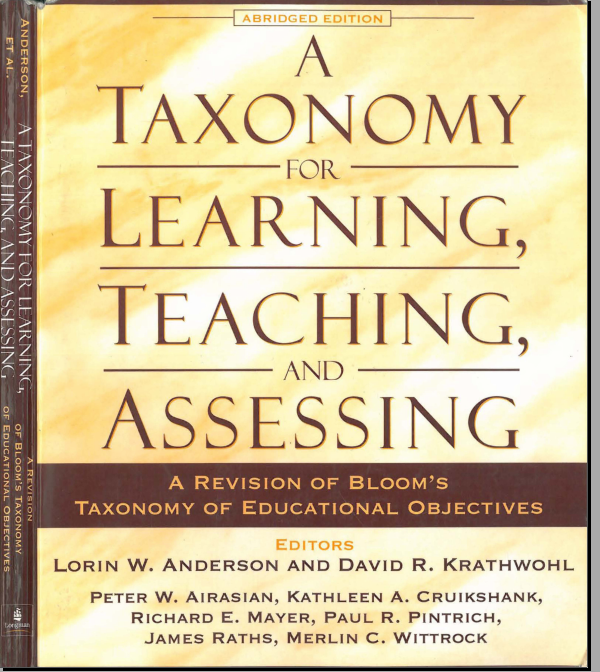
This book entitled “A Taxonomy for Learning, Teaching and Assessing: A Revision of Bloom’s Taxonomy of Educational Objectives revised by Lorin W. anderson and David R. Krathwohl published in 2001, states that: “In life, objectives help us to focus our attention and our efforts; they indicate what we want to accomplish. In education, objectives indicate what we want students to learn; they are "explicit formulations of the ways in which students are expected to be changed by the educative process."
Taxonomy Benjamin S. Bloom

The idea for this classification system was formed at an informal meeting of college examiners attending the 1948 American Psychological Association Convention in Boston. At this meeting,. interest was expressed in a theoretical framework which could be used to facilitate communication among examiners. This group felt that such a framework could do much to promote the exchange of test materials and ideas about testing. In addition, it could be helpful in stimulating research on examining and on the relations between examining and education. After considerable discussion, there was agreement that such a theoretical framework might best be obtained through “a system of classifying the goals of the educational process”, since educational objectives provide the basis for building curricula and tests and represent the starting point for much of our educational research.
One of most popular educational objectives is what stated by Benjamin S. Bloom called taxonomy (1956). As the taxonomy is now organized, it contains six major classes:
- 1. 00 Knowledge
- 2. 00 Comprehension
- 3. 00 Application
- 4. 00 Analysis
- 5. 00 Synthesis
- 6. 00 Evaluation
Taxonomy Benjamin S. Bloom Revised
A taxonomy is a special kind of framework. In a taxonomy the categories lie along a continuum. The continuum (e.g., the wave frequencies underlying color, the atomic structure underlying the periodic table of the elements) becomes one of the major organizing principles of the framework. In our Taxonomy we are classifying objectives. A statement of an objective contains a verb and a noun. The verb generally describes the intended cognitive process. The noun generally describes the knowledge students are expected to acquire or construct. Consider the following example: “The student will learn to distinguish (the cognitive process) among confederal, federal, and unitary systems of government (the knowledge}."
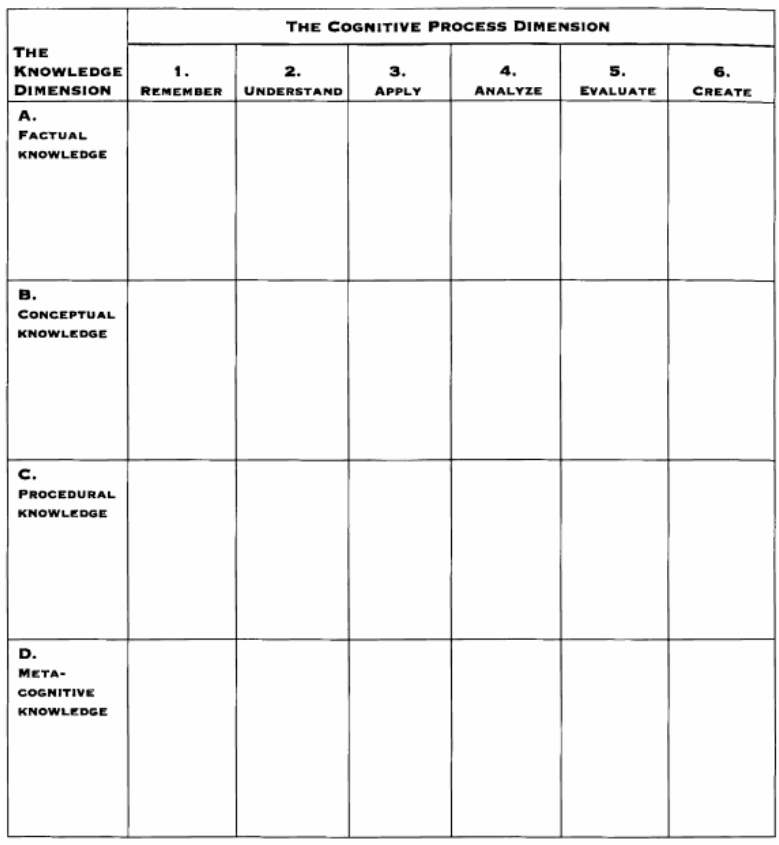
In contrast with the single dimension of the original Taxonomy, the revised framework is two-dimensional. As suggested in the preceding paragraph, the two dimensions are cognitive process and knowledge. We refer to their interrelationships as the Taxonomy Table. The cognitive process dimension (i.e., the columns of the table) contains six categories: Remember, Understand, Apply, Analyze, Evaluate, and Create. The continuum underlying the cognitive process dimension is assumed to be cognitive complexity; that is, Understand is believed to be more cognitively complex than Remember, Apply is believed to be more cognitively complex than Understand, and so on.
The knowledge dimension (i.e., the rows of the table) contains four categories: Factual, Conceptual, Procedural, and Metacognitive. These categories are assumed to lie along a continuum from concrete (Factual) to abstract (Meta cognitive). The Conceptual and Procedural categories overlap in terms of abstractness, with some procedural knowledge being more concrete than the most abstract conceptual knowledge.