


Science Fair Safety Information - Very Important!!!!
All students should use the Intel "Rules Wizard" to check the safety level and forms needed for their project. The correct forms must be filled out and approved BEFORE any experimentation can begin. This includes exact procedures. All science fair applications must be reviewed for safety by a school safety committee
Projects with Human Subjects require additional permission forms and approval by a review board which includes a medical professional such as a doctor, nurse, or school psychologist.
Any project that involves ingestion of any substance, exercise, or psychological study is defined in the Intel Science rules as containing more than minimal risk. According to the Intel Science Fair International Rules, projects with more than minimal risk require approval by a review board that includes a medical professional.
Projects with more than minimal risk must be directly supervised by a qualified scientist (according to the Intel rules, this is someone with an earned doctoral/professional degree in the biological or medical sciences). A master's degree with equivalent experience and/or expertise is acceptable when approved by a Scientific Review Comittee. Parents - anything involving chemicals or anything remotely dangerous must be supervised by a qualified professional. Johnny does not have permission to mix chemicals in the backyard using the excuse "But it's for science fair!".
Note - there are a lot of rules for Intel Science Fair. Some are required by law. Others are required by the general science community. Local hospitals follow these rules in their labs. Thousands of students around the world follow these rules every year in many countries. No project can qualify for the city or regional science fair with major safety issues.
Madison Science Fair Awards from Dec. 14, 2004
Madison Science Fair Awards from Feb. 9, 2004
Science Fair Help
How to make your display board - Word document
(includes examples of an abstract with conclusion)
Science Fair Proposal in Word format
Experimental Design Diagram -you need this on your display board
Click on the link to download a blank EDD in Word Format
Levels of the Independent Variable: Brand A, Brand B, Brand C or 5 ml, 10 ml, 15 ml, etc...
Links for your Bibliography and how to list a citation
Advice on doing your science fair project from a judge, teacher, and parent
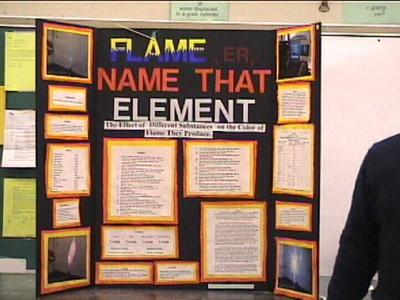
View a sample Display Board
Monday
Complete abstracts and submit type/printed copies to your science teacher by end of the day.
Bring boards to school if they are completed
Place all signed permission forms in your project binder.
Tuesday
Bring boards to school in morning. All boards should arrive by noon!
1 pm - boards will be set up in the school cafeteria by 6th grade staff and students
2 pm - students staying for judging should report to rooms 207/208.
3 pm - Judges arrive and review abstracts. Students should return to school by 3 pm if they go home.
Students will be called to the cafeteria by category. Judging will begin between 3 and 3:30 pm.
Students should not leave immediately after they have been judged in case there are questions
Please leave your permission forms at school with your display for judges to read. The forms tell the judges that your project was approved for safety and procedures.
4:30 pm - all science fair students should depart by 4:30 pm.
7:00 pm - Science Fair Open House in the cafeteria. Ribbons and certificates will be placed on boards.
7:45 pm - Take Science Fair Boards home.