







|
|||
|
|
|
|
|
|
|
|
The Kirrae, Buloke, Tjapwurrong and Gunditjmarra peoples all had territory within the Mortlake area. The local Koories were less nomadic than in many other parts of Australia, which resulted in well constructed houses, some of which were built from stone. These houses were grouped together to form small villages. Several important tribal meeting places existed throughout the area, including the trading station at Mt Noorat and the meeting places at Lake Connawarren and Salt Creek. Articles traded in the area included forest kangaroo skins, axe stone, wattle gum, volcanic glass, sandstone blocks, saplings, grass tree stalks, red ochre and marine shells. More was traded here than just goods. News, new forms of art, rituals and corroborees were also swapped.
 Until
recently the remains of one of the massive stone weirs built by the Gunditjmarra
people could be found on the Hopkins river near Framlingham. These weirs, used
to catch eels, were constructed from long wooden poles driven into the ground
and interlaced with sticks horizontally. Also of note are over 207 man made
mounds, used as camping places and burial grounds, some of which are thought
to be in excess of one thousand eight hundred years old. The largest were at
Lake Connewarren measuring some 30 metres across and two metres high.
Until
recently the remains of one of the massive stone weirs built by the Gunditjmarra
people could be found on the Hopkins river near Framlingham. These weirs, used
to catch eels, were constructed from long wooden poles driven into the ground
and interlaced with sticks horizontally. Also of note are over 207 man made
mounds, used as camping places and burial grounds, some of which are thought
to be in excess of one thousand eight hundred years old. The largest were at
Lake Connewarren measuring some 30 metres across and two metres high.
 Major
Thomas Livingston Mitchell led what was probably the first European party
to view Mount Shadwell as he passed to the north west on his 1836-37 expedition,
naming many of the local landmarks from afar. Both Mt Shadwell and Mt Clerke
(now known as Mt Elephant) were named after his friend, Sir Thomas Henry Shadwell
Clerke, an honorary secretary of the Royal Geographical Society. The nearby
Hopkins river was named after Major John Paul Hopkins.
Major
Thomas Livingston Mitchell led what was probably the first European party
to view Mount Shadwell as he passed to the north west on his 1836-37 expedition,
naming many of the local landmarks from afar. Both Mt Shadwell and Mt Clerke
(now known as Mt Elephant) were named after his friend, Sir Thomas Henry Shadwell
Clerke, an honorary secretary of the Royal Geographical Society. The nearby
Hopkins river was named after Major John Paul Hopkins.
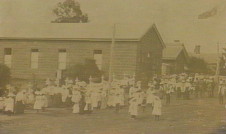 The
further exploration of the Western District was not of government sponsored,
but rather organised by ambitious adventurers and companies hoping to find themselves
a good living in the wonderful lands described by Mitchell on his return. It
is almost certain that the first white men to arrive in Mortlake were David
Fisher and his party in 1839, working on behalf of the Derwent Pastoral Company.
They set up Mount Shadwell station and left it under the charge of Thomas Anderson.
This was at the same time that the Watson brothers arrived at the Hopkins river
on the west bank, where the present day township of Hexham stands. By the end
of 1839, six pastoral stations had been established. The Mount Shadwell station
was later subdivided, creating the Hexham Park station.
The
further exploration of the Western District was not of government sponsored,
but rather organised by ambitious adventurers and companies hoping to find themselves
a good living in the wonderful lands described by Mitchell on his return. It
is almost certain that the first white men to arrive in Mortlake were David
Fisher and his party in 1839, working on behalf of the Derwent Pastoral Company.
They set up Mount Shadwell station and left it under the charge of Thomas Anderson.
This was at the same time that the Watson brothers arrived at the Hopkins river
on the west bank, where the present day township of Hexham stands. By the end
of 1839, six pastoral stations had been established. The Mount Shadwell station
was later subdivided, creating the Hexham Park station.
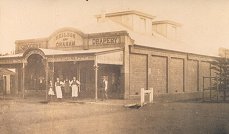 During
the gold rush years, the stations were crossed by many hopeful gold diggers
arriving and departing from the ports of Port Fairy & Warrnambool. It was
during this period that settlement of the Mortlake area began in earnest, with
many of the buildings constructed during that time still standing today. Mortlake's
layout was actually based on a plan that had proved very popular in South Australia
at the time. One of the most notable buildings erected in Mortlake at this time
was the Old Flour Mill, built in 1856 for Mr George Bostock, which processed
wheat destined for the Ararat goldfields.
During
the gold rush years, the stations were crossed by many hopeful gold diggers
arriving and departing from the ports of Port Fairy & Warrnambool. It was
during this period that settlement of the Mortlake area began in earnest, with
many of the buildings constructed during that time still standing today. Mortlake's
layout was actually based on a plan that had proved very popular in South Australia
at the time. One of the most notable buildings erected in Mortlake at this time
was the Old Flour Mill, built in 1856 for Mr George Bostock, which processed
wheat destined for the Ararat goldfields.
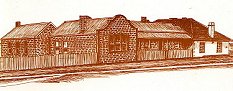
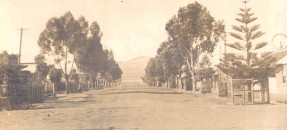 Other
buildings constructed during the 1850s and 60s include the Mount Shadwell Hotel,
The Stables, Greive & Benn's Store, the Old Post Office, the Courthouse,
Mac's Hotel and the Mill Cottages. By 1864, the Shire of Mortlake was formed,
and soon the town became a flourishing community. It was also during the 1860's
that Simon & Mark Kozminsky set up a general store and watchmakers. They
later disbanded the business and Simon went on to set up "Mortlake House"
in Melbourne. He founded the famous antique business that still bears his name
to this day. By 1880 the town had become a well established and recognised township
of some 590 residents.
Other
buildings constructed during the 1850s and 60s include the Mount Shadwell Hotel,
The Stables, Greive & Benn's Store, the Old Post Office, the Courthouse,
Mac's Hotel and the Mill Cottages. By 1864, the Shire of Mortlake was formed,
and soon the town became a flourishing community. It was also during the 1860's
that Simon & Mark Kozminsky set up a general store and watchmakers. They
later disbanded the business and Simon went on to set up "Mortlake House"
in Melbourne. He founded the famous antique business that still bears his name
to this day. By 1880 the town had become a well established and recognised township
of some 590 residents.
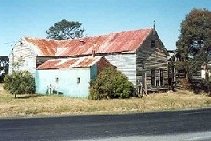 However,
seven years later, it was no longer expanding. The Goulburn Valley selection
rush of the 1880's drained Mortlake of the majority of its population. However,
Mortlake did benefit from the various agricultural and closer settlement advances
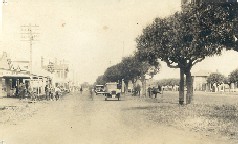
which were to come. A Butter Factory was set up in 1894, and by 1910 this building
was also serving as the towns first electricity supply. The Butter Factory still
stands on the corner of boundary road and the Terang-Mortlake Road. The town
was also bolstered by the creation of the Mortlake-Terang branch railway line,
which was opened for public use on February 4th 1890. This resulted in the towns
renewed growth, its population rising to 626 in 1890, and by 1920 the town had
a population some 800 citizens. By the 1950's the amount of wool forwarded and
superphosphate received at the Railway Station in Mortlake was the largest of
any in Victoria. The railway continued in operation until its forced closure
in 1978.
However,
seven years later, it was no longer expanding. The Goulburn Valley selection
rush of the 1880's drained Mortlake of the majority of its population. However,
Mortlake did benefit from the various agricultural and closer settlement advances
which were to come. A Butter Factory was set up in 1894, and by 1910 this building
was also serving as the towns first electricity supply. The Butter Factory still
stands on the corner of boundary road and the Terang-Mortlake Road. The town
was also bolstered by the creation of the Mortlake-Terang branch railway line,
which was opened for public use on February 4th 1890. This resulted in the towns
renewed growth, its population rising to 626 in 1890, and by 1920 the town had
a population some 800 citizens. By the 1950's the amount of wool forwarded and
superphosphate received at the Railway Station in Mortlake was the largest of
any in Victoria. The railway continued in operation until its forced closure
in 1978.
In an effort to overcome the problematic sparse rural population, the Closer Settlement Board purchased some 46,000 acres for farms between 1920 and 1929. Although some farms were successful, the majority were tragic failures at best, with land being too far from the markets, unsuitable or too rocky and the roads in poor condition. The Soldiers Settlement Commission of the post World War Two years was perhaps a little better prepared, when land was again purchased for farms. Mortlake was one of the closely settled areas, with some 360 settlers and their families arriving in the first ten years after World War Two. By 1958, the Mortlake area's population was some 1500. Today however, Mortlake's population is closer to 1000.
For more information on Mortlake's past, contact the Mortlake Visitor Information Telecentre or alternatively the Mortlake & District Historical Society.
Created by TIGMAD Web Design. This site is best view by Internet Explorer 4.0+ at 1024 by 768 resolution