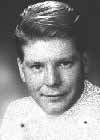
| Returning from Scotland in the winter of 2002, on what Chef Ross Stewart Andrew called a "Culinary Chase Feast of the Gas-tronomic Kind". I was able to catch up to the man of Arisay Gourmet Co. and Arisay Culinary Ltd., and asked Chef few questions. -The Web Master. WM) You started your career as a chef almost 20 years ago what was you first inclination to become a chef? RSA) I really don't know when I decided. Seems to me I have always been cooking in one-way shape or form. Probably, one of the earliest influences was with my grandmother. We would cook up the neighborhood during the summer around the headwaters of the Missouri River in Montana. She and I would literally dawn gas masks out in the back yard. We would hack, pick and grind fresh horseradish in to the creamiest potent concoction that the world has ever seen. Just to be served with a roast that only the two of us would share. She was an excellent cook, and rarely used recipes. She, more over, is the one that I learned taste and the exploration of food. My mother on the other hand, an excellent Chef in her own right always uses recipes, she had so many requests for hers she decided to author a cookbook in the mid 70's to distribute to family and friends. It was such a success the entire family was involved. WM) Once the decision was made to pursue cooking what was your motivation? RSA) Unique flavors and the ability to put satisfaction in the people enjoying my food. As far as professionals, there were many. And over the years, maturing in the kitchen seems to be one of the greatest rewards to me as an individual. Taking that lowly dishwasher and explaining to him/her that all is not lost, that I, too washed dishes, and hated it as well. Bringing them in the zoo, as we call the kitchen, for a little smack-taste of what lies to come. Giving them the "mental" tools they need to perform their job and watching them do it, and love it. That is my motivation. WM) What were some of the early challenges as a chef? RSA) Not smelling like a bloody shallot. On the first day of culinary school the exec., found out that I wanted the best, and some where between a joke and a hard place, I ended up mincing fourteen cases of shallots for the second year culinary students. I could taste them for a month. WM) Obviously your passion for food runs deep, why is it so satisfying? RSA) Food is life. Without food, who are we? (I mean) Food is the perpetual definition of who we are, where we are, and how we got there. The varied cuisines of the world are as different as the people who eat them. There, is the great known fact. You will never know it all about food, ever. Every day, something new is learned about a different cuisine, an herb, spice, ingredient or presentation. It never stops, it is so cool!.. and I hate a stagnant environment. WM) You mention "new", do you have favorites? RSA) I think every chef has favorites. If they say they don't, they're the ones who (when asking for a recipe) leave out, say that secret something. We all have favorites. I do. The things in life that are comfortable, familiar and well experienced. Growing up in the Northern Rockies, wild game is one of my favorites along with fresh morels, wild rice, cherries, apples, horseradish (laughs) and many more. We are in a time of exploration, don't be shy, eat that funky food found flopping in your souk. There is a whole lot of eating going on! WM) You have traveled extensively throughout Europe, Eastern Europe and the USSR. In your travels what local ingredients were of the most interest to you? RSA) The ones that have a bit of local history behind them. Olive oil and capers from the med. Fruits and cheese from France. Haggis from Scotland - it's not as bad as you think. There are so many other flavors to be found it would take a lifetime to be bored. Seafood tapas from Spain. Porto, borscht, pirogies, gravet laks, kasha, salumi and tons more. That's just Europe, don't forget the rest of the world, I left out almost a billion people. Seriously eating what the locals eat, drinking what they drink. Take the time and take the journey. Walk around these new tastes, chase that new flavor, and smile. WM) What would you consider "Montana" cuisine? What present Cuisines that you are working on now? RSA) Most of the chefs that I know, who have been around the block, describe their "local" cuisine as boring. I don't find that to be true. Montana is a beautiful state, with some of the world's finest ingredients. It is comfort food there. Montana is an ever-changing place and the cuisine is following along as well. New chefs are coming to Montana, and bringing along their specialties with them. A comrade of mine is introducing cutting edge Thai cuisine to the customers at her restaurant. They love it, and for the steak and potatoes crowd that's pretty good. It's interesting that "comfort cuisine" is making such a comeback around the world and so many chefs are getting back to their roots, I suppose it is understandable recently, I guess quality never goes out of style. But the basics that one learns in school are the building blocks of our party. Culinary School and Home School. That's the way to go. Knife skills, the mother sauces, making great stock and a good knowledge of how are things are combined. These are the things that define and separate the wheat from the chaff. What was the second question? WM) Are you currently working on any Cuisines? RSA) Constantly, yes. WM) Chef, you said "Culinary School and Home School", what would you say are the advantages. RSA) Culinary school taught me why, what is happening, how is this possible? Chemistry, the who, what, when, where and why. More tactics and basics than anything else. Plus food cost. Hey, if I have a cook who understands food cost and applies it to prep. Saving me thousands of dollars, that person"s got raise. Most chefs just do not have time to sit down and afford to go over the basics. There was no way when I was starting my career that any of the places that I was in, would hold my hand and teach me how to cook, or how not decapitate a digit or two. They may teach me what to cook, but not how it worked. Home school to me is being in the kitchen of your employ, actually doing what they are teaching you (in school). On a massive scale, and consistent. Reading books, going out to eat, tripping the veggie section of your local market, and getting to know the corner butcher and farmers. There was a time when all my friends thought I was bent, because I would buy fifty pounds of peanuts just to make that perfect peanut brittle. And give it all away I still am not keen on peanut brittle, but I sure know how to make it. Home School and Culinary School. WM) You have had many careers throughout your life. Commercial fisherman, nanny, general contractor, real estate professional, business owner, publican, to name a few. What were some of the occupations that have influenced you most in the last twenty years? RSA) When I was younger, it seemed that I just could not stay in one place (Ed: over fifty countries) and I thought that people who did were crazy. Now that I look back, I am so glad that I did travel and break-the-bank a time or two, Shoot-the-moon, or whatever you call it. There is comfort in knowing that you could fall back on many a career, even if you know you?re here to stay. As far as influence? There is a mental hodgepodge of each and every experience, one has. Commercial fishing probably taught me the most. What a bunch of rough-rouge predators. Seventy-two hours straight makes a sixty-five hour workweek seem wimpy. You sleep standing up, on a rolling deck, with thirty-foot seas in the North Pacific or Russia, the middle of nowhere freezing your butt. Just to catch the elusive crab. That was life, man! The smell of rotting octopi rolling in the scuppers makes a grease trap smell like perfume. And on top of that, when I didn't work the deck, I would cook. WM) Any Regrets? RSA) Too late now. That would be comparable to burning a cream soup. I think what you do with your experiences make the chef. Knowledge is great, but if the application is off, no amount of ingredients will fix it. WM) What challenges you the most? RSA) New ingredients and combinations. Twenty years ago star fruit and tropical's were all the rage. Now look at where cuisine is going. I saw a guy putting lychee marinated liver on a grill and serving it with a poivre-vert and marsala wine sauce on a bed of roasted cabbage with black caraway. I didn't even bat-an-eye. I can't wait for the next twenty. This, is good challenge. WM) Do you have a favorite spirit to work with? RSA) Lately it seems that I have been working with a lot of beer. I have excellent friends in the micro-brew industry. Although they are technically competitors they are still best of friends. Just don?t let them compare products to each other at the same brew-fest. Owning a pub in Montana has one of the perks. Access to good beer! A quality product is a necessity for any plate. Montana I believe still has the highest per-capita percentage of breweries in North America. Quite simply, excellent. Brad Robinson (Big Sky Brewing Company- Montana's Largest) imports all of his grain from Scotland to brew all his line. And Juergen Knoeller (Bayern Brewing Inc.) is a German brewmeister from Bavaria. It has been quite a while since the "micro-lution" began; it's really versatile stuff. From the crystal lime clear lagers to the darkest fino triple-bock there is not a spectrum in site that this stuff does not touch. WM) What are some of the ingredients that is always on hand in your kitchen? RSA) I like staples, well stocked good staples. It is important to any one, and more fair to your tongue to keep the best quality elements about. Great flours, ten types of sugars, rice, five kinds of salt, oils etc. I try not to keep much stock at the house. Reason is, I travel when I am not working, try to always buy fresh and usually make my own condiments. Oranges are usually kicking about, prosciutto di' parma, balsamic vinegar, maybe some melon, parmigiano-reggiano, gorgi, onions, homemade pesto and fresh sage. My brother and his wife have an incredible herb garden. So I garner a turn at their plot, "sow" to speak. WM) What about freshness of spices and herbs and vegetables? RSA) Herbs are a tough one, at the Fairmont the Ed Hendricks (GM) had a great herb garden guarded by a bunch of suicidal llamas, so we always had fresh herbs during the season for the restaurants and catering facilities. While they are in season there is no other, out of season I make pesto, persillades, etc. and try to make do. Spices are easy; if they don't smell pungent toss 'em. You would be a fool to use older and more bitter spices, when smaller quantities are available by the ounce. Vegetables are much the same as anything else, trust your muzzle if the tomato smells like a tomato and not plastic, so-be-it-bought! Figs, bananas, oranges, apples all in general should smell like what they are, and nothing but. In general, good color, good smell, good skin, good buy. WM) You were telling me of a restaurant that you recently visited, why was it so good? RSA) Ah yes, Foyer Restaurant! (pulls out a tiny map of downtown Aberdeen) Right there, just off of Union Street on Crown. See? (points to this little blue dot) Well first of all the service was impeccable. So much is lost in the front of the house to the back of the house and vice-versa that to see a staff as "Mozart in Motion" is smart. The food, albeit simple, was cooked to perfection. Clean, clean, clean and mod. Plus one thought the owners support: local shelters for the troubled youth in Scotland. All this, a gallery on site, and a great wine list made the night. WM) You seem to enjoy this. Why such a small map? RSA) Believe me, I think the North of Scotland was designed by committee. Still, in all the years of going there I haven't found one street parallel to another for over ten feet. Also, this one fits in my wallet. Finding great food in Scotland can be a chore, especially when most people think Scottish Chefs are somewhat of an oxymoron. Akin to happy dishwashers and the loo police. WM) What are some of your favorite cookbooks or food references? Without a doubt: Larousse Gastronomique- indispensable, this is probably the most used book in my collection, complete with duct tape, Jacques Pepin- La Technique, for the kitchen staff, a picture is definitely worth a thousand words. Wenzel's Menu Maker- Give up the guessing. Understanding Cooking- This was one of my first textbooks ever given to me by a chef instructor. I use this for settling those technical arguments with some hair splitting precision. And my turn of the Century Books- food really has not changed that much and plus they're fun to read. Like how to gut a cow, pig or other barnyard beast, (sweeping hand motions) and stuffing small children. (laughs) WM) Name some of the most essential equipment in the kitchen to you. RSA) Knifes, knifes, knifes. You can't do a thing without them; I have a fetish with them. I know I only need three basic knives, so why do I have lots? Why did Imelda (Marcos) need shoes? It is tough going, butchering meat with a hoe. Pans are up there as well, but you can always adjust the heat. Stoves are very important too. Beyond knives, knowledge and a sense of humor are the most important equipment of all. WM) I understand that you are working on a cookbook, tell me about it. RSA) Five years seems like quite a while to be working on a book, it just keeps getting bigger and more diverse. My sister in-law jokingly suggested that I take a sabbatical for the next decade and finally finish. I really don't quite know what to make of that. I will probably end up having my family work on it with me, like I did with my mum. WM) As a closing note, what would your advice be to an aspiring Chef? RSA) Ask yourself, what foods you don't like. If the list is large, this profession is not for you. Being a particular eater will be the demise of your career. Being fastidious about the quality of foods and ingredients is expected, but if you don't like something just because it is green, or weird - GET OUT NOW!, and make the career somewhere else. Educating yourself with different cuisines is "responsibility" as a chef. Being timid in the kitchen is another discredit to the profession. Be aggressive, assertive and timely. If you don't know - ask, or better yet, look it up. I keep a surplus of cookbooks, manuals, and reference materials available to anyone in the front or back of the house. I use them all the time, don't be shy. Any chef worth their salt won't look down upon you for using a manual, that's what they're there for. Above all ascertain good communication skills with humor, tact and grace. WM) Thanks Chef! |
 |
| Culinaria: |
| Contact: |
|
|
 |
| Arisay Culinary Ltd. Foodservice International Group |
| Interview: |
 |
 |
 |
 |
 |
 |
 |
   |

|
| Copyright 2002 : Arisay Culinary Ltd. / Foodservice International Group All rights reserved |
 |
|
| Ross Stewart Andrew |
|
|