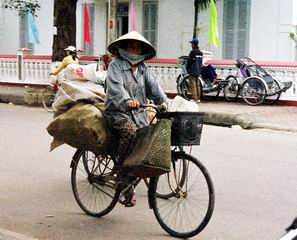
A Cyclist in Hue

Cycling down the
East Coast of Vietnam

(January –
 February 2004)

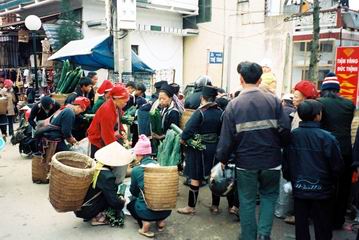
Dao, Black and Red Hmongs in Sa Pa
A Loaded Cyclist in Hue
 
Dao, Black and Red Hmong Women in Sa Pa
Summary
  
  • Touring Hanoi on a Bicyle on Tet Day
  • Biking in and around Hue
  • The Vietnam Seaboard from Hue to Nha Trang
  • Conclusion


Equipment

See "Yet Another Bicycle Tour of Southern France"

Reference 

  • Cycling in Vietnam, Laos and Cambodia (Lonely Planet) - The section on packing a bicycle in a box is a must read.
  • Vietnam Guide, Lonely Planet - The most recent edition you can get.
  • VeloAsia
All prices are in US dollars or in dongs ($1 = about 15,000 dongs, or 15 KD)

Touring Hanoi on a Bicyle on a fine Tet Day


Thursday, January 15, 2004

              My plane landed on schedule around noon at the Noi Bai International Airport, a few kilometers north of Hanoi, after a 30-hour flight with stops in New York, Anchorage and Taipei. I retrieved my bags and my bicycle in its box (which was in surprisingly good shape, even after three plane transfers). The temperature was cool and cloudy, and it stayed so for the next ten days. For a set price ($10), a taxi drove me to Nam Phuong II Hotel in central Hanoi, where I got a clean and quiet room for $15, breakfast and temperamental satellite TV included. That hotel is one of many recommended places listed in the LP Vietnam Guide, the unofficial tourist bible in South-East Asia. No reservations are needed in low season.

              Except for a few new hotels, there are no high-rise buildings in Hanoi, which looks very much like a small, homey town, despite its crowded streets and its dense, ever moving, wall-to-wall traffic – an endless swarm of whirring and honking motorcycles, with some bicycles and a few cars and trucks interspersed. For a newly arrived Western tourist, even crossing the street can be quite an ordeal, as there are very few traffic lights, and even then, pedestrians have no priority whatsoever. I was shocked and appalled, because there was no way I could ever ride my bicycle in that crazy city. But what I needed most was a good night's sleep to cure a 12-hour jet lag, and that took care of the next 10 hours. 

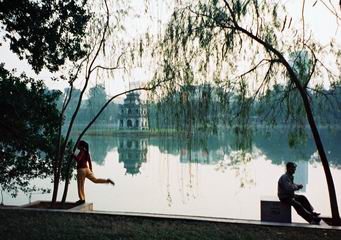
             Early in the morning, I went for a walk around
lake Hoam Kiem, just a block away from my hotel. In the nice and clean park around it, Hanoians of all ages play ball games, do Tai chi exercises or jog around. Then, map in hand, I headed for the Canadian embassy, to meet an acquaintance who was supposedly working there. The lack of public transportation in Hanoi didn't worry me; walking was an option in the relatively light early morning traffic. People at the embassy directed me to his office, a couple more kilometers away. Walking on the sidewalks of Asian cities is never boring; just observe the pack of microbusinesses thriving there – food stalls, sidewalk restaurants with small plastic chairs, cackling poultry in cages, racks ans shelves full of clothes, lottery ticket vendors, mechanics fixing disassembled motorbikes – you name it. Most of the time, you have to walk in the street, because there isn't enough place left on the sidewalk. You smell all sorts of odors and you may even see weird things like a man skinning a dog – for some, pooch-eating is a time-honored rite to finish the year, just before the Asian New Year.

             Claude Potvin was surprised to see me in his office, because navigating in
Hanoi's narrow and confusing streets can be tricky, even with a map. I showed him my compass – which saved my lost soul several times in town or countryside. Claude gave me useful information which helped me a lot to plan my stay. A motorbike taxi brought me back to my hotel for 10 000 dongs – about 70 cents. There was an inescapable hurdle, the Tet holiday just one week away. During that 10-day period, all the trains and busses are booked solid, as most Vietnamese stop working to visit friends and family. Because I was, in a way, stranded in Northern Vietnam for that period, I thought I might as well visit a place or two before starting my bicycle ride. After comparing the relative merits of various tours offered in Internet cafes, I signed in for a three-day visit of Sa Pa, a small mountain town about 10 km of Lao Cai, the northernmost town on the Red River, sitting on the Chinese border. I made some friends on the night train and had a nice stay there, but that story is outside the scope of this bicycle trip report.            

 
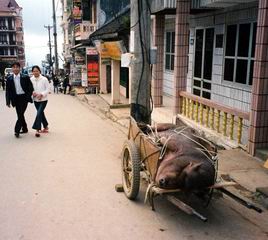
A Pig for Tet
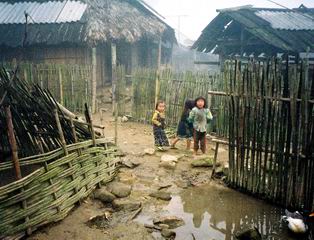
  Children in a Hmong Village
A Pig for Tet

Children in a Hmong Village


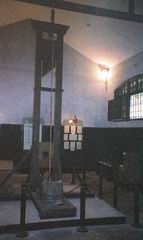
              Before leaving Hanoi, I walked to the infamous Hoa Lo Jail (a.k.a. "Hanoi Hilton" by the shot-down American pilots), now a museum featuring a genuine French guillotine, a relic of the colonial past. During that time, this prison harbored in its walls most of the leaders of the future Communist government, thus objectively serving as a resistance center. Then, I walked up to the Red River, to see the old Lon Bien Bridge, a narrow cantilever steel structure designed by Gustave Eiffel, and the colorful public market there. By that time, I had learned several essential urban jungle survival techniques, like joining other pedestrians to form a human wedge inching its way across the street – slow but sure. I also had made good progress in dealing with Asians for all kinds of goods and services. You will probably get ripped off a few times (hopefully, for small amounts) before you get used to the local currency and know the price of things. Some rest is advisable in the first days, because you are an easy prey if your judgment is dulled by the jet lag. Everywhere you go in Hanoi, motorbikes or cyclo taxis will offer you rides. Street peddlers can be a pain; some of them insist on selling you things you don't want, even if you decline politely. Getting angry will get you nowhere. Just smile and say something like "I know what I want - don’t take me for a freshly landed tourist", and go away without looking back. A few prostitutes are working around lake Hoam Kiem, but they are very low profile. If you say "No, thank you", they won't bother you. 

              I also met nice people who didn't try to sell me things – or maybe they couldn't make their point because they didn't use the right approach or were inhibited by the language barrier. Whatever. While I was reading in the Hoam Kiem Park, a 25-year old student came up for a chat. His English was very good. He offered me a glass of Vietnamese tea (which smells like lawn mower undercoat). He thought that traveling alone like I did was a terrible idea – for the Vietnamese, solitude is an horrible vice. On another occasion, a fiftyish man came up and presented himself in laborious French. We chatted a bit; as he was going to Hue by bus the next Sunday, he offered me to accompany him. I gladly accepted. We booked our tickets in a Sinh Cafe. This is a good outfit – very professional services and good prices. Not bad for a governmental agency in a "Communist" country

              I got back from Sa Pa on Wednesday the 21st, on the eve of Tet . The hotel staff invited me to celebrate the Asian New Year with them on the terrace of the top floor. We had a splendid view of the midnight fireworks on lake Hoam Kiem, with the cheering crowd filling the streets below. Thus began the Year of the Monkey – my lucky year. That very morning, I finished assembling my bicycle and went for a ride in the then empty streets of Hanoi. I was so glad to be riding again in that strange, almost deserted city. Later, in a cafe, a Vietnamese woman offered me to rent a room in her apartment. It was located in an old, but nice building, and I could use her kitchen and satellite television. On a small table sat a bottle of "snake wine", containing a bundle of snakes pickled in alcohol, in the middle of which stood a cobra with a fully deployed hood (the stuff cures a lot of things, like impotency for men, headaches for women – how convenient!). She said I could give her whatever amount I deemed appropriate and stay as long as I wished. That was a straight business proposal: in Vietnam, salaries are so low that to get by, most people are willing to sell or rent almost anything to earn extra dongs or dollars. I loaded all my things on my bicycle to moved in, riding in the heavy evening traffic without too much trouble.

             Whatever a Western observer may think, there are rules for driving in Hanoi. Did you ever watch two schools of goldfish crossing through each other in a water basin? In short, these rules are: never stop, never make an unexpected move, never look back, always try to guess what the guy in front of you might be doing the next second, and be ready to move on one side or the other as needed. After a while, you will love that kind of no-nonsense "creative driving". Of course there are some drawbacks: if you are a cyclist, you are very low in the pecking order – actually just one notch above the humble pedestrian or stray chicken. So, if you hear a motorcycle beeping behind you (all the more so if it's a truck honking), get out of the way as fast as you can! If you pass a stopped bus or truck, watch the tail lights; as rear-view mirrors are purely decorative items in Vietnam, the driver won't see you if he moves off. You will be a seasoned rider when you master the dreadful cross-traffic left turn. Remember: Vietnamese drivers never stop, so if you do and signal a left turn, you will stay there forever. The proper way to do is: 1) cross the street somewhere before the intersection, whenever you can cut safely through the left lane traffic; 2) run in the opposite direction of the traffic, as close to the sidewalk or to the edge of the road as you can (no problem, everybody will move off a bit as you go); 3) at the intersection, turn left and keep on, still moving in the opposite direction; 4) whenever you spot a break in the left lane, move fast through it and merge in right lane – et voilà!
  
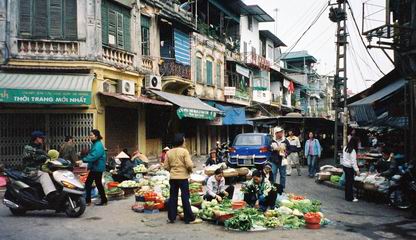
A Street Market in Hanoi
  Hoa Lo Jail
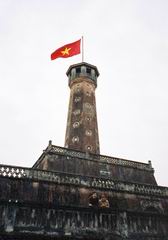
  The Imperial Fort in Hanoi
A Street Market in Hanoi
 
Hoa Lo Jail
 
The Imperial Fort in Hanoi
   
            On Friday, the sun shyly shone through for the first time. I left for a long bicycle ride in and around Hanoi. First, I went to the Ho Chi Minh Mausoleum, and waited in line to get a look at the stiff. The man looked like he was sleeping. I was impressed: what a great destiny was his! You can leave your bicycle safely, locked or not, in the parking section reserved for cycles; for a few pennies, the keeper will keep an eye on it. Then, I wanted to see the Aviation Museum, but I got lost. Phrase book in hand, I asked several people for the right direction, and they gladly obliged, but they sent me to the airport! When I saw that I was about to cross the Red River, I realized that I had to go back. I rode along the shore to get back to central Hanoi, a very interesting ride indeed (all in all, more than 50 km). A lot of people were carrying home mandarin trees full of orange fruit for Tet (the Vietnamese Christmas tree) on their two-, three- or four-wheeled vehicle.

             The following day, I took a tour with Sinh Cafe to visit the Chua Hong pagodas, some 60 km south of Hanoi, which feature the same type of mind-boggling karstic formations as Ha Long Bay (because of the lousy weather, I left out for some other time this classic "must-see" attraction), except that they are inland. The sculptured hills take all kinds of fantastic shapes, and the view is gorgeous. Traditional wooden paddle boats carry the pilgrims up and down the Perfume River, snaking in the middle of an astounding landscape. I was with a small and lively group of Italian tourists. In Huong Son, our guide rented one of these Vietnamese gondolas, propelled by two strong women handling a long and heavy paddle, one at the bow and the other at the stern. The first two temples are nice enough, but the highlight is the last one, located in a huge (and well-preserved) 50-meter high grotto, full of stalactites and stalagmites. To get there, you have to climb several hundred steps carved in the rock, with a lot of pilgrims who seek the blessings of Buddha for the New Year. Moreover, there are dedicated chapels for women who want to bear children, people who need money, etc. (I tried the latest, and it really works!) Despite the countless vendors on both sides of the steps all the way up, the mountain setting is beautiful and inspiring. On the way back, while I was chatting with the guide – a nice-looking young woman, we heard a racket at our feet: an angry old woman was throwing stones at us. Surprised, we quickly moved out of range. She must have thought that I was some sex tourist with a local girl. Obviously, Vietnam is not Thailand, where almost anything goes. When we got back to the boat after an hearty meal in an outdoor restaurant, one of the rowers was missing. She had accepted another contract instead of waiting for us. So, our guide had to take her place – obviously, unions have not spoiled Vietnam yet. After a while, one of the Italian tourists – an athletic young man - offered to take her place, and he found it very hard. I took the next turn, but, as I was sending just about as much water on the passengers as behind the boat with that heavy wooden paddle, I had to give up. Fortunately, the missing rower took back her place, after a laborious boarding in the middle of the river. 

            Sunday was my last day in
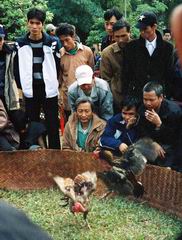
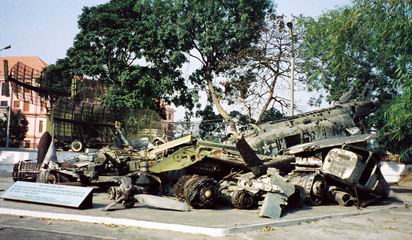
Hanoi, and I tried to make the most of it. I jumped on xe dap (Vietnamese for bicycle) and headed south to visit the Aviation Museum, but it was closed! Fortunately, the young Air Force cadets who were guarding the entrance did let me in the courtyard, probably because they were bored stiff, and I visited the outside exhibits. Beside a silvery Mig 21 and a bright white SAM missile on its launcher, there stood a huge pile of shot-down airplane debris, capped with the sorry wreck of a F4F Phantom, which had seen much better days. On my way back, I got lost and saw the slums of Hanoi, along the canals and the railways. Poverty is well hidden in Vietnam; beggars are not tolerated on the street, as they are in other big Asian cities. I also visited the Ethnographical Museum, which features huge communal bamboo houses typical of various mountain tribes, most of them authentic and reassembled here. Just beside in the yard, bettors were standing around cock fights, ignoring disturbing reports about avian flu aired all over the world. Everywhere else, chicken was on sale, and civets hung in some markets. Vietnamese don't care much about Western media shows. 

            My Hanoian friend met me at the Sinh Cafe. There was a problem because the tightly packed shuttle taking us to the bus terminal didn't have any place inside for my bicyle, and didn't have a roof rack either. My friend offered to ride it there. That wasn't a fun ride, because the seat was too high for him. On the night bus, we talked for a few hours. He told me that he earned about $200 a month, barely enough to make a living in
Hanoi. He served in Laos during the American War, but he never got to shoot at anyone because he was in a logistic unit. "Now, he said, we have turned the page, and everybody is glad to live in peace". He shunned all things politic, and told me a couple of time not to speak so loud - somebody may be listening. In a Communist country, people soon learn to keep their opinions to themselves. The bus reached Hue at 6 a. m.

   
Cock Fight in Hanoi
  Aircraft Wrecks Display
Cock Fight in Hanoi

Aircraft Wrecks Display

Day by day

Biking in and around Hue

Day 0

Monday and Tuesday, January 26 and 27 (About 80 km in two days) 

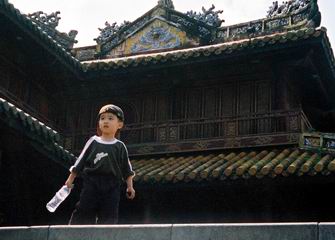
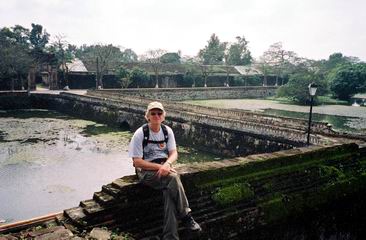
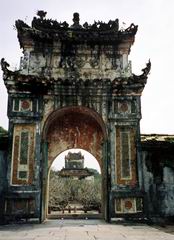
            I booked a clean and quiet room in Dong Phuong Hotel (where the bus stopped), with a decent satellite TV ($7). The sun was out for good now, and the temperature was perfect. I hopped on xe dap and crossed the bridge to visit the Imperial Palace – well, what's left of it. Although most of the buildings are in a sad shape, they are still very impressive. The Nguyen emperors, who ruled from 1802 to 1945, were anything but humble. They saw themselves in the sneakers of the emperor of China, the Son of the Sky, and thought that they had to keep up with the Joneses. They built countless palaces big and small, lavish with all the luxury absolute power can buy. Every detail carries some encoded meaning; for instance, top mandarins wore silk robes with four-clawed dragons, but only princes could sport five-clawed dragons. Some time later, after a nap, I pedaled a few kilometers along the quiet Perfume River, to visit the seven-story Thieu Mu pagoda. In the temple filled by small clouds of incense, an old Buddhist monk and his young assistants, dressed in saffron robes, were chanting the office. Except for the gong and tambourines, everything was just like in a Benedictine monastery. There are a lot of sumptuous and well-kept pagodas to visit in Hue, a very dynamic Buddhist center.

           The following day, after visiting three more pagodas, I headed south for the tomb of emperor Tu Duc. A guy on a motorcycle closed in on my left to chat; he explained me how to get there. Tu Duc (1848 -1883), who had 104 wives (not counting concubines), was one of the most extravagant of the Nguyen emperors. During the last years of his reign, he left the management of the country to his mandarins, living in style with his concubines and composing poems in the little Versailles built there for him. For five years, he supervised the building of his tomb, including a secret chamber for his burial, then he had the architect and 200 workers beheaded to keep the secret - so far, nobody ever found his wretched bones. The excessive sumptuary expenses of the Nguyen emperors, draining much of the country's resources, caused several uprisings, most of which were harshly repressed, and were instrumental in the gradual takeover of Indochina by the French. On the way back, I got lost again – except on the main roads, there are little or no signs at all, and you have to ask your way around. To make things worse, my wireless bicycle computer was useless. Little street rascals stole my wheel sensor in Hanoi, while I was in an Internet cafe. Despite that hitch, I could find my way without too much trouble because I was following the set itinerary proposed by Cycling Vietnam, Laos and Cambodia. On the bright side, most people were very friendly, and especially kids, who bombarded me with warm, high-pitched "hallos" wherever I went. I soon learned to smile and wave back (to calm things down), and felt like a Tour de France champion close to the finish line.

 
The Imperial Palace in Hue
  The Author in Hue
The Imperial Palace in Hue

The Author in Hue

The Vietnam Seaboard from Hue to Nha Trang

Day  1 

Wednesday, January 28 - From Hue to Lang Co (67 km, 5 h)

              Early on a grey morning, I set out for the sea, after lining up with school kids to buy a couple of sandwiches (French baguette stuffed with cold meat) from a sidewalk vendor. After crossing the railroad overpass at the outskirts of Hue, I headed inland instead of to the coast. Passing a group of cheering young soldiers, I had to smile and wave back to everybody like a real celebrity. After going uphill for a few kilometers, I had second thoughts and asked people for "Lang Co". They pointed the other way, and I turned back. National Highway 1 (NH 1) is well kept, and the traffic is medium to heavy. There is a convenient paved shoulder to ride on, except on narrow bridges and around market places, where all vehicles have to inch through dense crowds. Just before noon, after a couple of easy climbs, I was in Lang Co. In front of every other house, there was a roadside stand offering the same jars of shrimp in tomato sauce, neatly piled in superposed rows. In that country, whenever anybody has a neat idea, all the neighbors will copy-clone it. A kid on a bicycle joined me and proposed me a room in a nearby guesthouse. I took it, only to realize that it wasn't worth the price ($10). Then, I went for a stroll on the deserted beach, pounded by the rough, grey surf. Obviously, it wasn't high season yet.

Day 2
 

Thursday, January 29 - From Lang Co to Danang through the Hai Van Pass (45 km, 4½ h)

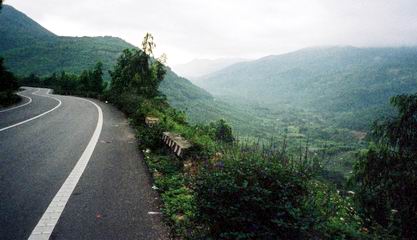
             That morning, as soon as I left Lang Co, I started climbing the Hai Van Pass – the well-named Pass of the Clouds. There, high up, the central cordillera cuts across the land to meet the sea, acting as a natural barrier separating the cool and cloudy Northern provinces from the warm and sunny Southern provinces. The pass is not very high (500 m), but the steep winding road (with a grade of 8 ° or more in some places) can be challenging, especially in narrow stretches where the shoulder disappears. I had to take a break once in a while. As I was climbing, I kept leapfrogging with a young woman on a motorbike picking up empty beer and soda cans. I piled some for her on the roadside, and she thanked me with a big smile. I kept going up in the clouds, with a visibility of less than 50 meters. Past the summit, I enjoyed a 7 or 8 km descent, as the sun was breaking through. I reached Danang around noon, and easily found Thanh An Hotel, close to the river (recommended by LP), where I took a $5 room. It was now a warm, sunny day. In the afternoon, I visited the Cham Museum, featuring outstanding sculptures and archaeological vestiges of the Hindu colonial period (5th century). I didn't make the required detour to see the temple remnants in My Son.

Day 3
 

Friday, January 30 - From Danang to Hoi An (32 km, 3 h)

              On the outskirts of Danang, I rode around the Marble Mountain, where all manners of sculptures are displayed in front of the workshops. Most of them are Buddhist temple supplies, but there are also stylized peasants, horses and bulls, and even kitsch Western favorites like stylized veiled maiden or chubby mannekenpis – anything that sells. Except for official monuments in public places and a rare government-sponsored poster, Socialist Realism is definitely out.

              I got a $8 room with satellite TV in Thanh Binh Hotel (LP). While I was walking on the street, one of the lenses of my sunglasses fell off. I had it fixed for $1 by a jeweler working on his tiny outdoor stand in the public market. Old Hoi An is a very well preserved museum town. It used to be an important sea port with a large community of Chinese merchants, who built rich houses and splendid temples. From 1975 to 1980, most of the Chinese left, with more than one million South Vietnamese who had become instant traitors to their country after the Americans left. Refugees fled by any available mean – remember the upsetting boat people episode. Now, the government is trying to woo them back, with very limited success.

              For the rest of the trip, weather was rather hot during day hours, with some mosquitoes biting after sunset. In most hotels, I had to use the mosquito net provided with the bed. However, malaria is not a threat in that part of Southeast Asia, and nobody takes anti-malarial drugs.

 
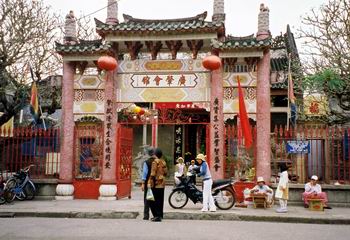
A Chinese Temple in Hoi An
  Children in Sa Huyn
  Tu Duc Tomb
A Chinese Temple in Hoi An
 
Children in Sa Huyn
 
Tu Duc Tomb


Day 4
 

Saturday, January 31- From Hoi An to Quang Ngai (123 km, 7 h)

             I left Hoi An at 7 h 30 for my first long distance stretch. Around noon, I stopped at a sidewalk restaurant in the center of a small town called Tam Ky. Because nobody there understood my phrase book Vietnamese (except, of course, basics like bao nhieu, - how much?), I had to use sign language to order a noodle soup ($0.45). While I was waiting, a little girl came by. I reached in my pocket for some prop and took out a Canadian penny. I showed her the maple leaf and said "Canada". This caused a small upheaval around my table; a man took the penny and asked me how many dongs it was worth. I mimed "very little" (actually, 120 dongs). The man, thinking it was a one-dollar coin, offered me 5000 dongs for it. I gave him the penny, and that made his day.

             In the afternoon, the temperature rose to some 30 °C. Riding a bicycle under the tropic sun can be quite tiresome, even in a country as flat as a pancake. Because there are still a lot of old Russian diesel trucks and busses belching dense clouds of black smoke on the road, most Vietnamese cyclists and motorcyclists wear a cloth face mask to protect their respiratory tract. Not to speak of the continuous blaring and beeping in busy spots. I was passing a lot of cyclists riding like me on the shoulder, mainly peasants on heavily laden clunkers, young beauties dressed in floating light blue ao dai and school kids riding in small bunches. Often, they would catch up with me to try their limited English: "What's your name?" - "How old are you?" - "Where are you from?", etc., repeatedly. If you are thirsty, forget about cold drinks: everything drinkable is served tepid (including coffee, which takes forever to ooze out of the dripper). Fortunately, cheap bottled water is available on every corner. In some places, the shoulder either disappears completely or is coated with dried mud, or it is used by the locals to dry grain or some kind of sliced vegetables. As for stopping to relieve your bladder in the nature, forget it: there are no vacant lots along NH 1. Remember, you are a celebrity now, and you forfeited all your rights to privacy. Perhaps there was another explanation for my instant fame: I didn't see *any other* long distance cyclist, foreign or local, so everybody probably just wanted to get closer to see that clown with flashy clothes and a ridiculous hat on.

 
            When I finally reached Quang Ngai around 4 p. m., I didn't have any trouble finding another lousy, $7 room in Kim Thrang Hotel, but I did have to walk a lot to find a bar offering cold beer, which is ample proof of the assertion that I was the sole tourist in that godforsaken place.
Day 5
 

Sunday, February 1 - From Quang Ngai to Sa Huyn (65 km, 4 h)

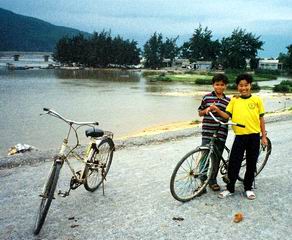
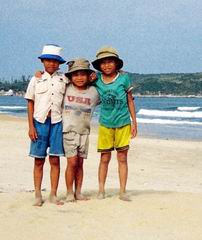
           After an easy and uneventful ride, I was glad to reach the sea around noon, as the day was getting hot. After a quick tour of Sa Huyn (pronounced "Sa-win"), I was still looking for an hotel. A shop owner advised me to take a look past the bridge, a couple of kilometers away, and there it was, Te Vinh Hotel (a lot of new, modern hotels are not listed in LP). I got a pretty little room with a view on the sea for 100 KD. After a delicious tuna soup, I went to the beach for a first dip. Despite the sunny afternoon, there wasn't a soul in sight; obviously, the sea was too cold for the locals. I went in and, bobbing in the middle of the waves, I enjoyed myself some. Back on the beach, a group of curious children, three young boys guarded by their slightly taller elder sister, came to see who was there. Seeing that I was taking pictures of them, they played all kinds of games in front of me. Vietnamese children certainly are great actors. Back to the hotel, an employee was dumping garbage in the small laguna nearby, dotted by floating plastic bags.


The Cu Mong Pass
  Boys in Lang Co
The Cu Mong Pass

Boys in Lang Co
 
Day 6
 
Monday, February 2 - From Sa Huyn to Dieu Tri (105 km, 7 h)

The next morning, as I was leaving, I noticed that I had a flat tire. As I was pulling out the wheel, a few hotel employees came to look. A teenager pointed to my patch and glue kit, asking me by signs to let him fix my tube. I smiled at him and soon after, he came back with a good tube. He wouldn't take any money for his service. As I was going to leave, one of the bystanders showed me a broken weld under the seat: a steel bar reinforcing the frame had come loose. I decided to have it be fixed while I was in town. I mimed the act of soldering with a mask: "Pshshshshshsht!", and someone pointed his hand in the general direction of the village. After repeating my performance a few times, I found the solderer. He fixed my frame for 5 KD ($0.33), with a smile. I was about one hour late on my schedule. Each hour counts, as the asphalted road gets hotter. In Phu My, I stopped in an empty roadside restaurant for a delicious Tonkin soup, and the restaurant immediately filled up. Celebrity certainly can be a drag, after a while.

After lunch, as the temperature was getting close to 30 °C, I had best change my snazzy cyclist clothes for long-sleeve shirt and trousers. I stopped in the remotest spot I could find, but to no avail. An old man pushing a cart came by to see my gear and chat. I didn't understand a thing he said. Then half a dozen school kids on bicycle stopped to try the few English word they knew. I finished changing and they escorted me for a few kilometers, until they reached their school. I didn't mind; the Vietnamese may be curious, but they are very kind people – well, most of them. The only rude person I met in that region was a motorbike taxi driver in Dieu Tri, who had decided that I needed a ride. I tried to ignore him, but he was following me everywhere and interfering constantly. I finally told him that he'd better get lost or something because there was no way I'd go with him, even if I had to crawl or walk on my hands. He left mumbling assorted curses.

Reaching Dieu Tri around 3 p.m., I decided not to go on to the planned stop, the old sea port of Quy Nhon, 12 km out of the main highway, because I was pooped. Dieu Tri is a highway stop with not much to offer. Yet, I got a clean, air-conditioned room for $10 in an unlisted brand new hotel. That country is developing fast.

Day 7
 
Tuesday, February 3 - From Dieu Tri to Tuy Hoa (101 km, 7 h)

            I left at 7 a.m. for my biggest day yet, effort wise, with no less than six climbs, including a 3.5-km buster, the Cu Mong Pass, muffled in foggy clouds. In tropical countries, clouds are a blessing for cyclists, but alas, they soon gave way to the blazing sun. Right after a stop for lunch in Song Cau (Fish River), I changed for long sleeves. With the hood I cut out in an old T-shirt, I looked more like a mehari rider than a cyclist. The road was somewhat nicer and less busy than usual. All day long, I tried do go easy on liquids, because that morning, I had the runnings – a very annoying predicament for a lone cyclist in Vietnam. However, I made it to Tuy Hoa without any problem. I got a $8 room in Huang San Hotel, a big, almost empty building, featuring a kitsch European-style fountain, graced with two oeuvres d'art, a thin-veiled, ethereal maiden *and* a small, plump mannekenpis, probably bought together in a Marble Mountain sculpture shop.

            After a short nap and a cold shower, I took a motorbike taxi to the 12th century Cham temple built on top of the hill dominating the city - now a Buddhist pagoda. The driver had learned English working in a USAF base during the war. Having fought on the wrong side, he was sent in a re-education camp after 1975. Then, I asked him to drive me to a good restaurant. Good it was, but the menu, in Vietnamese only, didn't show prices. Taking advantage of the communication problem with the only tourist in town, they served me breaded shrimp instead of the shrimp soup I had ordered. The whole thing set me back some 64 KD ($4.25), a small fortune there. One good thing about Tuy Hoa: this is the first coastal town where I could find cold beer. Everywhere else, they serve warm beer on ice. Because ice is unsafe in most places, you have to ask for a "beer no ice" – a depressing thing for a gentleman, but apparently good enough for these people and the Brits.


Day 8
 
Wednesday, February 4 - From Tuy Hoa to Nha Trang (126 km, 8 h)

            The finale day was the tallest order. I left in a daze due to the cocktail of medication I gulped down the night before, because I was coughing and my nose was running. Being mildly hypochondriac, I was afraid I might be getting the dreaded avian flu or another of these horrible Asian diseases, and that I would die miserably stranded in some godforsaken hole. I placed all my bets on getting to Nha Trang (pronounced Nya-chang) by hook or by crook, to recover in a nice setting from whatever illness was grinding me down.

            After climbing one more pass, I was at last riding on the coast, along shrimp basins and coconut trees. The last 10 km were a feast for the eye. Leaving NH 1, I had to walk my bike up a steep hill covered with banana trees and dragon fruits. Then, it was all downhill to Thang Loi Hotel, where I got a clean room with a ventilator, warm water and satellite TV for only $6.50. I decided to settle there and rest for a few days. Despite my long clothes and hood, my face was red and my lips were badly chapped.


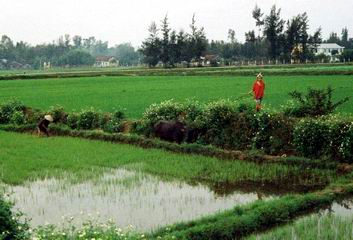
Rice Paddy
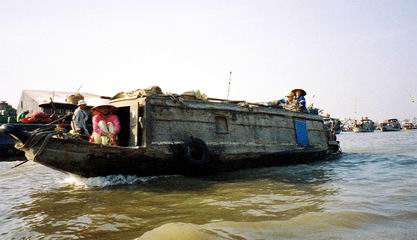
  A Boat House on the Mekong River
Rice Paddy

A Boat House on the Mekong River

Conclusion


            The following day, I decided to forget about Pham Thiet and take a few days off for various reasons: sunburns, a throat irritation probably due to road pollution, running out of time and, last but not the least, I didn't think it was fun anymore. However, I have no regrets. Traveling alone in Vietnam is much more than a technical challenge, it is, first and foremost, an unforgettable adventure, if only because it's a great place to learn to use non verbal techniques and smiling to communicate. For a Westerner, this is an integral therapy.

             I went to Café des amis, on Nha Trang main drag, and put up a sign on xe dap. After one short hour, I sold it to a fiftyish Vietnamese who badly wanted a good 10+-speed bicycle. He gave me $40 for it - exactly the price I had paid for it in a yard sale, but it was still a good deal, because that price included tools and equipment I didn't want to carry (like a helmet and panniers). Good bicycles are hard to come by in Vietnam. Most people cannot afford anything better than one-speed Chinese bicycles (as sturdy as tractors, and just about as heavy) or cheap local brands. Then I bought a backpack for $15 for the rest of my trip (yet another story). Finally, the total distance traveled, from Hue to Nha Trang, was 660 km in 8 days (instead of 1000 km in 12 days, to Pham Thiet). Adding the 150 km I rode in Hanoi and Hue brings the total score to 800 km.      

            About the weather: During the dry season (November-April), rain is scarce. I didn't have to use my raincoat at all on the road. January is probably the best time to cycle Southern Vietnam

            About the road: Some inland stretches (for instance, from Hoi An to Quang Nhai) are uninteresting, unless you just got out of the plane. A much better strategy would be to hop on the bus to skip them, but then, in small places, you may have trouble explaining that you want to put your bicycle on the bus if nobody there understands you. However, whatever itinerary you choose, there are no insurmountable technical obstacles as such: the road is well kept, there is plenty of cheap drinkable water and food everywhere, most hotels have available rooms (no reservations are needed), local people are good-natured and ready to help in case of trouble (language barrier is not really a problem), and it is possible to get a good protection from the sun by dressing appropriately and wearing a mask (with the added reflection on the pavement, sun screens are not good enough for day-long UV exposition). As to the Vietnamese driving way, you soon feel secure with it, because there are a lot of cyclists (adults and school kids) riding on the shoulder. You may even come to feel that it's cool to ride like a fish in a pound, never stopping and merging with the flow (except, of course, in extremely dense traffic areas like Hanoi).

             The only remaining hurdle is the risk of getting sick, and coping with road noise and pollution, particularly breathing diesel smoke from heavy vehicles. Eventually, the situation should get better because, when the Ho Chi Minh Highway is commissioned in one year or two, most of the long distance traffic and a large portion of the heavy vehicles will use it, leaving NH 1 for local traffic. My advice to other cyclists: wait for the highway! This is evidenced by the fact that I didn't see any other cyclotourist during the whole trip – and conversely, by the royal treatment I got from the local people. They made me feel like a god blessed hero. Unless it's some form of Vietnamese humor I didn't get, like: "Who is this moron traveling on a bicycle instead of taking the bus like everybody else?".
     
             Vietnam is changing fast. What lies in the future for that courageous and crafty people? Compared to its "Asian dragons" neighbors (Korea, Honk Kong, Taiwan, Singapore) or quasi-dragons like Thailand and Malaysia, Vietnam, the "Asian gecko", is still far behind, but it can climb walls; it's China-like mixed economy is growing fast. Riding a strong wave of population growth, it has managed so far to keep its tightly knit social tissue and the best part of its Communist heritage. "Here, everybody eats and has access to public school and health care", an elder citizen told me. However, the other side of the medal is that Vietnam is challenged by all the growth problems of market economy countries, like poverty, corruption, overexploitation of resources and pollution, which may overwhelm its China-style gerontocratic government alternately hanging tough or trying to surf the tsunami of change. It remains to be seen what degree of stagnation or change its young population is willing to accept in the years to come.

 
Lake Hoam Kiem in Hanoi
  A Cao Dai Temple
Lake Hoam Kiem in Hanoi

A Cao Dai Temple
 

[ French ] [ Bicycle Page ] [ Home Page ]
Hosted by www.Geocities.ws

1