 |
Bicycle Tour in Southern France (October 1998) |
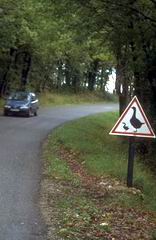 |
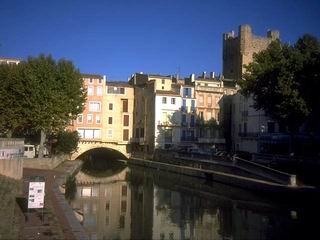
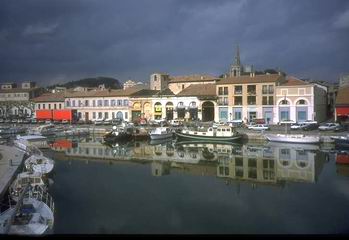
| Canal de la Robine, in Narbonne | Somewhere in Périgord |
|
Bicycle Tour in Southern France (October 1998) |
|
| Canal de la Robine, in Narbonne | Somewhere in Périgord |
Featuring
| A solo, 21 days, 1300 km (800 miles) tour starting from Toulouse and ending in Marseille, going through the Canal de la Garonne, Quercy and Périgord (a very good place to start a bicycle tour in France), the prehistoric sites in the Dordogne and Vézère Valleys, the Aveyron uplands, the Canal du Midi, a string of medieval cities from Carcassonne to Arles, and the Mediterranean Coast. |
| This was my first bicycle trip in Europe. Initially, I was supposed to go with a friend, but, because we couldn’t agree on the scope and the itinerary of the trip, we mutually concurred not to do it together. As for myself, mainly because I had already bought my ticket (arrival in Toulouse, departure in Marseille 21 days later), I decided to go solo. |
| My aim was to see as many different regions
and places as possible within that limited time/space frame, on a limited
300 F a day budget (1 FF = $0.19 US or $ 0.26 CAN – average hotel price:
140 F; I busted my budget in Marseille, but then, I didn’t care anymore).
I ruled out camping because most camping grounds are closed in October
and because I wanted to travel as light and as conveniently as possible.
Besides, I knew I would be stopping here and there, and I didn't like the
idea of leaving behind a loaded bicycle, locked or not.
As it turned out, I kept a tight schedule and managed to visit almost all the places I had set out to see. To avoid idle time, good planning of arrival times (and consequently, of departure times) is essential for each leg. One good thing about traveling alone is that you have a lot of time to optimize your itinerary. It's easy because a) your mind works all the time and b) there is no interference. |
| My gear, divided between 2 panniers and
a front bag, added only 16 kg (35 lbs.) to the dry weight of my Raleigh
hybrid bicycle, weighing 18 kg (39 lbs.). As for my own weigh, It dropped
to 74.5 kg (164 lbs.), a net loss of 4 kg (9 lbs.).
I was carrying all the tools and equipment I needed to take care of most road contingencies, including:
|
| The weather was unusually cold for that time of year (as a matter of fact, it was colder there than here Montréal, my home town), with heavy fog and lows of only 5-8 °C in the morning. When the plane landed in Toulouse, it was snowing in the Pyrenees, and the sun didn't show up until the fifth day of travel. Except for the last day, the chilly mistral was blowing from the north all the time, although most of the days in the afternoon, I could peel off to my T-shirt and enjoy the sun. But all in all, I consider myself lucky because I got only two half days of mild rain, and that didn't stop me. Normally, October is a good time for cyclotourism in France, but 1998, the El Niño year, is the exception that confirms the rule. There were few long haul cyclists; I saw only a handful of them in three weeks. If you are properly dressed, cold weather is not that bad for cycling, because after 5 minutes, you have already warmed up. |
 |
|
 |
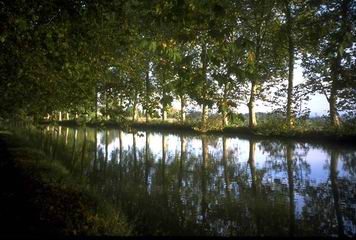
| Canal du Midi, near Castelnaudary | Canal du Rhône, in Beaucaire |
Following the canals
| Southern France is crisscrossed by a grid of canals, built before the railroads some two hundred years ago; some of them are more than 100 km long. As a matter of fact, traveling exclusively on canals paths, a cyclist can cross Southern France from Bordeaux, on the Atlantic Coast, to Agde, on the Mediterranean Sea (a 450 km ride). From there, it is probably possible to reach Beaucaire, on the Rhône (near Arles), following the Canal du Rhône (can anybody confirm our deny that?). As a rule, at least one side of the canal can be used by cyclists, because there used to be towpaths for horse teams towing barges. The status of these towpaths is extremely variable: while some sections near cities have been fully revamped for cyclists, the rest is only fair to so-so, and some sections can be bumpy and/or very narrow, just like dirt paths, and you should expect some mud after rainy days. This is where hybrid and mountain bikes really shine (literally speaking only); if you don't mind kicking mud once in a while, you will enjoy following the canals for the quiet, glorious and always changing scenery. Canals are also most convenient to get in or out of big cities (like Toulouse), and they are great to avoid the hassle of buzzing traffic and/or the ugly suburbs. During this trip, I followed the Canal de la Garonne from Toulouse to Moissac (80 km north), and the Canal du Midi from Castelnaudary to Agde (160 km). |
| All in all, I rode for 15 out of 19 usable days, with an average daily run of 85 km, which took me about 6 hours (average speed: 14 km/h). In this article, the reported times are actual riding times, without the breaks. On a typical day, I would leave at 9 a.m. and arrive before 5 p.m. Because most restaurants don't open before 7 p.m., I still had time to shower and stroll downtown before dinner. I took a first day off in Carcassonne on a Sunday, after a stretch of 10 days. I needed some rest; due to points of hard contact with the saddle, my waning butt was aching, and I had developed a pain in the left leg that was waking me up at night (retrospectively, I learned that I could have avoided both pains by doing some conditioning exercises every day). When I reached Nîmes on day 14, I thought I've had it and took some rest. After one more day on the road to reach Arles, I called it quit and hopped on the Friday night train for a last weekend in Marseille before catching the plane on Monday. Three weeks is indeed a very short time to visit Southern France, whatever your plans and interests are. |
| In Southern France, drivers are used to share narrow roads with cyclists, and, as soon as you get the hang of the ronds-points (traffic circles), you will feel very safe almost everywhere, except perhaps on national roads and getting in and out of large cities on busy avenues. Even there, you will encounter only a fraction of the jerks you could expect on a comparable trip in Canada or in the United States, where some uptight motorists positively resent cyclists. In France, most of the secondary roads are narrow by North American standards. Once I had trouble finding the bicycle path of La Canéda, near Sarlat, because all the roads looked like bicycle paths to me. On the positive side, the grade is always gentle, except for occasional steep climbs in old cities. If you feel comfortable on your low gear, you may, like myself, never have to dismount while climbing a hill. Wherever you go, road signs and markings are exceptionally good on national and departmental roads (the "N" and "D" roads); I got lost only a couple of time, always on remote communal roads (the "GR" roads). The hardest part is probably finding an address in a city, because the French have the knack to hide their street name plates in improbable places, but then, you can always ask. In every city, the Information center is easy to find and offers free maps and booklets about the place and the surrounding cities. In some places, the attendant will phone hotels for you. In most of the cities I visited, this was my first stop. |
| As a rule, October is low season and you don't need to reserve, except perhaps for the weekend in cities. A good strategy is getting there on Friday and reserving for two days (or more), and then use your hotel room as a base to ride unburdened by panniers. You can lock your bicycle safely anywhere, as you would in your hometown. Another good strategy is to phone ahead for reservation. Get one of those telephone cards (about 40 F) and use it to phone to hotels mentioned in tourist information guides (see above). Because it's low season, most of the hotels are almost empty and you can cut a deal on the phone. If you go directly to a hotel, the owner will probably figure that you are too tired to go elsewhere, and he will charge you the marked price. But if you phone in advance and say, for instance, that you are looking for a room with shower and television for about 140 F, the attendant may ask for 150 F to reserve for you an otherwise unused 190 F room. Don't forget to ask if there is a safe place to leave your bicycle (you should lock it there). If you want a dirt cheap room in the center of a city (120 F or less), don't expect television or a private toilet. Forget economy if you don't like the idea of sharing the shower and the W.C. (for water closet, as they call these places in France). But then, if you don't mind staying near highways or in the suburbs, you can get a modern hotel room with all the services for a decent price. Or consider trying a bed and breakfast in the countryside. Some hotels may be closed for staff vacation, so check before heading for one-hotel towns. |
| Food and drink are easy to come by, except perhaps between noon to 3 p.m., when most stores are closed. So plan your shopping and visits accordingly. To get the bread, cheese, ham and wine for your lunch, you may have to go to as many different stores (and one more for a black coffee), but this is what a trip in the Midi is all about. It will soon be part of your daily ritual. Everywhere you go, the attendants will salute you, and failure to answer back "Bonjour, madame/monsieur" (or "Au revoir, madame/monsieur" when leaving) is considered boorish. Tap water is good everywhere and, if you prefer, you can get cheap bottled water almost everywhere. If you travel in October, you probably won't need to carry more than two 500 ml bottle for a day. You can get delicious fresh fruit in small quantities in most places. Don't forget to always carry some (non perishable) food for contingencies; in small towns, all the restaurants may be closed at night (or for the month!) because it's low season. |
| A potentially dangerous situation is a loose pannier or bag (and this will happen a few times before you get the hang of securing everything rock solid every time). I was lucky: all the things that fell off were still there, waiting for me, when I went back to pick them up. Bungees are great to bundle your gear into a tight pack. The only mechanical problems I had were a couple of broken spokes (which I fixed up myself temporarily) and a slow leak. I was glad I carried my own compact high pressure hand pump. If you need air in France, you have to ask the attendant, and he may be busy, or the garage may be closed. About mid-way in Sète, I stopped in a bicycle shop to have my rear wheel straightened and my brake blocks changed. |
| I used both shorts and long slacks, T-shirts and long sleeve shirts, or any combination thereof. In the cold foggy morning, the winner was, with slacks, a loose-fitting cotton T-shirt under a light lined windbreaker. That would keep me warm and let the sweat out, until the sun was high enough to peel off a layer. I also had one of these snazzy designer cyclist shirts, but whenever I was speeding, it clung to my skin and felt very cold (besides, I would end up with sore *nipples* by the end of the day – yes, guys do have nipples and on rare occasions, some of them may actually feel them). So, I put vanity aside and reserved that shirt for warmer days. Tip: coin-operated washing machines are expensive in France, but not the dryers. I saved time and money by hand-washing my clothes in the sink of my hotel room, then going to the coin-operated laundry to dry them. |
| I wish to thank Norman Ford and Mike Bedard, whose travel tips helped me a lot (like phoning ahead to deal and reserve hotel rooms, getting free bike rides on trains and leaving the panniers behind for visits). |
Day 0
| Tuesday, October 6 - Toulouse - Blagnac Airport -Toulouse (20 km, 2 h) The plane landed at 10 a.m., about 20 km north of Toulouse. I assembled my bicycle in about one hour and headed south, following the Garonne River. The easiest way to downtown Toulouse is the Canal de la Garonne, just a few hundred meters east, but I didn't know then… I wanted to have a quick look at la Ville rose, so I took a 120 F room at Hôtel des Arts, smack in the center of old Toulouse. From there, I went for a ride without my panniers and visited La Cité de l'espace, a fascinating aerospace museum featuring a huge Ariane 5 rocket mock-up and a full-size explorable model of the Russian Mir space station. While I was in a reclining seat in the planetarium, I fell asleep – without asking, my body just reset my biological clock to cancel the jet lag. I certainly enjoyed the few hours - conscious or not - I spent in Toulouse. |
Day 1
| Wednesday, October 7 - Toulouse to Moissac (75 km, 5 h) In the morning, I took the bicycle trail heading north along the Canal de la Garonne. The sky was gray but fortunately, last night's rain had stopped. Despite the damp temperature and some occasional drizzle, I was enjoying the ride. There is a lock about every 5 km; some are well tended and sport ornamental trees and flowers, while others look rather shabby. Pleasure crafts are going in both directions. Some people rent a converted barge (4-12 persons) and cross Southern France from the Atlantic to the Mediterranean Sea, or vice-versa. Just before Moissac, the canal actually crosses the Tarn River on a bridge! That was my first encounter with a pont-canal. The baker's wife recommended Hôtel du Luxembourg for dining and sleeping, and that tip was a good one. |
Day 2
| Thursday, October 8 - Moissac to Cahors (60 km, 4 h) The next morning, I was back on the road at 10 a.m. and, leaving the canal, I headed north in the countryside. Soon after, I was going up and down rolling hills. The most memorable one is just before a medieval city called Lauzerte. Then, I took narrow country roads and soon, I was in rural Quercy, going through small, ageless and deserted towns. The countryside is gorgeous with its small fields and stone houses. Even the farm buildings are made of stonework, so nothing spoils the illusion of visiting another epoch. Despite occasional drizzle, I was soon in Cahors, where I found a cheap 110 F room, connected to an authentic 16th century spiral staircase. |
 |
 |
 |
||
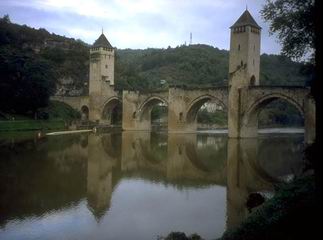
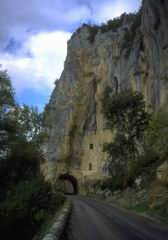
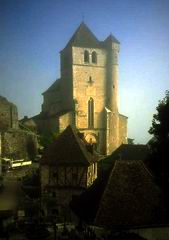
| Valentré Bridge, Cahors | Grottoes on the Lot | St-Cirq La Popie (Quercy) |
Day 3
| Friday, October 9 - Cahors to Sarlat (91 km, 6 h) When I went to the Café de la Bourse to check out and eat breakfast at 7 a.m., it was dark and raining gently. One hour later, the rain had stopped and I was crossing the Lot on the fortified 13th century Valentré bridge. I followed beautiful Lot Valley for some time, through vineyard towns with names like Caillac and Creyssac. Then I headed north in the wilderness, to Cajus and Lavercantière. The hills were manageable. Soon after, I went through St-Martial and I climbed a 300-meter hill to visit the bastide (fortified town) of Domme, a cliff-hanging city-fortress with a grand view on the Dordogne River and Valley. From there, I was soon in Sarlat, a neatly renovated medieval city. I reserved a room for 2 days because it was already Friday. |
Day 4
| Saturday, Oct. 10 - Sarlat-Vézère Valley-Sarlat (90 km, 6 h) The next morning, to avoid busy D 704, I took to the hills and rose over the foggy valley. I cut across the hilly countryside to La Chapelle and then, to Lascaux II. I was there at noon as planned, but to no avail because a) the next tour was scheduled for 2 p.m. and b) tickets were sold in Montignac only (a 10 km ride!) : call that bad planning. But since Lascaux is only a replica, I decided not to wait and to move on to the Vézère Valley. Just after Montignac, a light drizzle started. It got heavier and soon, I was riding in the rain without my raincoat, which I had mindlessly left in my hotel room with my panniers. I was glad to stop in Laroque - St-Christophe to dry myself while visiting the troglodytic city, inhabited sporadically for the last 400 centuries. Then I moved on to Les Eyzies to visit the Abri Pataud, a prehistoric site dug out in the sixties by Professor Movius, an American archeologist. This is how I got to see authentic cavemen sculptures - and dry my hide again as a bonus. After aanother 24 km sprint under the rain on D 47, I was back in Sarlat, drenched to the bones, but glad to be in a warm, dry spot for a change, with some bread, cheese and a good bottle of red wine. |
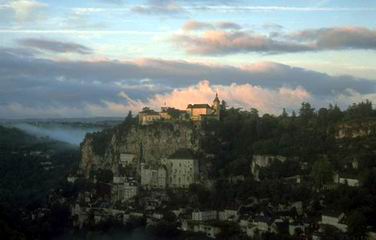 |
|
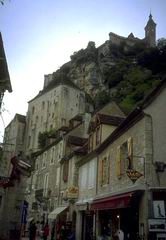 |
| Rocamadour at Daybreak | View from the Village |
Day 5
| Sunday, Oct. 11 - Sarlat to Rocamadour (65 km, 4 h) I took the cool piste cyclable from La Canéda to Grojeac, across the Dordogne River (actually a decommissioned railroad). The sun finally showed up briefly in St-Julien. In Souillac, I took some time to tighten up a few loose nuts. Soon after, I was in the Ouysse Valley in Lacave, and I started an endless climb on D 247 to reach the eerie uplands, divided in small plots by dry stone fences. Around 3 p.m., I reached Rocamadour, the high-perched sanctuary and citadel stacked on an eagle's nest. I had to forgo a visit to the nearby Padirac chasm because it had closed down early due to abnormally high water levels. It rained again that night, but from then on, the bad weather was over. |
Day 6
| Monday, Oct. 12 - Rocamadour to Figeac (57 km, 4 h) I went downhill through small villages like Rignac and Lavergne on D 36, then through St-Simon and Reyrevignes. I stopped in Assier to visit a Renaissance castle built by Galiot de Genouillac, Grand Artilleur of king François I. In the local church, next to St Michael clobbering Lucifer, this character proudly stands in front of his cannon; obviously, the sieur de Genouillac was an honored patron of that church. Later, I was in Figeac, a clean and quiet town on the Lot. |
Day 7
| Tuesday, Oct. 13 – The classic Lot and Célé Valleys circuit: Figeac - St-Cirq Lapopie - Pech Merle - Figeac (118 km, 6 h) It was still dark when I left Figeac, at 7:30, following the Lot Valley. The sun needed some time to burn through the fog for an occasional peep. The road was easy, with only three climbs, the first one on D 622, just past Figeac. As anywhere else in Quercy, the scenery is always interesting, but the Lot Valley is something special, with small fields, vineyards and picturesque small towns, and all along the river, high chalk cliffs dotted with large and small grottoes. No wonder why this place was settled by early humans. I wanted to visit hill-sitting St-Cirq Lapopie, "one of the most beautiful villages in France", says the guide. To get there, I had to climb a 300 meter hill, but it was well worth it; just as I got there, the sun came through the fog for good and shone on a superb view of the village, the ruins and the Lot Valley. Going down, I met a couple of young Australians riding from Paris to Rome in four weeks…(now, talk about serious cyclotourism!). The highlight of my tour was a visit to the cave of Pech Merle. That day, my timing was perfect : I got there at 2 p.m., just a short time before the visit. I chatted with an American from Washington, D.C., who looked like Harrison Ford and spoke good French (which is still rarer). The tour was exciting: even without the stunning cave paintings (of which the red polka-dotted horse is the most famous), Pech Merle's mineral lace is something to see. Our guide was a trained speleologist who could answer just about any question. Then, I hopped on my bike and made it back in three short hours, following beautiful Célé Valley, which is smaller than the Lot Valley but offers spectacular views all the way to Figeac. |
Day 8
| Wednesday, Oct. 14 – Figeac to Albi (124 km, 7½ h) My longest day on the road. To go to Albi, I took the straightest route on my Michelin map (since that epic day, I always check the altitude marks on same). Soon I was climbing up a hill on which sits Capdenac, a strategic place forte dominating the Lot Valley, occupied by the Gauls, the Roman, the Visigoths, the Franks, etc. (in short, by whoever wanted to rule the country). From there, I took D 994 to Montbazens, down to quiet Compolibat on the Aveyron River. From there, to get to Rieuxperoux, I started a 900 meters, 18-km long climb (the climb of my life), which took me 2 hours. The view, which was superb all the way up, combined to the physical effort, kept me pedaling up as if I were in a trance. From the top of the world, true to Newton's law, I rolled down non-stop at reckless speed for 16 km on the empty road, until I reached Port-de-la-Besse on the Viaur River. Then, after a roller-coaster stretch, I arrived in Carmaux, my original destination. But there, in the warm light of the late afternoon, I decided to push on to Albi, some 30 kilometers ahead. Fortunately, the highway had a convenient shoulder, and soon after, I could see the massive silhouette of the cathedral, which guided me downtown. Albi, one of the rare medieval cities built in an area without any freestones, is different: when I reached the Tarn River, I paused for some time to admire the handsome brickwork of the bridges and historic buildings, of which the plump Ste-Cécile cathedral is the jewel, a class in itself. |
Day 9
| Thursday, Oct. 16 - Albi to Bram (128 km, 8 h) The next day, I did an even longer leg, but that time, because of a sore backend, I got wise: I started checking the topological altitude marks on my map to avoid unnecessary climbing. Leaving Albi in the fog was a bit dicey; from there, I climbed to Graulhet and St-Paul to Puylaurens, where I took a short nap under the noon sun. Then, I took westward country roads to bypass the Montagne Noire heights. A few kilometers from Castelnaudary, I saw the beautiful snow-capped Pyrenees kissed by the late afternoon sun. In Castelnaudary, I couldn't find any room for less than 180 F, so I phoned ahead in Bram, the next town, to reserve a room at a decent price. Soon after, I was pedaling in pure bliss along the Canal du Midi, in the golden light of the setting sun. The canal is bordered by continuous rows of centennial trees, which grace the waters with all kinds of shadows and light reflections. "Chez Alain", the hotel I had selected, is a modern one. As a matter of fact, it is a motel-like truckers’stop, but with a French twist. The restaurant filled up at 9 p.m., as long-haulers from all the EC stopped to eat and drink in the large dining hall. Some came up to sit to my table and talk, and the fun was on until after midnight. In Europe, trucking is a recent and growing industry, not a quasi-institutionalized culture like in North America. |
Day 10
| Friday, Oct. 17 – Bram to Carcassonne (54 km, 3 h) I left Bram in heavy fog, and went up a long hill to visit one of the many namesakes of my home town, Montréal-en-Aude, a small medieval city built around a vintage gothic cathedral. Except for the name, there was not much I could relate to there. Back on the canal, I hit some rough spots; in some places, I was riding on a simple dirt trail in the middle of long weeds, barely wide enough for my panniers. Assuming you don't get stuck too often in the mud, you may think that these patches of wilderness add to the charm of the Canal du Midi. Effortlessly, I reached old Carcassonne and its twin walled strongholds. I stayed there two days to visit the place and get some rest: my left leg was aching at night. I took some time to visit an Internet café and send some "electronic post cards" to friends and relatives. If you type fast enough, they are cheaper (and much more faster) than the cardboard type. Another good idea is to get a free e-mail account (for instance, with hotmail.com or yahoo.com), so that your parents and friends can reach you while you travel. |
Day 11
| Sunday, Oct. 19 – Carcassonne to Narbonne (76 km, 5½ h) Just before leaving, I had to fix two broken spokes on my rear wheel. The cloudy day softened the look of that neglected and bumpy leg of the canal. I couldn't go fast but I didn't mind: I was enjoying the ride. Once in a while, I would leave the towpath and ride on the narrow paved roads more or less parallel to the canal. I would ride in the middle of vineyards covered with small, sweet and seedy grape, obviously grown for winemaking. It was always easy to get back to the canal, marked by a double hedge of tall plane trees or dense yews. I was in Narbonne early enough to visit some interesting spots and, as usual, I took a cheap room in a small downtown hotel. In the TV room, I met Vincent, a young seasonal grape picker, who explained to me the ropes of the trade and gave me some good travel tips, like where to find cold beer to take out (available in small grocery stores only). |
Day 12
| Monday, Oct. 20 – Narbonne to Agde (the sea) (90 km, 6 h) The day was sunny and cold. I got out of Narbonne following the Canal de la Robine, which connects to the Canal du Midi in Capestang. There, I sipped a coffee on the square to celebrate my 1000th kilometer. That well-tended leg of the Canal du Midi, which crosses a string of handsome, clean small towns, is a treat for the eyes. Save your dry bread to feed the ducks: even if only one or two are visible, you may see a whole bunch of them racing for food as soon as the first crumb hits the water. I lunched on a hill nearby, on the site of the Oppidum d'Ensérune, where a Roman hill-fort controlled the access to the country. I visited the ruins and from the watch post, I had a first glance at the shiny Mediterranean Sea, some 40 km to the southeast. I zipped by Béziers on another incredible canal bridge crossing the Orb. Then, I was riding on a cozy, paved (and skater free!) bicycle path, all the way to Portiragnes. Soon after, I was back on a shabby path crossing the salt meadows and the yellow grass lowlands stretching endlessly to the sea. I finally made it to the lagoon of Agde, where the canal ends. That night, in one of the few open restaurants (a pizzeria), I dined with two guys from Avignon who were visiting museums and historic sites. They gave me a lot of information about what was ahead. I decided to follow the seashore to Sète and Aigues-Mortes instead of going to Montpellier. Because I wanted to be in Marseille Saturday, I had some difficult choices to make, like skipping Béziers, Montpellier and the Camargue. |
Day 13
| Tuesday, Oct. 21 – Agde to Aigues-Mortes (85 km, 5½ h) It was a cold, sunny morning; the mistral was still blowing. I took the coastal road straddling the narrow sandy strip separating the lagoon from the sea. In Sète, passing in front of a bicycle shop, I stopped for minor repairs (I had a squeaking rear brake and the spoke job I did in Carcassonne badly needed some professional overhaul). A couple of hour later and 200 F lighter, I was back on the road and my bike felt like a new one. After a seaside pick nick on a beautiful deserted sandy beach, I passed through several chic summer resorts and spiffy marinas like Pavalas, Carnon and Grande-Motte, all the way to Aigues-Mortes, a beautiful walled city that was used as a seaport by the Seventh Crusade led by king Saint Louis. |
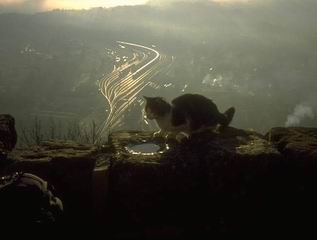 |
|
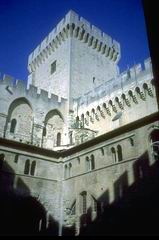 |
| Cat and Switchward in Capdenac | Papal Palace of Avignon |
Day 14
| Wednesday, Oct. 22 – Aigues-Mortes
to Nîmes (53 km, 4 h) On yet another sunny
morning, skipping Camargue with regret, I went straight north, facing the
chilly mistral, snaking my way through hills and small vineyard towns like
Algouze and Galargues. Then I hit a very convenient
piste cyclable
on the shoulder of D 40 and zipped straight to downtown Nîmes. By
then, the air had warmed up and I took the rest of the day to visit that
beautiful and lively city mellowed by the golden light of a fall afternoon,
from the ruins of the Roman Arena to the top of the Magne Tower. By then,
I had developed all kind of aches that denied me a good part of the pleasure
of riding. It was time to take another break…
The next morning, I left for Avignon, but that time, I was travelling in style on the TGV (train grande vitesse, round trip), which freed a whole day for the visit of that outstanding city-museum. I was impressed by the high-walled palace-fortress of the Avignon popes and by the view on the Rhône River and Valley from the promontory on which the palace and its gardens are built. |
Day 15
| Friday, Oct. 24 – Nîmes to Arles (90 km, 6 h) My last day on the road was a busy one because I wanted to visit the Pont du Gard first, a colossal Roman aqueduct whose jaw-dropping look has made a great impression on visitors for some 2000 years. First, I headed north on D 979 and soon crossed a French army range complete with barracks, tank crossings and athletic characters with shaved heads dressed in fatigues and running around with funny equipment. When I reached St-Nicolas Bridge, the setting was quite different: I was in the garrigues, a rocky, semi-desertic, irregular terrain. Under the bridge, the half-dry Gard River looked like one of those African wadi whose bed can become completely dry just a few weeks after a flood. Passing through Sanhilac and Collias, I finally behold the titanic structure of the aqueduct spreading across the steep banks of the Gard. Then, I headed south to Remoulins and from there, I followed the Rhône Valley. The day was sunny and warm. Ironically, my last day on the road was also the only nice and warm one I had. I lunched under the weird ship-looking dungeon of Beaucaire. After a quick hop in Tarascon, on the east bank of the Rhône, I was back in Beaucaire and for a few kilometers, I followed the Canal du Rhône which leads to Sète, on the Mediterranean Coast. Then I headed south on D 15. Before crossing the Petit Rhône, I stopped and an old timer came by for a chat. He had been a champion speed cyclist in the fifties. Now 77 (like John Glenn), he was still riding, but just for fun and to keep in shape. Soon after, I crossed the Grand Rhône and I reached Arles, where I spent a few hours before I literally hopped on a running train with my bicycle, just as it was leaving for Marseille. I stood with my bicycle in the first class wagon entrance, just behind the engine. Later, kids came in for a smoke. |
In Marseille
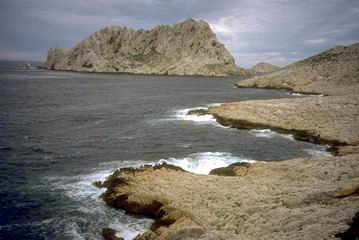
Maïre Island, in the Calanques
| Saturday, Oct. 25 – Monday, Oct. 27 – A weekend in Marseille I was in Marseille Friday night at 10. From the St-Charles Station, I had no trouble finding my hotel near the Cannebière, Marseille's main drag. The next day, I got a cardboard box from a bicycle shop and disassembled my trusty bicycle. I took the rest of the day to ramble in that charming old city, full of spectacular views with gorgeous sea or mountain backdrops. I especially liked my last day, which I spent hiking in the Calanques, a spectacular coastal area of barren hills and cliffs, dotted with scraggy patches of juniper speckled with small deep purple flowers. The cold mistral was blowing hard and, looking at the dark mass of Maïre Island under the gray sky, I had the uncanny feeling of being some place on the north shore of the Gulf of St. Lawrence, near Newfoundland. That was an appropriate finale of a great journey through France, a beautiful and diverse country. |
![[ French ]](francais.gif) |
![[ Bicycle Page ]](pgbike.jpg) |
![[ Home Page ]](enghome.jpg) |