|
A 1000-km Bicycle Ride in Cuba
(January 2002) |
|
|
|
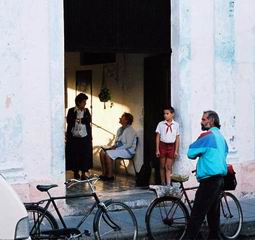
A Street Scene in Trinidad
|
|
|
A 1000-km Bicycle Ride in Cuba
(January 2002) |
|
|
|
A Street Scene in Trinidad
|
Introduction
| Cuba is a very
peculiar country because of its apparent lack of tourist infrastructures,
except in a few places specifically designated for that purpose;
visiting other places sometimes requires careful planning. When I
got off the plane in Cienfuegos, I had second thoughts about the wisdom
of my choice, or lack thereof. But, after a few kilometers on the
quiet road, the scent of the sea and the warmth of the sun had brushed
aside all my apprehensions, and I felt alive again. As I was about
to find out, while Cuba is not exactly a paradise for its residents,
it is for cyclists, in a way, certainly due to the light traffic conditions
created by a chronic shortage of vehicles and gasoline, but also because
traveling outside organized circuits is an interesting challenge. You
have to learn the rules of a brand new game, and this can be a rewarding
experience, which I will try to describe. |
| Equipment:
See " Yet Another
Bicycle Tour of Southern France
" My loaded bicycle weighted some 35 kg on departure day. Don’t forget: A good map of Cuba (detailed if you can get one), assorted pharmaceutics (some are nowhere to be found in Cuba), a Visa card. Good addresses: Whenever possible, I give the address of the places I can recommend. I left out those without a State permit to avoid getting people in trouble. Weather: Except for some rain while I was sitting in front of a cold beer in Sancti Spiritus, the sunny and generally cool weather was perfect for cycling. Sometimes, it was a little cold at night (10 °C) or a little hot in the afternoon (30 °C). Complementary information: In this trip report, I tried to avoid duplicating run-of-the-mill tourist information available in guides like Lonely Planet (which I recommend), Le guide du routard, Rough Guide, etc., which are requested reading before visiting Cuba, because they present essential information to survive and get by in a very special country. Glossary:
|
|
Day by day
Day 0
| Thursday, January
3 -Getting there
- First, I wanted to land in La Havana and from there, take
a plane or a train to Santiago de Cuba, on the eastern end of the
Isla Grande. But there was no way to arrange for a connection before
leaving, and I didn’t like the idea of dragging my bicycle and bags
in the biggest city of a country I didn’t know. This is why it made
sense to land in Cienfuegos, a small city right in the middle of the
island. It was a good idea for two other reasons: because controls are
lenient compared to those in La Havana, the custom officers didn’t request
a $50 deposit for bringing a bicycle in Cuba (to counter “unauthorized”
bicycle trade in Cuba), and they didn’t check my fake hotel reservation.
All tourists going to Cuba must reserve a room in a hotel for at least three
days (rumor has it that, because the service is so bad, and/or the management
so inept, this is the only way they can grab some tourists). If you get off
a charter plane with a whole bunch of canned tourists, all you have to do
is write as destination hotel, on the visa form, the name of the hotel where
everybody is going (“Rancho Luna” in Cienfuegos). An Italian cyclist
I met in Matanzas wasn’t so lucky; he got caught by Immigration in La
Havana Airport and had to waste three days and $250 in a so-so hotel of
the capital. When I got out of the airport terminal, someone was waiting for me. A Cuban friend of mine living in Montreal had sent his sister to pick me up. We exchanged greetings and I charged my bags into the trunk of an old battered Lada driven by a friend of her. As we were leaving the airport, the police stopped us and called a taxi for me, because only taxi drivers are allowed to take non-Cubans in their car. Soon after, I was unpacking my things in Teresa Vasquez’s casa particular (ave. 52 No. 4310 e/ 43 y 45) booked for me by my Cuban friends. At $20 a day (plus $3 for breakfast), it wasn’t exactly a bargain, but I didn’t mind: all I wanted was a quiet place to assemble my bicycle and rest, after a sleepless night at Mirabel Airport. I visited Palacio de Valle in Punta Gorda, an architectural marvel built by a rich planter in the beginning of the 20th century. Then, I took some time to visit the nice pedestrian mall in the center of the city and to get a few dollars’ worth of pesos. The rate was 27 pesos for one dollar at the Cadeca, but, because the waiting line was too long, I accepted 26 to the dollar from a street changer. Pesos are required for things like inflating your tires in a gas station, for public phones or, if you are the adventurous type, to sample local delicacies like fresh cane juice or cheap snacks like cheese pizzas sold by sidewalk vendors. I decided to leave for Trinidad the next day and get some rest in nearby Playa Ancón. That was a sensible thing to do, because the bay of Cienfuegos is so polluted that nobody ever swims there now, and the beaches of Rancho Luna and Faro Luna, devastated by hurricane Michelle, fared only marginally better. |
Day 1
| Friday, January
4 - From Cienfuegos to Trinidad (98 km, 6½ h) - I left Cienfuegos
on a cool, sunny morning, on a deserted new road, expressly built
to shuttle tourists in and out of Rancho Luna. I could see the purple
mountain line of Sierra Escambray on the horizon. I should have turned
left a few kilometers before the beach, but, because of a missing sign
(swept away by hurricane Michelle), I ended up in a dead end in Rancho
Luna with four other cyclists, two Americans (the only ones I met during
my whole trip) and a couple of Dutch cyclists who were going to Trinidad
on big, heavy bicycles. Seeing all the trouble they had climbing the low
hills at the start of the connecting road, I don’t know if they ever
made it. The good news is that these hills are just about the only ones
I had to climb this side of La Havana, and the bad news is that I had
to fight a front wind blowing from the north during the first days. About half way, I met Claudia and Ivo, a couple of young Swiss cyclists in snazzy outfits going in the opposite direction, and we exchanged addresses of casas particulares. Because the official prices are so high in Cuba, a kind of mutual help culture developed between tourists; just ask and you will get plenty of useful tips for any place you are going. I was very glad to have a good address in Trinidad because when I got there, I was very tired (which is normal after the first day on the road) and I had to flee packs of jineteros who wanted to drag me in this or that casa particular (for an extra $5 fee). Fortunately, a firm “no gracias” was enough to get rid of most of them. The place recommended by Claudia was full, but the owner served me a cafecito and sent for a friend, who had an extra room. As most Cubans, that man didn’t speak English and my basic Spanish came in handy. At the end of the trip, I had made remarkable progress in that language, because (as far as I know) Cubans love to chat with gringos and they don’t seem to mind if you practice your Spanish on them. Finally, I got a $15 room with a private entrance right in front of the Internet café ($5 an hour). Most tourists there were Germans. Actually, the whole city of Trinidad seems to be a German colony, and this is no accident: that beautiful colonial city, next to a first class light sand beach, has always been a favorite tourist destination. The major drawback is that the level of hassling is exceptionally high: almost everybody is trying to sell you something. That night, I had a hearty chicken Creole dinner at a paladar ($8 with a beer), where I met a French couple traveling in a rented car with their baby. I went to bed relatively early, but the music playing in the bar across the street went on until 1 a.m. Fortunately, it was traditional Cuban music, and I managed to sleep well enough. |
Day 2
| Saturday, January
5 - A day off in Playa Ancón (29 km, 2 h) - The next
day, earmarked for the beach, couldn’t have been better. At 10 a.m.,
I was on my way to Playa Ancón, a 14-km ride around the lagoon.
After a cold night, the sun was slowly warming the flat seaboard. The
beach, a remarkably clean strip of fine sand with a big hotel in the
middle, was lined with a few shading trees. Here and there, some tourists
(Germans, to be sure), were sunbathing in the buff. The water temperature,
too cold for Cubans, was just right for most gringos. Because I didn’t
want to get a sunburn on the first day, I left around 2 p.m. On the way
back, I met Franz, an Austrian who spoke very good French (his girlfriend
was his former French teacher, as he explained). He had been wandering
about in Cuba and Mexico for 2 months, and he didn’t want to go back to
Vienna until he was broke. After an excellent shrimp dinner at his casa
particular ($6 with a beer), we went to Plaza Major to pick up his friend
Marcel, a nearly blind German working as a therapist in Munich. Two black
jineteras came by. Franz told them that we had other plans for the evening,
but they kept insisting. We finally got rid of them and went to the stairs
(the plaza), where a large band was playing traditional tunes. The only
dancers were locals; obviously, most tourists lack the combination of
skill and abandon – or nerve - it takes to dance salsa. Later, I accompanied
Marcel back to his room. Guess who were waiting for us there? The two chicas,
still looking for dollar-studded tourists, and this time, they wouldn’t
take “no, gracias” for an answer. One of them actually grabbed my crotch;
I told her to get lost in whatever Spanish words came to my mind. In Cuba, everything is for sale, and in some places, prostitution is seen as just another way of getting dollars. However, as this activity is illegal, a tourist bringing a chica in a casa particular can get the owner into deep trouble. In a place I will not name, the señora asked me if I would be bringing back any chica in my room. “Certainly not, ma’am”, I said. Nevertheless, she took time to explain that the week before, she was mad because a young German tourist was bringing back a new girl every night, and that she had to stay home almost all day to watch the place because they were getting up very late. “If you bring back a chica, just ask her to show me her papers, and everything will be fine”, she added. In Cuba, sex tourism is rampant in most tourist spots, but fortunately, things are not as bad in other places. |
|
|
|
|
|
|
Day 3
| Sunday, January
6 - From Trinidad to Sancti Spiritus (73 km, 4 h) - Next
morning, I asked the owner if he could recommend a casa particular
in Sancti Spiritus, which he did. Just before leaving, the young classic
beauty who was tending the house dropped by for a chat. I had assumed
that she was the daughter of the owner, not the maid: I was wrong.
She told me that she was 28 (exactly half my age), and she started
asking me all kinds of personal questions, to which I answered willingly.
But in my mind, it was time to go. Pulling my hearth together, I hit
the road and zipped through the endless flat sugar cane fields. I was
in better shape than the previous Friday. The road was deserted, except
for an occasional passing car or mufflerless diesel truck that delivered,
in a very short extent of space and time, a concentrated amount of pollution
just about equivalent to what I would normally breathe in during two
or three weeks in Montreal. Naturally, when you meet a truck belching
a black, carcinogenous cloud, you hold on to your breath as long as you
can, but what if the truck is passing you while you are climbing a steep
hill? As such, this possibility is probably a good reason to avoid the
hills altogether in this incredible country, which I did, except in Pinar
del Rio (see below). Anyway, that stretch was easy enough; I remember climbing only once. When I reached the top, I stopped in a cantina for a cold drink. While I was sipping a lemonade, some cane workers came to talk and take a look at my bicycle. Obviously, before I got there, that place hadn’t been spoiled by tourism. The clouds slowly settled in as I reached Sancti Spiritus, a quiet rural center. I didn’t see any jinetero there, except maybe on the main square. This is good news: it means no hassling for a change. I fumbled through the signless streets until I reached Señora Echemendía’s place (Maceo No. 4 Sur e/ ave. de los Martires y Doll), with some help from her neighbors hanging at the windows. I had to work hard getting my panniers and bicycle on the second floor, but it was well worth it: for $15, I slept on a terrace, in a gorgeous gazebo with a view on the city. Of course, this wasn’t Granada, but I enjoyed the glorious starry night just above my head. The drawback is that I was awakened a few times, well before cockcrow, by synched-out roosters rehearsing at various hours of the night. However, before going to bed, I still I had a few hours to kill in that godforsaken place, where the few places worth a visit were closed because it was Sunday. In Cuba, the official ideology may be atheist, the churches may be crumbling to pieces, but the Sunday rest is still a revered institution, not to be tampered with. One of the few places open was the bar next to the railway station. The draught beer was only 6 pesos. Later, I decided to explore the city. As I was walking in the center of the city, the rain started pouring and I had to take refuge in Don Pepe’s Taberna. A man came to my table to talk. I couldn’t understand all he said, but he was a nice guy, so I offered him a beer. Soon, friends and relatives of his joined us, passing around a bottle of rum. They were a group of campesinos who were there with their families for Maria’s birthday (Maria, a cute two year old girl, was proud as a princess in her pink dress). In Cuba, any reason is good for a celebration, I guess |
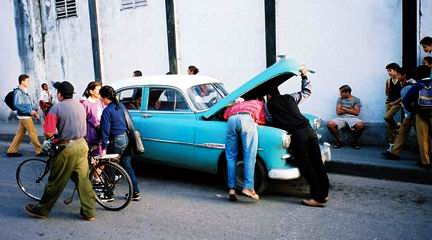
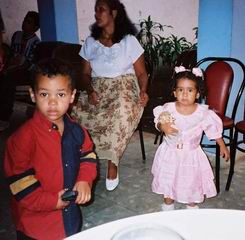
A Street Scene in Trinidad
Day 4
| Monday,
January 7 - From Sancti Spiritus to Santa Clara (91 km, 6 h) - That
morning, I was at the crossroads: should I go eastward to Santiago,
or westward to La Havana ? A British cyclist coming from Oriente province
didn’t recommend the flat and endless 400-kilometer stretch from Sancti
Spiritus to Bayamo. “Skip the boring fields - take the bus”, she advised.
Finally, I decided to go to La Havana first, and I headed north for
Santa Clara. Except for the head wind, the weather was perfect. I was
crossing fields lined with tall royal palm trees, on a backdrop of distant
high hills forming the Alturas. In Santa Clara, I had some trouble finding
my casa particular because the name of the street had been changed to
reflect the new social order. Suddenly, somebody called my name: Señora
Echemendía had phoned ahead from Sancti Spiritus, and a boy sitting
on the sidewalk was waiting for me… In Cuba, the owners of casas particulares
send each other tourists and, because the competition is fierce, they
will do everything they can to accommodate their customers. That includes
offering hearty meals - I didn’t loose any weight on this trip. Finally,
I got a very quiet room with a private bathroom for $15 a day in a place
tended by Señora Noe Bermúdez (E. P. Morales No. 2A e/ Cuba
y Colón). I immediately liked Santa Clara, a good-looking city
where you can stroll around without being hassled. I decided to take
a day off to see the place. At the paladar, the waitress tried to short-change
me (giving me the change of a 10-dollar bill for a 20), but I knew enough
Spanish to protest, and she excused herself and handed me back $10. I was
victim of the same “mistake” some days later... The next morning, I visited
the Che Guevara Memorial, an impressive site, with a quasi religious atmosphere
(especially the museum, full of revolutionary regalia) – a good show
for an atheist regime. I also visited the Tren Blindado Park, where people
can walk into the wagons of an armored train taken by the Fidel’s Rebels.
One of the exhibits is a cocktail Molotov made out of a bottle of Canada
Dry, a popular soft drink then. |
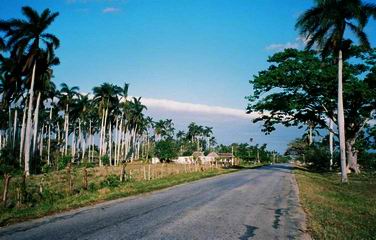
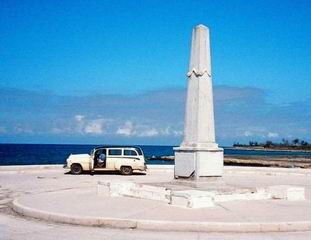
Road to Santa Clara
A Monument in Matanzas
Day 6
| Wednesday,
January 9 - From Santa Clara to Sierra Morena (110 km, 6 h) -
For the next stretch, I wanted to head north until I reached the
sea and follow the coast westward. The stretch from Santa Clara to Cárdenas
(the next big town) is about 200 km long; obviously, I had to find
a place to sleep, preferably about half way. But, except for Baños
Elgua, a plush sea resort about 150 km away, there is no hotel or casa
particular in sight past Sagua La Grande, which is only 40 km away. In
other times, I would have stopped in La Panchita, a beach for Cuban people
(read: second class) on the north coast, but the whole village had been
blown away to the sea by bad-tempered Michelle just two months ago. I
explained my problem to Señora Noe Bermúdez, where I was
staying. She searched her agenda and made several phone calls. Finally,
she got lucky and booked me a room in Sierra Morena, exactly half way.
She also recommended other places in Matanzas and La Havana. In a sense,
I stayed under her umbrella of good care all the way until I reached my
destination. So, I left Santa Clara in a light-hearted mood, with a head wind from the north. Whenever you feel tired on the road in Cuba, an appropriate morale-boosting slogan will pop up on a board or a fence, like: “Siempre otro paso hasta la victoria” (Always one more step on to victory); “Luchar – Resistar - Vencer” (Fight, Resist and Win) “La verdad y las ideas siempre vinceren” (Truth and ideas always win). I stopped in Sagua La Grande, graced with a beautiful church which, like many churches in Cuba, seems to be falling to pieces (the most unsafe ones are fenced). Then, as I was pedaling westward, a young Cuban joined me and we began to chat. He was very cool and I accepted an invitation for lunch at his place – actually, his mother’s house, because his own house had been badly damaged by the hurricane. He stayed there while he was rebuilding it; his wife and one-year old baby were staying elsewhere. On her kitchen diesel fuel stove, his mother cooked a frugal meal, made of eggs, rice, black beans, yucca and green tomatoes. Appropriately enough for my 57th birthday, I even got a piece of a huge cake buried into a heap of frosting, that a neighbor had just brought in (bartering is a national sport in Cuba). All kinds of people came by to say hello; an elder folk asked me if I had any pastillas for him (he meant Viagra pills, for which there is a brisk black market in Cuba, as for all other unavailable drugs). Some time later, I was back on the road; I had to reach Sierra Morena before the night. I got there by 4 p.m. The house was rather decrepit; to take a shower, I had to use a pail of hot water, because the running water system had broken down a long time ago due to a lack of spare parts – just like the old Russian television set sitting in a corner of the living room. Except for the homemade cheese, the food, albeit plentiful, was nothing fancy. The bill amounted to $25 ($15 + $10 for dinner, breakfast and a couple of beers – not cheap, but there was no alternative). However, I got there a very special treatment: I was treated like a member of the family, and they insisted on keeping me company all the time. Once I got used to their heavy campesino accent (Rule no. 1: all “esses” are mute, except those at the beginning of a word; for instance, the beloved daughter who works in “La Vega” is the sponsor of the family, sending dollars from Las Vegas). I could understand most of what they said because they had adopted a slow verbal throughput just for me. The old man gave me a guided tour of his garden and installations; at seventy, he was still riding his horse and tending a small farm with his sons. |
Day 7
| Thursday,
January 10 From Sierra Morena to Varadero (113 km, 5 h 45) -
Tanks to a strong tail wind, I was soon in Varadero after an easy
ride at an average speed of about 20 km/h (total distance from Cienfuegos:
500 kilometers). Around noon, as I was going through Cárdenas,
an old, decrepit sea port, I figured that I might as well push on to
Varadero. I was in for a good surprise: the La Havana four-way autopista
which, according to my map, stopped in Varadero, actually reached Cárdenas.
In Cuba, cyclists can ride on the shoulder of any highway; as a matter
of fact, Cuban highways are used by all types of vehicles, motorized or
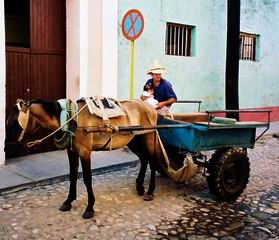
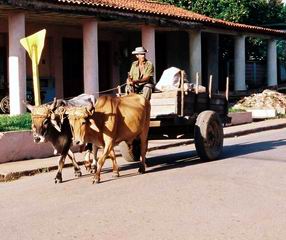
not. Because of the gasoline shortage, a lot of Cubans are using horse-drawn
(or ox) carts. However, you wouldn’t believe that petrol is in short supply
in that country, because there are oilfields all along that part of the
coast, where small bunches of red dinosaur-looking pumps keep on pecking
at the white corral beach. Soon, I was riding in Varadero, the Cuban Babylon,
where casas particulares are not allowed (guess why). So I went straight
to hotel Villa del Mar; besides, now that I was 57, I thought I might as
well start pampering myself for a change. The only hotel I sampled in Cuba
is a low-budget complex ($36 with breakfast) built on the highway side.
As always, I was the only gringo there, but I didn’t mind: all I wanted
was a quiet place. I laid in the sun by the swimming pool for a while, sipping
draught beer (only $0.50 instead of $2 in town). Some time before the
sunset, I went for a walk on the golden beach, which didn’t steal its
legendary reputation. Back in my room, I was glad to watch international
television (CNN, RAI, TV5) for a change, because you don’t get much international
news on Cuban television (which shows a lot of old American soaps and dramas
dubbed in Spanish, an incredible opportunity to learn that language). |
Day 8
| Friday,
January 11 - From Varadero to Matanzas (46 km, 2½ h) -
The next morning, because I was only 40 km from Matanzas, there
was no reason to hurry. I went to the sea to swim a few hundred yards
along the beach, deserted at that time of the morning. In the middle
of the afternoon, I was in Matanzas. I had trouble finding the casa
particular where I was expected, because the old city center, full of
narrow one-way streets, can be very confusing. When I got there (calle
79 No. 27608 e/ 276 y 280), Señora Margarita Romero told me that
they were expecting me the night before, and that right now, she had no
free room. She asked me to come back at 5 p.m., she would make a few calls…
I tried to find some other place, but they were all full. In the old city
center, I found a peso bar, where rum shooters cost only 3 pesos. There,
a local magician sat at my table to talk and to make a few hand tricks
for one dollar. Then, a young man called Yuri came by and asked for money
with the lamest excuse I ever heard. He needed $2.50 to buy a pacifier
for his teething baby, who was keeping him awake all night… I said I would
take care of that myself; however, wherever I went in that city, pacifiers
were in backorder… Many small articles are impossible to find in Cuba
- matches, for instance. Because most peopple cannot afford a butane lighter
($1), they have to get a light from another smoker. Later, Señora Romero told me that she had a room for me, but only because I was recommended by Señora Noe (my guardian angel from Santa Clara). There was another cyclist there, an Italian named Gino, travelling in the other direction. As he was going out that night, he invited me to join him. We went to the main plaza to meet the young Cuban and his girl friend who had proposed to guide us through the Matanzas night scene. We went to “Las Ruinas”, the hippest disco in town. Entrance cost $1 for the Cubans, but $5 for us gringos (one Cuba libre included). The music was good enough and the show, featuring a strident pop diva and a goofy drag queen in kitsch costumes, was extravagant and funny. One thing was less cool: the girls coming from all over the place and asking us to buy them drinks. One dollar is not much, but if you buy a drink to anyone of them, the rest will flock around to have some, too. In all fairness, let it be said that we were the only gringos there… Others, trying very hard to please us, were inviting us to dance (I don’t). Finally, I got bored and told Gino that I was leaving. Gino asked me to wait for him, he had to get rid of a girl sitting on his lap first… When we got back at the casa, around 1 a.m., I found out that Señora Romero and her husband were sleeping on the couch in the living room. They had moved there to free their own room for me. That night, uh – oh! - I felt an horrible gurgle in my guts, and the next morning, I was suffering from a very bad case of turista. Fortunately, I had brought some Imodium tablets to take care of that (a couple of days later, I also dropped a single Cipro and soon after, everything was back to normal). The source of this annoyance is anybody’s guess, because the day before, I ate a peso pizza and drank in a peso bar, and for the last 10 days, I had been drinking tap water. On a normal riding day, I would drink about 2 liters of water and, because bottled water is available only in large towns, I had to drink tap water (the first times, I used iodine to sterilize it, but I couldn’t get used to the wretched pharmaceutical taste of iodinated water). That was my only health problem in three weeks; for all I know, food and water in Cuba are as good and safe as in any other Latin American country, if not better. So there I was, weak and sick, stuck in Matanzas for one more day. In the afternoon, I went on a hike with Gino to visit the Bellamar caves nearby. The guided tour ($5) is a rip-off: most of the stalactites have been broken off by vandals a long time ago, and the guide spoke in ultra fast Cuban slang without even acknowledging our presence. |
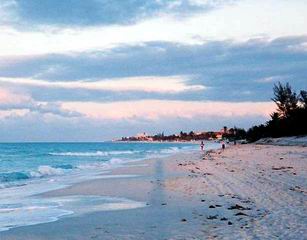
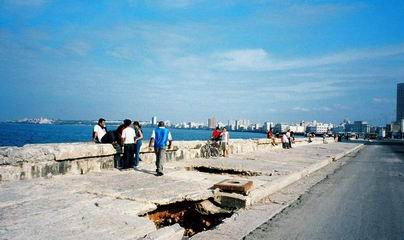
Beatiful Varadero Beach
The Malecon in La Havana
Day 10
|
Sunday, January 13 - From Matanzas to La Havana (113 km, 7 h) -
The next morning, I was feeling well enough to leave that place full
of memories I would rather forget. I had no fixed plans; if I got tired
on the road, I would stop in Sancta Maria del Mar, for instance, about
80 km from Matanzas. There were a few long hills to climb, but that
was easy enough. There is a breath-taking view at the Bacunayagua Mirador,
over a 100-meter high viaduct crossing a deep ravine. Past the hills,
the highway follows the coast again. At noon, I decided to go on: La
Havana or burst. Because cyclists are not allowed in the tunnel crossing
the Bahia de la Habana, when I reached the Colimar traffic circle, I
headed for Regla, a dilapidated working-class suburb on the south side
of the capital (according to the guides, that place is unsafe at night).
I figured that cutting through the harbor to reach the center of the city
would save me some kilometers. Actually, the harbor was so full of cops (apparently
gathered for some bust) that I felt very safe there. After a long ride around
the harbor wastelands, I was very glad to see the majestic dome of the Capitol
towering above Habana Vieja. Getting there was easy; from a cyclist’s point
of view, the traffic is not bad at all for a city of that size. Navigating
in La Havana was not a problem either, and soon, I was in Vedado, where
I was expected. I got a large room with a television, a refrigerator and
a private bathroom for $25. The owners recommended me Juanita La Cubana’s
paladar, a couple of blocks from there, where I could get decent meals for
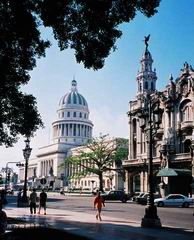
3 to 5 dollars - not bad for La Havana. The next day, I rode my pannierless bicycle downtown to a paying parking ($1) and I walked through La Havana, a lovely city indeed, except that it badly needs some revamping. Despite the unsightly piles of rubble and junk blocking the streets here and there, Habana Vieja has a definite charm. Nevertheless, I decided to move on to Pinar del Rio the next day; I would spend some more time in the capital on the way back. Why Pinar del Rio? According to the information I had gathered, the two primo places for cycling in Cuba are Oriente and Pinar del Rio provinces. I thought I might as well start with the closest one. First, I wanted to take the train, but when I compared the schedules, I found out that the bus was much more convenient. The owner of the casa particular phoned to make reservations for me at the Via Azul bus terminal ($12). |
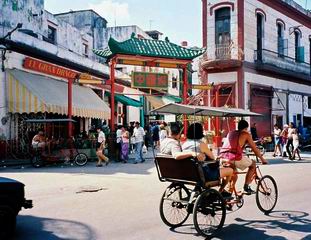
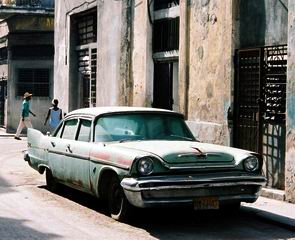
The Chinatown
A Classic Car in La Havana
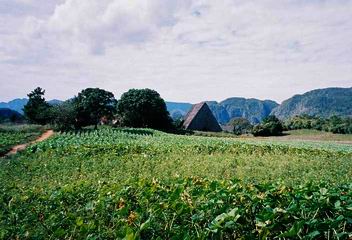
Viñales: Tobacco Fields Forever
Day 12
|
Tuesday, January 15 - From Pinar del Rio to Viñales
(34 km, 2½ h) - At the bus terminal, many travelers were
tourists from all over the world. The attendant helped me to install
my fully-loaded bicycle into the luggage compartment. On the bus,
I met Claude, another Québécois, going to Viñales.
When I got down the bus in Pinar del Rio, I told him that I would join
him soon. The stretch between these two cities is very hilly, but the
grade never exceeds 4 degrees. The scenery is quite different, with emerald-green
tobacco fields alternating with brick-red freshly ploughed fields, and
large kilns with typical steep, thatched roofs; this is prime land
for tobacco. The lethargic economy of Cuba has miraculously preserved
that region from wild development and mass tourism. You get the feeling
of traveling back in time whenever you see things like horse-riding campesinos
wearing cowboy hats or ox teams with ploughs splitting the red soil.
In Viñales, I met Claude again, who had booked a $10 room for
me (Tatio – Calle Orlando Nodarse Interior No. 93214). We were treated
as special guests by a family in a place advertising servicio gastronómico.
The 95 year-old toothless abuelo, who had been smoking cigars since he
was 15, was alive and kicking, though a bit difficult to understand. The
food was abundant and the best I had in Cuba ($7). I even found a bottle
of reasonably drinkable Cuban rosado ($2.50) in a local store, so nothing
was missing for the feast. The next day, Claude rented a bicycle and we headed for the hills. Viñales is surrounded by huge haystack-shaped hills, the mogotes, which are very rare and spectacular geographical features. These soft limestone formations are full of holes, and the changing shadows give them a spooky look, reminiscent of gothic movie decors. We stopped to visit the El Indio caves, a well-preserved and spectacular attraction; the tour includes a motor boat ride out of the caves. The next day, Claude left to catch his plane in Varadero. |
Day 14
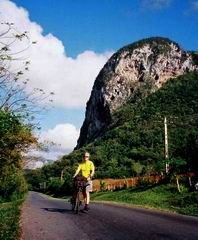
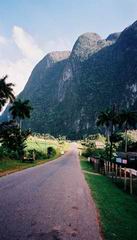
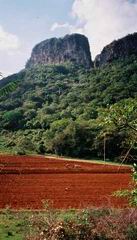
Meeting the Mogotes Valley of the Giants In the Cigar Country
|
Day 14 - Thursday, January 17 - Around the mogotes (105
km, 6 h) - That morning, I left
at 9, without my panniers, for a square circuit on the quiet deep country
roads (Viñales – Minas de Matahambre – Santa Lucia – San Cayetano
– Viñales). From Santa Lucia, I tried to reach Cayo Jutías,
a fashionable sea resort on the coast, but time was getting short when
I reached the 4.5-km jetty. I stopped at the gate and ate my lunch on
the shore before turning back, saving the $5 entrance (one drink included).
That ride is the best I had in Cuba, with beautiful and diverse landscapes.
I even had to climb real hills, some of which en valseuse (standing up on
my pedals). Fortunately, I was traveling light, the setting was gorgeous,
and there were few stinking diesel trucks. The Santa Lucia - San Cayetano
stretch, parallel to the coast, is absolutely flat, but the road is in such
a sorry state that only cyclists can dodge the gaping potholes all over.
Past San Cayetano, the road is much better. The highlight was the last
stretch, passing through a valley carved between groups of mogotes standing
up like giants. With its eerie landscape, the region of Viñales
is certainly a first class destination for cyclotourists. The next day, I was heading for La Palma, but I got lost somewhere, because my map wasn’t detailed enough, and I hadn’t bothered to check by asking my way. Instead, I went to Valle Ancón, a small, isolated village built in a dead end, at the bottom of a beautiful valley surrounded by pine-covered hills and massive mogotes. Some muscle is needed to get in there; for the first time, I had to walk my bicycle up a hill. |
|
|
|
|
|
|
|
|
On Saturday afternoon, I took the bus going back to La Havana, where I stayed for the weekend. One thing that impressed me is the Museo de la Revolución, a step-by-step journey into the tragic history of struggles, disasters and successes of freedom fighters resisting first the Spanish colonial government and then, a succession of corrupt and bloody dictators. To protest the corruption of Batista’s regime, senator Eduardo Chibás, Fidel Castro’s mentor, actually committed suicide at the conclusion of a radio address in 1951. The following Monday, I took the bus back to Cienfuegos. That time, I stayed at La China’s casa particular (Ave. 56 No. 5503 Alto e/. 55 y 57; $15) and I spent my last days in Cuba visiting the region. If you like history, you may enjoy visiting the Museo Histórico Naval, exhibiting a rich collection of war relics with some Russian torpedoes and ship-to-ship missiles ($1). That was my last trip on my old Raleigh Sentinel bicycle. Instead of bringing it back to Montreal, I gave it to the son of a Cuban friend. Because good bicycles (new or old) are in short supply in Cuba, there is a chance that my old faithful hybrid will ride forever in that country where everything gets repaired over and over by the best mechanics of the world. Back on the plane, there was only one thing I missed: I didn’t see the Oriente province. Retrospectively, I think I should have done things differently to get the most out of these three short weeks. In Santa Clara, I should have taken the bus to Holguin, and from there, I could have visited Bayamo, Guantanamo, Santiago and the Sierra Maestra Coast. That would be a gorgeous itinerary for a two-week ride. |
| All in all, everything went very well on that trip: on a total distance of about 1000 kilometers, I had no mechanical trouble whatsoever, not even a flat tire, and I felt welcome everywhere. I warmly recommend Cuba to adventurous cyclists who want to try something completely different, yet safe. |
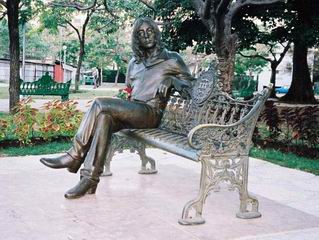
Meeting John Lennon in Vedado
The Cuban Capitol
![[ French ]](francais.gif)
![[ Bicycle Page ]](pgbike.jpg)
![[ Home Page ]](enghome.jpg)