| SOME FAMILY HISTORY |
| When the war between the states broke out in America, Charles came to the States from England to serve in the Confederate Army, in order to protect his interests in the cloth industry in Liverpool. He was enlisted September 18, 1862, became captain? in the service, and was discharged June 26, 1863. While in the service at Fall River, MA, he married a Scottish girl, Margaret Paton, on August 19, 1862. The South fell, and with it the hopes for cotton for the cloth industry. Charles returned to a ruined industry where he had been a designer of materials. One version says he died of poisoning from the |
| Notes say: "he was 5'8" high, Light complexion, blue eyes, brown hair; by occupation, when inrolled, a baker oath of identity." Occupation was once listed as Baker-Warehouseman. When his son was born, Charles was living with Margaret at 30, Roden Street, Eventon England. |
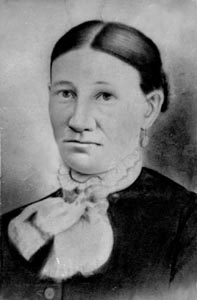
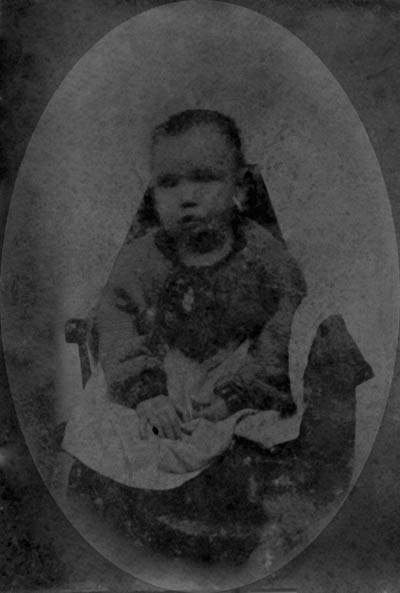
| His wife, Margaret Paton, was born in Glasgow, Scotland in 1843 to Thomas and Margaret Cov (Campbell) Paton, (for her Mother's story, click here) and came to America with her parents in 1844. She joined the Presbyterian Church at the age of 16 in Fall River, Massachusetts. Margaret was nineteen years old when she met and married Charles. Their first baby was born in the United States; a baby girl named Harriet Margaret on July 17, 1863. Margaret and baby returned to Liverpool with her husband after the war, to help him recoup his losses. There she knew both joy and sorrow: Her son was born there on July 9, 1865 and her husband Charles died. When the son, Charles Campbell, was 6 years old, in 1871, the young widow with her mother and two small children sailed again back to the states. Charles gives us an account of his crossing below. The mother and grandmother were to cross the Atlantic five times. One of those times they had a fleet of 7 ships lashed together with heavy ropes because of a storm. The ropes seemed like "weak threads". |
| Young Charles' account of his crossing: |
| "In 1871, when I was six, I sailed to the States with my mother, grandmother and sister. I remember going through a great storm and the captain asked everyone to pray, "whether they knew how to pray or not". Grandma Paton was not at her place in the dining room and when they went to find her, she was on her knees in her cabin, with her hands clasped in prayer. " |
| With her two children and widowed mother, Margaret Paton Platt went west to Logan County, Illinois, and after two years continued further west, to McPherson, Kansas, arriving in 1878. Near McPherson there was a huge ranch of over 4000 acres, where a Mr. Albert S. Crane had purchased a ranch in 1872 "with an initial capital of Three Million dollars: named "Crane's Ranch" or "Durham Park" by its owner. "...fine Durham cattle imported from Scotland. Seven tenant farms. Main ranch residence: 'White House'... W. D. Armstrong erected a two-story hotel and livery barn in 1902, the latter being burned to the ground in March, 1906, but was rebuilt at once." (May and June 1941: "Milking Shorthorn Journal", p.29, and 11, and '60th Anniversary of Durham 1887-1947'). |
| With his father-in-law's example and influence, Papa accept the Lord as his Savior, and was called to the ministry. He and Mama moved to Smith Center, Kansas. There must have been some gypsy blood in both Papa and Mama, for they moved around a lot at first. One of their homes in Waverly, Kansas (2 miles north and 4 miles west of town in 1889) was a soddy, made from the lush thick sod of the tall grass prairie. (for description of Soddy Houses, Click here) Trees for wooden houses were scarce in western Kansas. Stories of sweeping the dirt floors, snakes falling from the ceiling during heavy rains, and window panes made from coyote skins that had been stretched and pounded until they were translucent, abound. From there they moved back to Smith Center in 1892, to Scott City, Kansas in 1893, thence to Oklahoma for the opening of the Cherokee Strip. The Strip stretched from the Arkansas River westward to the Oklahoma panhandle. Along with many others, Papa was a "sooner", i.e. one of those who went into the Indian lands "sooner" than the others to scout it out and select the lands they referred. It was illegal, but an effective way to get a good choice of the lands available. Knowing where his selection was located helped Papa move quickly to the site and plant claim flags. |
| So on September 13, 1893, when Charles was 26 years old, he sat writing the following letter to his wife at Scott City, Kansas just 3 days before the opening of the Cherokee Strip. He was waiting in line at the "Stillwater Booth" to sign up before making the run for a claim. The procedure of signing up beforehand was taken as a precautionary measure to prevent people from sneaking into the territory and staking a claim before the 16th. |
| "Well I got here O.K. Am standing in line with about 4,000 ahead of me and about 500 behind, and still they come about 10 or more a minute. I expect to stand or sit anyway I can. Those around me just got a jug of dirty water for 20 cents and so it goes. Bro. Collier is taking care of the team and brings me my meals and water. I wish I had a drink of cold water, it will be worth 50 cents to have the dirt washed off. By night it blows hot and hard and the dirt is fearful. We move about a mile a week. I'll get out by 2 o'clock tomorrow. I engaged Bro. Witt to bring my mail to me. Bro. G. will not be able to get here and register. Perhaps we can get school land together but we will not be able to settle together anyway. |
| I don't think you can imagine how much yelling and going on there is, it's wonderful sure. Well, Bro. Collier has found a small spring and has borrowed a spade and is digging it out. Those along the line think he's the kind of man we ought to have. He's a noble man. Well, I'm tired holding the tablet. (He is writing this in his lap!) One man has made over $400 out of his well since the booth opened. Well, I'll have to stop I'm interrupted so much my head will give me lots of trouble tonight. Everybody nearly is finding fault. I did not think I'd register but I changed my mind when I got here, so I'll tough it now." |
| The day before, September 12, 1893 Annie Martha had given birth to Margaret Mary, her third child, and the only child out of 13 who did not make it to adulthood. She died when she was 2 years old. For more on Mary, Click Here After Papa claimed his selection and registered it with the Land Office, he went back to Kansas to get his family and their four youngsters (Lyman, Harmon, Aimie and Mary). They traveled across the Kansas prairie for many days in a covered wagon, making maybe fifteen miles a day, fording rivers and continuall searching for water. They were accompanied by another family, who had a cow for fresh milk every day. They finally arrived at a timbered piece of land in Pawnee county, S E 15-20-6, and stayed there for 20 years! It required an extreme degree of energy and resourcefulness to make a home out of the raw land. There were no roads, stores, nothing of the so-called infrastructure. Papa had to dig a well, build a log house, everything! And all by hand! The house and some of the buildings still stand at the homestead. (For pictures, click here) |
| On November 21, 1893, Charles C. filed intention of becoming a citizen of the USA in Perry, Oklahoma Territory. On April 21, 1903, he became a naturalized citizen. |
| This is how Charles' oldest child, Lyman, remembered the first winter on the OK homestead: |
| "1893. It was a wild country. We had to wait to get the tent up, a round tabernacle. Spent the rest of the winter in the tent. In the tent, over on one wall he had fixed a chimney for warmth, also to get the smoke out. Till then we had to make a fire in the yard. The first serious problem was trying to find anything to burn. The white man had burned it off (the new land) to see the land and rocks. That grass - before they burned it- would be about at the top of a man's head sitting on a horse. Where the creek ran down our claim -something happened- a little island in there as big as our yard where there was some grass and brush, and fire could not get to it. Papa would take this dead grass and twist it up in a bunch -that was the way we would get a fire started. We would watch for sticks and dead wood; that was one of our first serious problems, trying to get a fire going. Would have to get water at the creek and get out polly woggles and wiggle tails, strain it and boil it. Ate out of our fingers. Did not have much to eat. My Papa would make what he called oatmeal gruel, stir a little into water and drink." |
| Lyman's daughter, Essie recalls how Lyman helped his father build the stone cellar at the homestead. It has an arched ceiling with wedge-shaped cut stones and is still there. "When Grandpa told papa to pull out the poles that had been supporting the ceiling stones, he was scared, but he did it, and the stones stayed up there!" |
| Charles' second son, Harmon, was interviewed by an Enid, OK paper and recalled the following: He and his older brother and 2 younger sisters joined his parents on the homestead claim in 1893 following the run, and they put up a big round tent to live in, until his father could build them a log home. "The Indians used to come to the tent to trade calico for chickens, then take the chickens into town and sell them, and use the money to buy whiskey. The entire family was afraid of the Indians." |
| After buying a Ford car and appreciating its fine qualities, Papa sold the farm, auctioned the contents (For flyer on the Auction, click here) and moved the family first to Maramec, then to Stillwater where he bought and operated the first Ford agency in Oklahoma. His sons Lyman and Harmon worked with him, learning the business. Lyman ran the agency while Papa and Mama took the family to Colorado to spend their summers. Harmon opened Ford agencies in two other towns on his own. |
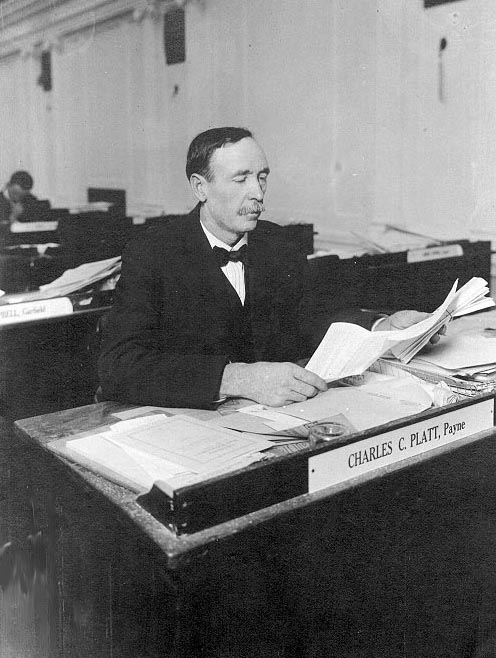
| Oklahoma became a state in 1907. After moving to Stillwater, Papa ran for the Oklahoma State Legislature representing Payne County . He did little campaigning, but ran on his record as a preacher, his good moral character, and experiences in building up the farm and was elected. He served for 4 terms and worked hard in getting some of the initial buildings for the budding Oklahoma A&M College, as OSU was then called. He also submitted several bills to the Legislature during the many years he was a Representative, although none passed. (Click here to view the list of bills) (Click here for samples of his campaign literature) |
| Annie Martha baked bread every week from a yeast starter that reputedly came from the World's Columbian Exposition (Chicago World's Fair) in 1893. Many of her descendants still bake bread from that starter and are divided in whether they believe Annie's parents brought it with them from Pennsylvania, or she picked it up in Pennsylvania from her relatives after the fair. They are not divided in their love of the yeast. It is incredibly strong, and makes a wonderful sweet dough bread that has plenty of body and lots of flavor whether white, wheat or rye. No electric breadmakers for these folks! (See Newspaper articles) |
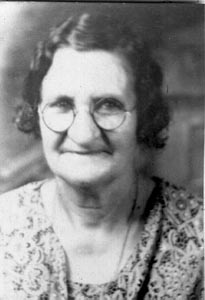
| After the divorce from Papa, Mama kept boarders at her home on South Main. In July of 1937, she married a long time family friend, Ernest Gately. The marriage only lasted a couple of years. The house on South Main was sold and, her savings dissipated, she ended up in a small bungalow on the south side of the yard on the farm of Ben and Annie Platt Fugate, just south- west of Maramec. She was mobile, and traveled almost constantly, staying for indefinite periods with one child or another. She would only stay long enough to can the vegetables that needed canning or make a quilt for a newborn. Vi used to pile up things all year for her Mother to do, so that Mama would have to stay a long time when she finally arrived. Short and rotund, she was a loving little bundle of energy that gave wonderful hugs and loved to hold grandchildren in her lap. One of the family traditions at that time and into the fifties, was the "chain" letter, called 'Robin', for round robin. It made a loop of most of the children, with each taking out his/her letter of the previous cycle and inserting a new one. Everyone looked forward to Robin's arrival, and kept up on the comings, goings and doings of Mama and their siblings. |
| (Updated June, 2001) For additional history, read children's biographies. |
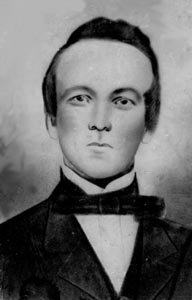
| Charles Platt Senior was christened May 21, 1844 in Liverpool, Saint Peter, Lancashire, England. The son of Joseph K. and Catherine (Burch) Platt. (Joseph may have been born May 14, 1810 in Sunning, Berkshire, England to Jacob and Ann Platt.) |
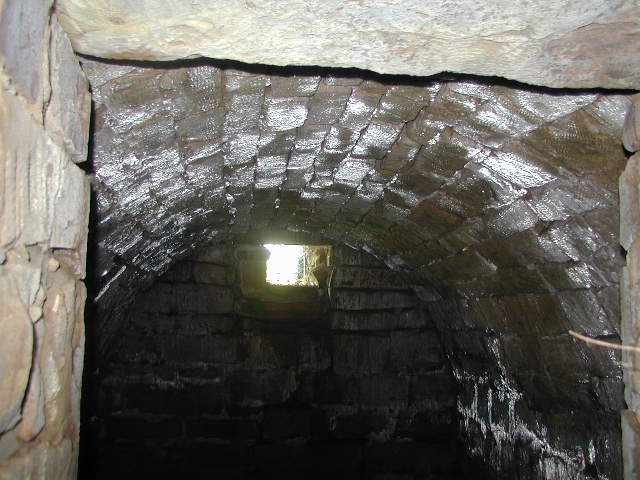 |
| The Stone cellar, arched ceiling (June 2001) |
| Oklahoma summers were terribly hot without air conditioning. After the Ford agency was established and doing well, Papa built an 'RV' to carry his family to Colorado where they camped out for up to 3 months in the mountains. The family loved it! They always stopped at Eads Lake, north of Lamar, to catch fish for their kitchen on their way out and back. Mama set up a large kitchen at the campsite and the meals were wonderful. The kids climbed mountains all day and sang songs by the campfire at night. (Vira's diary of the summer of 1924) |
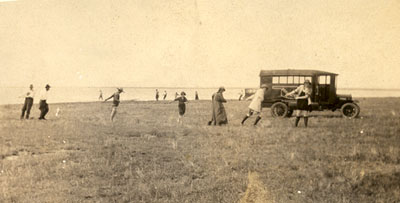 |
| Family pulling in the fish net at Eads Lakein 1924. Papa's 'RV' to right. |
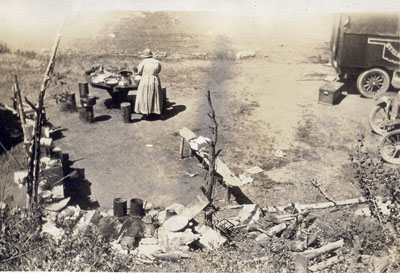 |
| The Colorado campsite on Bear Creek in 1924. (Note the Oklahoma Map on their 'RV'.) Of this picture Vi wrote: "Mother, at her natural task, cooking. A wonderful camp kitchen, with a wonderful cook!" |
| Papa was an intelligent and literate man. While on the farm, he built a printshop and wrote, printed and published a newspaper called the "Hummer" on Christian ethics and family values.. (For pages from the Hummer and related items, click here) He published the paper for several years, at least from 1907 to 1913. Nine children were born on the homestead, Wella in 1895, Raymond in 1896, Margaret in 1900, Elizabeth in 1901, Vira in 1904, Annie in 1905, Nora in 1907, Charles in 1909 and Fredie in 1911. |
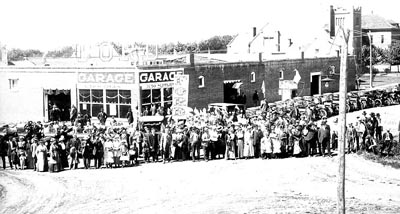 |
| Grand opening of the 2nd location of Papa's Ford Garage, at 8th and Husband, in Stillwater, Oklahoma |
| From "Stillwater" by Robt. E. Cunningham: "We recall the day when we made 25 cents worth of sugar last for a year, broke prairie sod barefooted, laid stone barefooted for a small wage. We freighted from Perry, Guthrie, Stroud and other points through all kinds of weather. We endured all the privations known to all Cherokee Strip settlers, and now we have staked it all, plus the limit of our credit, on Ford." Quote by C. C. Platt. |
| For a year, the family actually lived in Maramec, in the previous bankers house. It was on the north side of town and had a pond. Papa would ride the morning train to Stillwater and catch the evening train home. They ended up buying a house at 1304 South Main Street in Stillwater and it was there that Thelma was born, and the rest of the brood grew up. The house grew over the years to accommodate the sizable Family. Vira said that her father built large high-ceilinged rooms when times were good, and small rooms when they weren't. Rooms were added both upstairs and down. Vi had an old wooden footstool Papa made from lumber that was left when a closet was torn out to make an opening into a new room. Having so many children in the family kept the household lively. There was always someone to do something with, and apparently the parents became less strict as the number of children increased. The family added a pony, Nellie, who became a family pet. The pony sometimes rode in the open car. Vira once said, "She gave us so many rides, we felt she should have rides, too." Nellie performed tricks such as standing on a pedestal, kneeling, etc. Aunt Pete (Thelma, the baby of this large family) tells that Nellie was a smart pony who learned to open her stable gate, would go up the back porch steps and learned to open the latch on the back screen, and more than once came into the house. On one of these occasions she managed to open the ice box on the porch and broke a number of eggs. Once when their parents had gone to town, the youngest boys (Charles and Fred) took Nellie upstairs to the bedrooms. She went up willingly, but there were too many stairs to come down so she balked, causing the boys to get in trouble when Mama and Papa returned. |
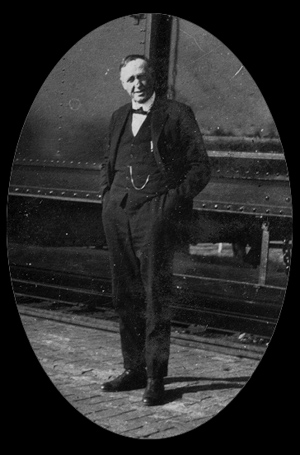
| In 1922, on one of their trips to Colorado, they met a woman named Clara, who Papa had known when he was young. For some reason, she came to live with them in Stillwater. Problems developed and in 1925, Mama filed for a divorce. Papa and Clara went back to Colorado together, but never married. He joined the family for a Christmas celebration in 1928, but sat in the corner ignored by most of his family. Papa was in Denver, on February 2, 1929, when he suffered a fatal stroke, at age 63 years. He is buried in the cemetery at Maramec, OK, near the farm he homesteaded. |
| Charles (Papa) married Annie (Mama) in LaCrosse, Kansas on Sept. 13, 1888. Mama had been born on September 29, 1871, in Aitch, Pennsylvania, in the Woodcock Valley of Huntingdon County. Aitch is now inundated by a reservoir. Though somewhat hilly, with cold winters, it is a beautiful area. Her parents were Michael Garner and Sarah Elizabeth Porter. Sarah bore 10 children, two of them dying in childhood. When her family had came to Kansas, "Annie had to walk all the way from Pennsylvania, following an oxen team". (For info on Annie Martha's ancestors, Click here) In Kansas they built and lived in a soddy. For years, children of Garner relatives in Pennsylvania lost track of Michael and his family and had no idea that he had a large family of children and grandchildren. A huge genealogy was kept by descendants of Michael's grandfather that excluded any reference to Michael and Sarah's branch. (See link above) (For pictures of our Garner relatives, click here) |
| Mama developed breast cancer, and in spite of surgery and whatever other treatment was available, she died April 29, 1945 in Enid, Oklahoma. Aimie was taking care of her at the last. After some discussion by her children, she was buried beside Papa in the Odd Fellows cemetery south of Maramec. (For pictures of the cemetery, Click here) |
| Email Me.. |
 |
| Return toTable of Contents |
|
| Another incident at 1304 So Main: Once when Papa and Mama were gone, the kids decided they wanted some divinity candy. Margaret made it and they put it on a great big platter and put it out on the back step to cool. They heard a noise and found one of their old hens right in the middle of the platter, stuck tight. Her feet and wings were just a-going to beat everything and the harder she tried to get out, the deeper she got in that divinity candy. They finally pulled the old hen out, and her feet were just absolutely glued together with candy! None of the kids wanted that candy then! Ugh! But here came seven of the Griener kids from across the street, five little boys and two girls, and they didn't know anything about that hen! They thought the candy just looked good, so the kids gave it to them! Boy, when Mama got home, she just about thrashed them for giving away candy not fit for human consumption! The house stayed in the family until after Papa's death. |
 |
 |
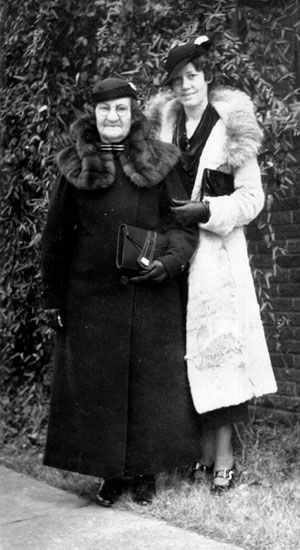 |
| Mama and Vi |
| Papa in the State Legislature |
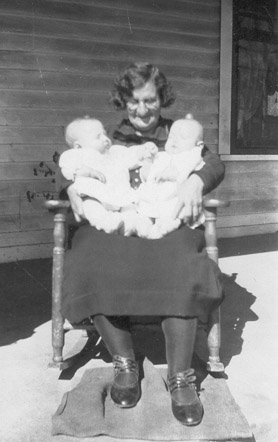 |
| The perfect Grandmother- Mama with Annie Fugate's twins, Sammy and Bennie. |
 |
 |
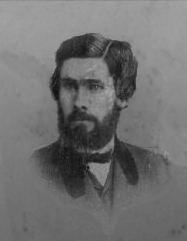
| Joseph K Platt |
 |
 |
dyes that were used in Cloth designing.. According to his daughter-in-law, Anna Martha Garner, he fell from the second floor of the cotton mill to his death. |
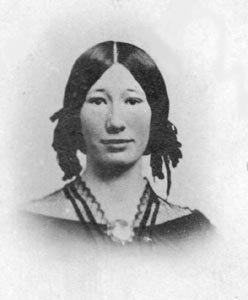
| Charles Platt Senior Margaret Paton Platt |
| Margaret Paton at 16 |
| On the ranch was a foreman, William D. Armstrong, and Margaret was hired as the chief cook, but later became the wife of Mr Armstrong. They had four children, Clarence Marion (Who died in infancy), William Joseph, Thomas Belt, and Walter Albert. When Margaret remarried, she and her mother decided that the rough language of the cowboys and their card playing were not good examples for the young Charles. He was "bound out" to the Wickershams, in McPherson, a Presbyterian Family who proved to be severe in their raising of the boy. They had been former slave owners. Charles told of their requiring him, at table, to cut in two each bean that he ate, and when they had finished eating, the food was put back into the cupboard, so that he was often hungry. There was no food cooked on Sunday, but prepared the day before. He was forced to go to church, and the rigorous life was more than he could bear. He finally got free by going to church one Sunday with the Wickershams, but leaving with a relative who met him and took him away. He had been bound out for six years, but with the determination and independence that has characterized the entire family ever since, he ran away. He was helped by a sympathetic cousin, and soon learned the frontier trades of herding sheep and cattle, shooting, farming, and making molded bullets for his guns. Charles' early education and childhood are not too well documented. By his account, he obtained 3 terms of school at the "Jack-Rabbit School 4 miles north of Melvern, KS. He was a Singer sewing machine salesman in the Hays, Kansas area when he met the Garners, including the lovely Annie Martha. Mr. Garner was a Quaker Minister and he was conducting a "camp meeting" in Scott City, KS when this youg upstart Charles Platt appeared. Annie was sweet sixteen, five feet tall, and 99 pounds when this "renegade" and his rowdy companions came to ridicule the "Friends" in their big tent. Charles' buddies teased him "Betcha can't marry the preacher's daughter" and he retorted "That little thing?" In later years, he and Annie would laugh at the retelling of the story. Lyman recounts that when the time came for the youn man to ask for the father's permission to marry, Annie hid herself behind a corner cupboard in the room to eavesdrop on the talk which was to determine her future. |
 |
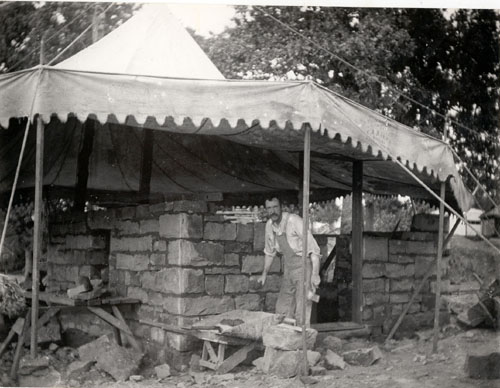 |
| Papa doing masonry work. I don't recognize the building. Grout looks neater than on Printshop. Anyone know which building this would be? |
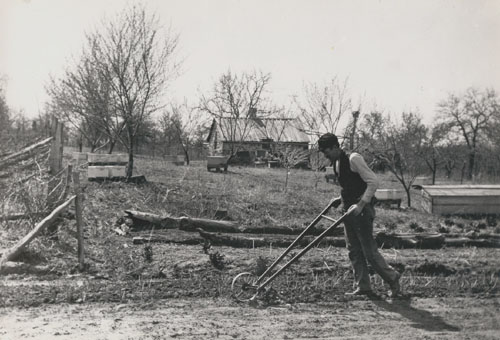 |
| Papa turning soil in garden, the printshop in the background. |
| It was hard in the Indian Territory for people to survive. Different bugs ate the crops than the family had contended with in Kansas. The country was in a deep depression in the 1890's. Papa wrote his mother about the situation in 1895. (To read the letter click here) |
 |