| Sod House on the Prairie |
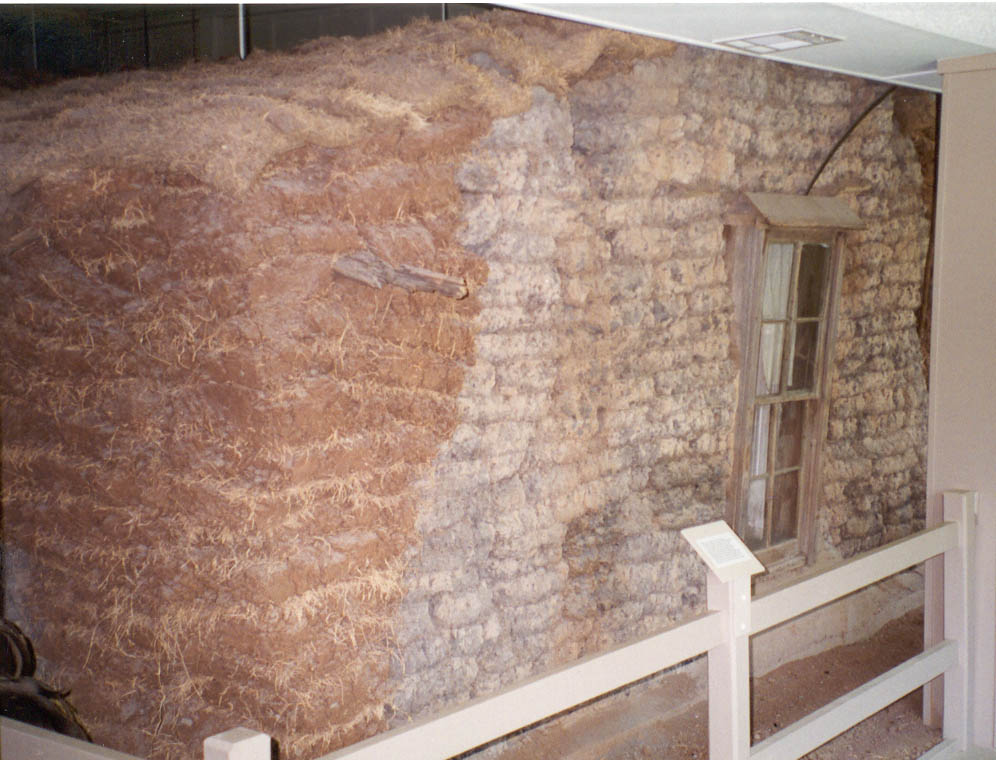
| Many settlers in Kansas, Nebraska and the Dakotas built their houses out of sod, or dirt with grass growing in it.� The strong grass roots held the dirt together, even after it was dug up. |
| Because plant roots were left in the sod, new growth sprouted each spring and summer.� Women even sent away for new flower seeds to plant on their roofs. |
| There was little else but sod to build with in that part of the world.� There were almost no stones close to the surface. There were few trees, and what trees did grow were not usually suitable for building.� Settlers might have to travel 40 miles or more by wagon to find wood usable for construction. The special clay needed to make bricks was scarce, and if available, there wasn?t enough wood for firing the brick.� Consequently, even schools and churches were made of sod. |
| Building a Sod House |
| Settlers, or "sodbusters", cut only as much sod as they could build with in a day.� Sod left over dried too much for building. To build a sod house, or "soddie", settlers had to mow the grass and then cut pieces of sod, or "bricks" with a special horse-drawn plow called a grasshopper.� They would lay two layers of bricks lengthwise and lay a third layer crosswise.� This crosswise brick pattern made the houses more stable.� Openings for windows were left and were ultimately filled in with paper greased with animal fat to let some light in, and keep bugs out.� A ridgepole and rafters were placed across the top to keep the ceiling up. Mounds of sod were placed on top. At first, the front door was usually no more than a blanket. Often they used a hillside as the back wall of their house, digging back in for a dugout and saving time in the building. |
| Settlers would donate a day of their time to help new people build their house.� Without neighbor's help, it could take a week to build a one-room soddie. |
| �������������� ��Preserved Soddy in Western Oklahoma |
| Life in a Soddie |
| What was good.... |
| �Sod houses were cozy in the winter.� Heat from the fireplace stayed in the house and the thick walls kept out the wind.� In very bad winters, many settlers in wooden houses did not survive the cold.� Insulation for those houses was not available. People inside soddies stayed warm.� And in the summer, the dirt walls helped keep the houses cooler than wooden houses.� They were safer during tornadoes, too; sometimes the roof blew off, but the walls would stay up.� In the 1800s there were few trees or buildings to act as windbreaks, so the danger from high winds and tornadoes was even greater than today. |
| Soddies were lifesaving protection against fires. Prairie fires were very dangerous to anyone caught outside. If it was windy, they spread quickly and were almost impossible to put out. One fire could sweep through hundreds of miles of grasslands, often moving faster than a running horse.� Inside a soddy was safe. Dirt does NOT burn.� The grass on the roof would catch fire and burn off but just grow back stronger after the fire. Fires from the cooking stoves inside posed no great threat. |
| What was not so good... |
| Snakes, bugs and globs of mud often dropped into people? beds or food.� In some places rattlesnakes made their dens in the walls.� People slept, cooked and lived in one room.� All their possessions would be crowded into that one room.� In dry weather, settlers got more living space by moving their belongings outside.� The outdoors became an extension of the house. |
| Sod houses leaked in the rain. People complained that the house would continue leaking for days after the rain stopped.� Sometimes the only dry spots in the house were the window wells. |
| To keep the dust down, women needed to pour water over the floor about once a week.� They would then smooth it out and have a new floor.� If they weren?t lucky enough to live close to water, they might have to make several mile- long trips back and forth from a neighbor?s well. |
| Making it better bit by bit... |
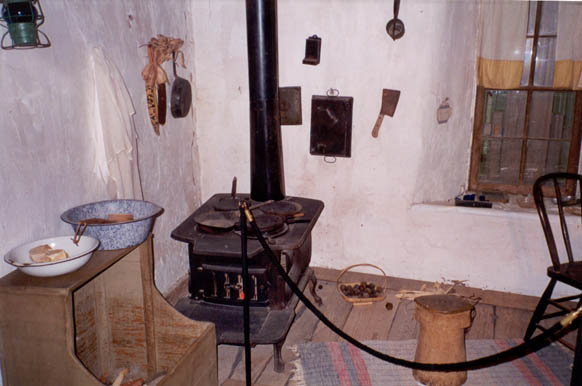
| At first settlers might cover the dirt walls with newspapers.� Many whitewashed the walls to help control the dirt and make the dark house brighter.� A big piece of cloth was hung under the ceiling to catch dirt sprinkling down.� Sometimes they used the canvas from the tops of their covered wagons. |
| When they had more time and money, they plastered over the walls and ceiling to keep dirt from falling off.� They bought lumber and put in wooden floors and roofs. |
| Most settlers wanted to live in wooden houses and bought lumber and built new houses as soon as they could.� The sod house then became a tool shed, outhouse or chicken coop. |
| Although soddies were most popular in the mid-1800s, people built them as late as the 1930s, during the Depression, when many people were too poor to buy housing materials. |
| ���������� ���������������Interior of Plastered Soddy |
 |
 |