|
SYSTEMS OF THE BODY |
|
Skeletal SystemBones of the Head and NeckThe skeletal system of the head and neck plays an important role in protecting the brain and all of its attachments that get sent throughout the rest of the body. The head and neck make up the top portion of the axial skeleton. The skull is the bony section of the head and consists of cranium and facial bones. The skull encases and protects the brain, houses the brain senses, provides attachments for muscles of the head and neck, and helps to form the first portions of the respiratory and digestive tracts. The skull rests on the first vertebra, which is called the atlas. At birth, the skull is large in comparison to the rest of the body, and a baby's skull is compressible. The soft spots in a baby's head harden and grow together until the bones meet and mesh like a jigsaw puzzle. Bones of the Chest and Upper BackThe skeletal system of the upper abdomen surrounds important organs such as the heart, lungs, and others above the diaphragm. The portion of the spine in the upper abdomen is made up of bones called the thoracic vertebrae. These are the twelve vertebrae in the chest area. They have facets on the sides of their bodies that join with the ribs. Bones of the Pelvis and Lower BackThe skeletal system of the lower abdomen, including the pelvis helps protect the spinal cord, digestive and urogenital systems and other internal organs such as the bladder, rectum, and in women, the uterus. Bones of the Arm and HandThe skeletal system of the upper extremities includes the shoulders, arms, hands and fingers. These bones allow for movement in the upper limbs. Out of all of the bones in this region, the clavicle, or collarbone, is the only bone attached to the central skeleton. The two clavicles join the top of the sternum to the scapula, allowing for the support of the rest of the limb. With the help of muscles, these bones keep the limb anchored to the axial skeleton. Bones of the Leg and FootThe skeletal system of the lower extremities includes the legs, feet and toes. This subsystem supports the muscles that help with running, walking, standing and more. The weight of the body is transmitted to the legs through the pelvic girdle at sacroiliac joints. These joints, along with the ligaments attached to them, anchor the lower limbs to the axial skeleton. |
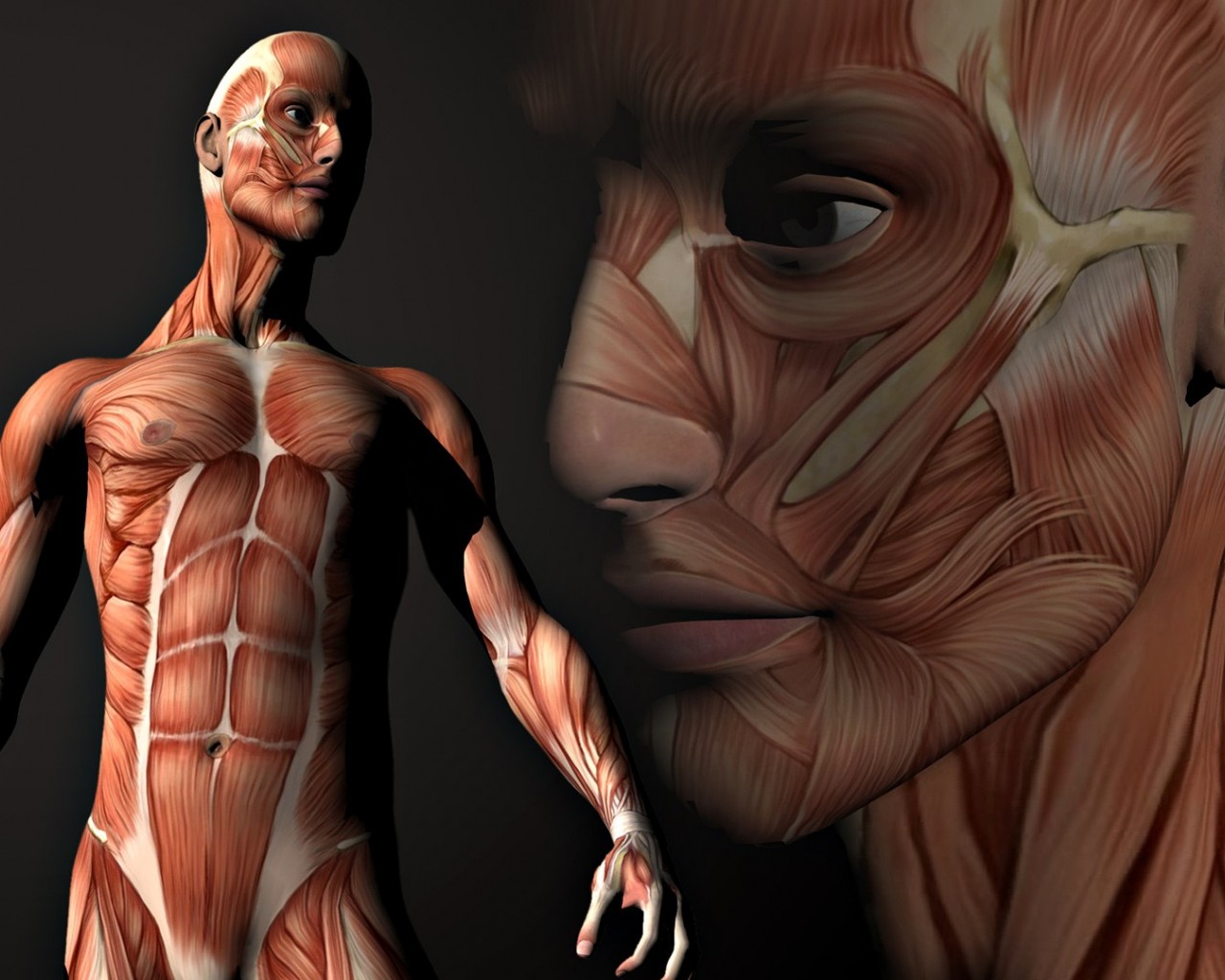
Muscular SystemMuscles of the Head and NeckThe muscular system of the head and neck is defined by two movements: One is the relatively fine movements of the muscles activating the sensory organs of the head; the other is by the grosser movements of the neck muscles, which allow those senses to be properly targeted. Muscles of the Chest and Upper BackThe muscular system of the chest and upper back is obviously defined by the pectoral, deltoid, teres minor, teres major, latissimus dorsi and the trapezius muscles. However, digestive, circulatory, and respiratory muscular systems within the chest, while less obvious, have substantially greater impact on the organism as a whole. Muscles of the Abdomen, Lower Back and PelvisThe muscular system of the lower abdomen, including the pelvis, is separated from that of the chest by the muscular wall of the diaphragm-so critical to breathing-and lies somewhat exposed between the protective bones of the ribs above and the pelvic girdle behind. As such, skeletal muscles across the lower abdomen play a critical role in protecting the delicate organs within the abdomen, in addition to providing propulsion and stability. Muscles of the Arm and HandThe muscular system of the upper extremities (from the shoulders down to the fingers) exemplifies the increasing fine motor potential of the skeletal muscle system, with the human hand so sensitive that it can perform brain surgery and so strong that it can twist a screw into wood. Muscles of the Leg ang FootSupporting and propelling the body is the work of the muscular system of the lower extremities, inclusive of the legs, feet, and toes. From the strongest muscle in your body, the gluteus maximus, to the finer muscles that run between the phalanges of the toes, the muscles of the lower extremities can exert tremendous power while constantly maintaining balance-whether the body is at rest or in motion. |
Cardiovascular SystemCardiovascular System of the Head and NeckThe cardiovascular system of the head and neck includes the arteries which supply oxygenated blood to the brain (and to the other organs of the head, including the mouth and eyes), and the veins which return deoxygenated blood from these organs to the heart. Heart and Cardiovascular System of the Upper TorsoThe cardiovascular system of the upper abdomen and chest includes a number of major cardiovascular organs and blood vessels. These structures are critical to the process of moving deoxygenated blood to the lungs where carbon dioxide is removed from the blood and replaced with oxygen, and then circulating the oxygenated blood throughout the body's tissues and organs. Cardiovascular System of the Lower TorsoThe cardiovascular system of the lower abdomen and pelvis is made up of the liver and a large number of blood vessels which come from networks in the stomach, intestines, pancreas and spleen. The veins of the lower abdomen's cardiovascular system carry blood from these organs through a portal vein to the liver. There, the blood enters capillary like hepatic sinusoids; all together, these are called the hepatic portal system. After passing through the portal veins of the liver, the blood is carried through a series of merging vessels into the hepatic veins. These empty into the inferior vena cava and return the blood into circulation. The corresponding arteries of the same names are taking oxygenated blood to these sites in paths parallel to those of the veins. Cardiovascular System of the Arm and HandThe cardiovascular system of the upper extremities ensures adequate flow of oxygenated blood to-and the removal of deoxygenated blood from-the shoulders, arms, hands and fingers. Adequate blood flow to these tissues is critical to the health of these extremities, helps regulate body temperature, and reduces the risk of frostbite of the fingers in extreme weather conditions. Cardiovascular System of the Leg and FootThe cardiovascular system of the lower extremities is the system which provides oxygenated blood to-and removes deoxygenated blood from-a person's legs, feet, and toes. |
Nervous SystemNerves of the Abdomen, Lower Back and PelvisIt is within the nervous system of the lower abdomen that the central nervous system ends and the last vestiges of the spinal cord branch out into the peripheral nervous system. Since the vertebrae continues growing later into a child's development than does the spinal cord, the spinal cord actually ends well up inside the last several vertebrae. The lattermost nerve bundles thus descend through and exit the column vertically, unlike the fairly horizontal passages of the vertebral foramina in the thoracic and cervical vertebrae. Nerves of the Chest and Upper BackThe nervous system of the upper abdomen (the chest) is a critical part of the nervous system as a whole, as the nerve bundles are second in importance only to the brain itself. Within it, substantial percentages of the body's locomotion, balance, and sensory information are sent and received through motor and sensory nerves to communicate between the central nervous system and peripheral nervous system. Nerves of Head and NeckWithin the skeletal structures of the head and the neck lie the most significant portions of the human nervous system. The whole of the brain and the largest body of the spinal cord are enclosed in this section of the nervous system, from there commanding and receiving messages from the whole of the body. Nerves of the Arm and HandThe nerves of the arm and hand perform a substantial two-fold role: commanding the intricate movements of the arms all the way down to the dexterous fingers, while also receiving the vast sensory information supplied by the sensory nerves of the hands and fingers. Nerves of the Leg and FootThe nerves of the leg and foot serve to propel the body through the actions of the legs, feet, and toes while maintaining balance, both while the body is moving and when it is at rest. Sensory nerves are of course present throughout the lower extremities; however, with the exception of the bottom of the foot, they play a lesser role here than in the upper extremities. Primarily, this section of the peripheral nervous system sends and receives signals regarding locomotion of the body. |
Endocrine SystemEndocrine System of the Head and NeckThe endocrine system of the head and neck contains several major glands and sets of glands. These are responsible for releasing hormones into the bloodstream; from there, the hormones are transported to organs and tissues throughout the entire body. The glands in this part of the endocrine system are the hypothalamus, the pineal gland, the pituitary gland and the thyroid and parathyroid glands. Endocrine SystemThe endocrine system of the upper abdomen and chest has only one major set of glands: the thymus. The thymus is a gland that forms part of the immune system; it produces the body's T-lymphocytes, also called T cells. The heart and the adipose tissue within the chest also secrete some important hormones: the heart produces peptides, which help regulate blood pressure, while the adipose tissue secretes hormones which regulate appetite and metabolism. HypothalamusThe hypothalamus is a tiny cluster of brain cells, just above the pituitary gland, which transmits messages from the body to the brain. It effectively uses the pituitary gland to link the nervous system to the endocrine system. |
Digestive SystemDigestive System of the Head and NeckThe digestive system of the head and neck contain the structures which are used for getting food into the body, to begin the process of breaking down that food for energy. These structures include the teeth, mouth, the parotid, sublingual and submandibular glands (all of which produce saliva), and the epiglottis. The opening to the trachea lies just behind the epiglottis, but is not significant to the process of digestion. Digestive System of the Upper TorsoThe digestive system of the upper abdomen and the chest is also known as the upper gastrointestinal tract. It includes several of the overall digestive system's most important organs. These organs are responsible for significant breakdown of food and for transporting the partially digested food farther along the alimentary canal. Digestive System of the Lower TorsoThe digestive system of the lower abdomen (including the pelvis) is also called the lower gastrointestinal tract. This is the organ system that completes the breakdown of the food a person eats. It causes the absorption of nutrients from that food into the bloodstream for distribution throughout the body. It also excretes indigestible waste products from the food and from the process of digestion itself. |
Integumentary SystemIntegumentary System of the Head and NeckThe integumentary system of the head and neck includes the skin and hair of the face, head and neck. The skin of the face is the part of the body which is most often exposed to sunlight, the elements, and environmental pollutants; thus, it is more prone to acne and to becoming dry or otherwise showing accumulated damage from these influences than the skin on the rest of the body. Integumentary System of the Upper TorsoThe integumentary system of the upper torso is made up of the skin and its appendages (such as the hair); its primary function is to protect the body from damage; it is also involved in temperature regulation and in the sense of touch. Upon exposure to sunlight, the integumentary system is also the primary vehicle for synthesis of vitamin D. Integumentary System of the Lower TorsoThe integumentary system of the lower abdomen and pelvis includes the skin and hair of this region. The skin of this system protects against damage to the organs contained within the abdomen. Additionally, the skin over the genitals is the first line of defense against sexually transmitted diseases and other diseases that affect these reproductive organs. Both men and women have hair on the lower abdomen that extends from the lower edge of the chest to the pubis. Hair in the genital region is known as pubic hair. Integumentary System of the Arm and HandThe integumentary system of the upper extremities (including the shoulders, arms, hands and fingers) includes the skin and hair, and nails of the upper extremities. The skin of the hands and arms (especially the hands) is more frequently exposed to sunlight and to environmental toxins than other parts of the body. Therefore, the hands are likely to show evidence of accumulated damage from these influences as a person ages. Integumentary System of the Leg and FootThe integumentary system of the lower extremities includes the skin, hair and nails of the legs, feet, and toes. The skin of this system is the first barrier against damage to the muscles of the legs, feet, and toes. Both men and women have hair on their legs and the tops of their feet, but this hair is somewhat thicker and coarser in men than in women. The toenails protect the toes from injury; they also enhance the sensitivity of the tips of the toes, although the nails themselves have no nerve endings. |
Reproductive SystemFemale BreastsIn the upper abdomen and chest, the female reproductive system is primarily represented by the breasts. The breasts serve a number of functions, mainly after pregnancy: the mammary glands are accessory organs of the female reproductive system which are specialized to secrete milk following pregnancy. A nipple is located near the tip of each breast, and it is surrounded by a circular area of pigmented skin called the areola. Reproductive Organs of the Lower TorsoThe female reproductive system of the lower abdomen and pelvis contains all of the organs necessary for initiating fertilization and bringing the resultant pregnancy to term. Most of these are housed within the abdominal cavity or pelvic area, but the vulva (the opening to the vagina) is made up of several smaller parts which are external. The ovaries produce and release eggs which move along the fallopian tubes to the uterus; the uterus is a hollow, muscular organ in which a fertilized egg is nourished until birth. The vagina is a muscular passage which forms a part of the female sex organs; it connects the neck of the uterus (called the cervix) with the external genitals. Fertilization and PregnancyFertilization is the first step in pregnancy. The ovaries are a pair of oval or almond-shaped glands that lie on either side of the uterus and just below the opening to the fallopian tubes. These contain the eggs, also known as ova (singular: ovum). The fallopian tubes lie in the pelvic portion of the abdominal cavity and each tube reaches from an ovary to become the upper part of the uterus. This funnel-shaped tube is about three inches in length; it carries eggs and sperm, and is where fertilization of the egg takes place. The larger end of the funnel is divided into feathery, finger-like projections, which lie close to the ovary. These beating projections, along with muscle contractions, force the ovum down the funnel's small end, which opens into the uterus. After sexual intercourse, sperm swim up this funnel from the uterus. The lining of the tube and its secretions sustain both the egg and the sperm, encouraging fertilization and nourishing the egg until it reaches the uterus. Birth and InfancyBirth, also known as childbirth, parturition or partus, is the end point of pregnancy and results in the expulsion of newborn infants from the pregnant woman's uterus. Birth has three stages of labor: the cervix's shortening and dilation, the descent and birth of the infant, and the expulsion of the placenta. Birth can also be done via caesarean section; this is the removal of the newborn through a surgical incision in the abdomen, instead of through the vagina. |
Respiratory SystemRespiratory System of the Head and NeckThe respiratory system of the head and neck marks the starting point for where oxygen enters the body. The system begins at the nose and mouth where oxygen is inhaled. The areas of the respiratory in the head and neck allow air to flow in and out of the lungs. Lungs and Resporatory System of the ChestThe respiratory system in the upper abdomen and chest area is where the intake of oxygen from the nose and mouth ends and is processed by the lungs. The human body needs oxygen to provide energy and growth to body cells to keep the cells alive. The respiratory system and the lungs help oxygen to enter the body as well as secrete carbon dioxide, the waste produced after the body has processed the oxygen. |
Urinary SystemUrinary System of the Lower TorsoThe urinary system of the lower abdomen functions to eliminate wastes from the body. The structure of the urinary tract includes: the kidneys, two ureters, (tubes leading from the kidneys to the bladder,) and the urethra, a tube leading from the bladder to the exterior of the body. The urinary tract is a little like a plumbing system, with special pipes that allow water and salts to flow through them. The kidneys make up a filter system for the blood, reabsorbing almost 99% of the fluid into the blood, and sending only two to four pints of waste (urine) into the bladder for storage until it can be disposed of. |