|
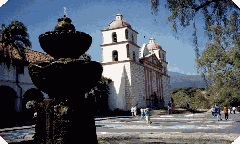
This beautiful mission was the only one that was continuously occupied by the Franciscan Order from the time of its founding to present day, therefore it has been the best maintained and preserved mission.
The presidio was built to secure the harbor, but approval of the mission was denied by Governor de Neve, who opposed the mission under the authority of the padres. He preferred civil colonists versus neophytes and was upset with Father Serra for proceeding with the founding of mission Santa Buenaventura. Approval for Mission Santa Barbara came through the new governor, Pedro Fages. By then, Father Juniper Serra had died on Aug 28, 1784, and his successor, Father Fermin Lasuen became the new Father President.
The first church was built of adobe but was destroyed by the 1812 earthquake. Its replacement, completed in 1820, lasted for 102 years until the 1925 earthquake, which required two years and some $400,000 dollars to restore. In 1950, chemicals used in the 1925 repair had weakened the facade, requiring it to be dismantled and reinforced with steel. The mission's classic facade was based on the Roman architecture book by Vitruvius. The mission was very successful and in some ways fashioned a small city, even requiring more buildings. The native Indians, mostly Chumash and Carolino were very cooperative and by the nineteenth century, the neophyte population reached 1,700. Two hundred and fifty adobe homes were built outside the mission walls to house them. The mission had the most complex irrigation system, parts of which are still utilized by the City of Santa Barbara. Under Father Duran, an Indian orchestra was created.
In 1833, adhering to the Spanish exclusion policy, Governor Jose Figueroa placed American-born Franciscans in charge of all the missions north of San Antonio. During this time, President of the Missions, Father Narciso Duran moved his office to Santa Barbara. In 1842, Francisco Garcia Diego, first bishop of the Californias, also relocated his headquarters from San Diego to Santa Barbara. Governor Pio Pico, once again, tried to sell off Mission Santa Barbara, but his plans were thwarted by the United States takeover.
Because it has been continuously occupied, it has never fallen into neglect like the other missions. Throughout the years it has been used as a hospice, aspostolic college, boys school, seminary and Franciscan School of Theology (until 1968). Over 4,000 Indians are buried in the graveyard.
|
|